
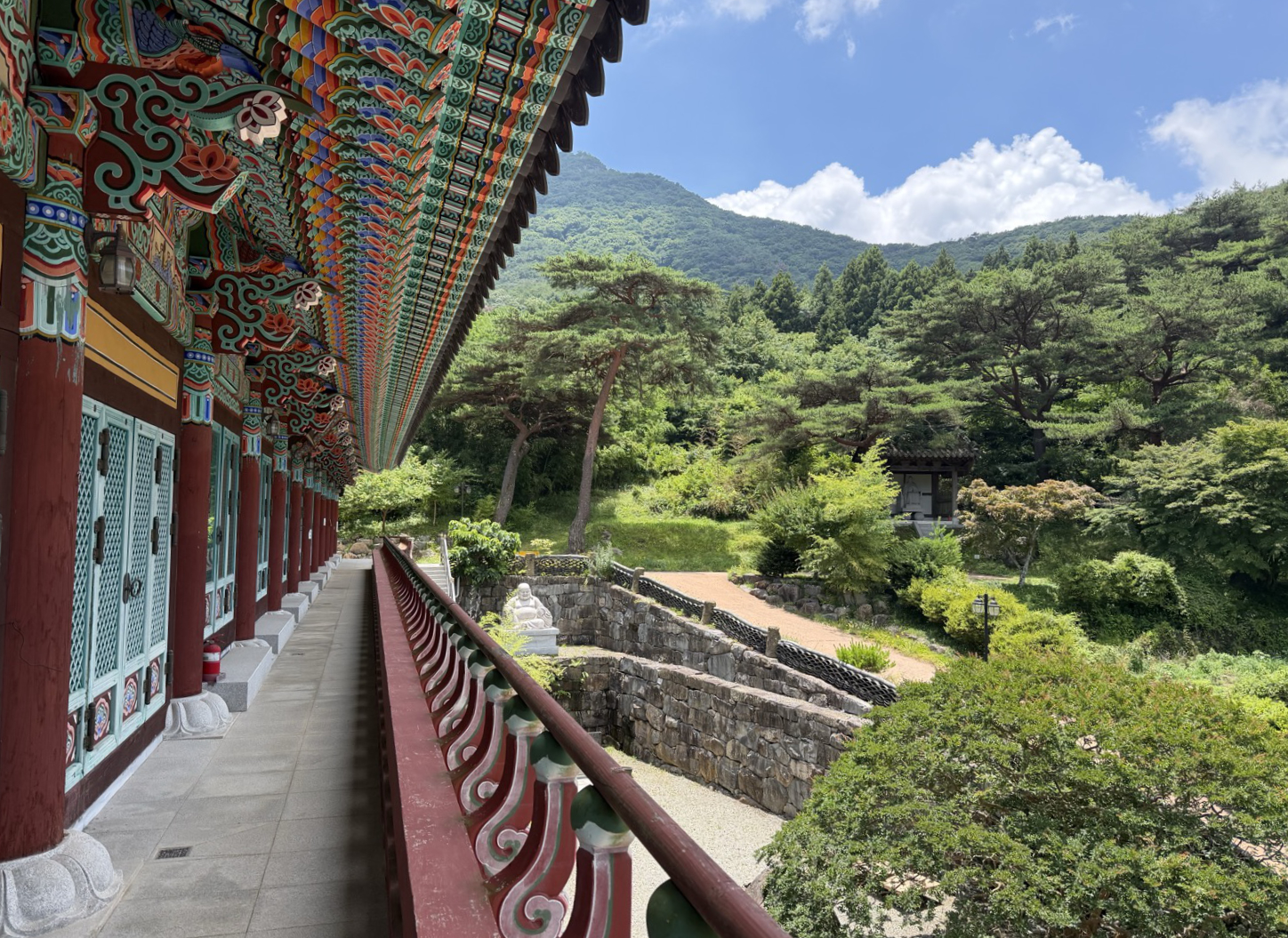
After spending a month and a half in South Korea, I’m sharing my impressions of the different places visited here. This experience allowed me to compare many destinations and think about what the “ideal” itinerary for 2 weeks in South Korea might be.
Throughout the trip, I found that some visits tended to repeat themselves. Several natural landscapes are similar, historical remains are rebuilt in similar styles, and several museums tell comparable historical episodes. I therefore tried to draw from my experience a selection of destinations that seem to me both interesting and complementary, in order to offer in 2 weeks as varied an overview as possible of what South Korea has to offer.
In the first part of the article, I present my tips for the different cities and regions visited. In the second part, I propose a 2-week itinerary in South Korea, built from this experience, to combine the destinations that seemed most interesting to me.
The article does not, however, cover Jeolla or Jeju-do, which I did not visit.


Overview
Seoul
Recommended duration: 4–7 days
The capital alone is worth stopping in South Korea and is an essential stop on a 2-week itinerary. Indeed, the city offers a fairly exceptional condensed version of the country, bringing together a modern metropolis, rich historical heritage, cutting-edge museums and many natural spaces. To discover more details about the neighborhoods, visits and hikes I recommend, see my article dedicated to Seoul: 5 days in Seoul: hiking, architecture and culture.

My recommendation for 2 weeks in South Korea: Seoul is, in my opinion, a must-see that I would keep for the end of the trip. This allows you to adapt your visits based on the places for which you still have a taste for more. The capital of South Korea is also a true temple of consumption, ideal for shopping at the end of your stay without having to carry purchases for 2 weeks.
West: Chungcheongnam-do
Buyeo
Recommended duration: 1–2 days
Buyeo was the last capital of the Baekje kingdom, one of the Three Kingdoms of Korea along with Silla and Goguryeo. Unsurprisingly, Buyeo has many remains from this period.
Here are the main sites to discover:
- The Buyeo National Museum, free, is a good introduction to the city’s history. It helps place the different remains in their context.
- East of the city are the royal tombs of Neungsan-ri and the remains of Busosanseong Fortress. It is possible to reach these sites on foot via forest trails visible on Maps.me from the museum.
- Seodong Park is particularly pleasant in summer. In July, I saw thousands of water lilies in bloom covering part of the ponds.
- Nakhwaam Rock offers a pleasant setting to end the day and enjoy the sunset. The site was officially closed during my visit, but I had no particular difficulty accessing it.
- Baekje Cultural Land is a vast complex dedicated to the ancient capital. It notably brings together reconstructions of several Baekje buildings as well as a museum, which helps visualize what the city might have looked like at the time.


My recommendation for 2 weeks in South Korea: Buyeo is a good stop near Seoul, away from the crowds and particularly interesting for travelers who want to deepen their knowledge of Korean history. However, if your time is limited, I would not put it in priority. For South Korea in 2 weeks, I would personally prioritize Seoul and Gyeongju, the former capital of Silla, which in my opinion offers a richer and more complete historical experience.
Gongju
Recommended duration: 1 day
Near Buyeo is Gongju, which was also one of the capitals of Baekje before the kingdom moved its capital to Buyeo. The two cities complement each other well for discovering the roots of this empire.
Here are the main sites to visit:
- The Gongju National Museum, located next to the tomb complex, notably displays objects found in the tomb of King Muryeong and his wife.
- The Songsan-ri burial complex, adjacent to the museum, then allows you to discover the tumuli. The site’s small museum presents the reconstruction of the interior of several tombs.
- The Gongsanseong Fortress completes the day with a walk on the ancient fortifications and beautiful views of the surroundings.
I stayed at the Hotel Fashion, near the station. It is a video game motel (my first), economical, but the rooms were clean and comfortable.


My recommendation for 2 weeks in South Korea: as with Buyeo, I would personally prioritize the visits to Seoul and Gyeongju.
East: Gyeongsangbuk-do & Gangwon-do coast
Gyeongju
Recommended duration: 2–3 days
There is enough to spend several days in Gyeongju, a true open-air museum and former capital of the Silla kingdom. The city and its surroundings concentrate a remarkable quantity of tombs, temples, palaces, sculptures and remains dating notably from the peak of Silla between the 7th and 10th centuries. The historic areas of Gyeongju have also been classified as UNESCO World Heritage since 2000.
I stayed there for three days, which allowed me to divide the visits between the remains of the city center, Mount Namsan, Yangdong Folk Village, as well as Bulguksa and Seokguram.
City center remains (1 day)
One day is enough to discover on foot a large part of the remains located around central Gyeongju. I suggest following a route passing through the following main sites:
- Noseori, Nodongni and Daereungwon : several groups of tumuli are scattered in the city and bear witness to the ancient royal and aristocratic tombs of Silla. The Daereungwon complex notably houses Cheonmachong, whose interior is accessible to the public. Personally, I did not find the interior particularly striking.
- Cheomseongdae : this stone astronomical observatory, built under Silla in the 7th century, is one of the symbols of Gyeongju and testifies to the importance given to observing the sky in the society of that time. In summer, light displays are projected onto the monument in the evening.
- Woljeonggyo : if you have time, make a detour to this covered wooden bridge. Rebuilt from the remains of the historic bridge, it is particularly photogenic at sunset.
- Wolseong : from the bridge, you can cross the remains of this ancient fortress that housed the royal palace of Silla. Few visible structures remain today, but the rampart is well laid out and makes it easy to rejoin the rest of the route.
- Gyeongju National Museum : by crossing Wolseong, you arrive at the Gyeongju National Museum. Admission is free and it is one of the most interesting historical museums I visited in South Korea. The collections notably help better understand Silla civilization and its artistic heritage. Allow easily two hours for the visit.
- Donggung Palace and Wolji Pond : if the schedules align well, end the day here. The former royal palace and its pond stay open relatively late and are particularly well lit at night. The setting is very pleasant, but you will obviously not be alone at that hour.


Mount Namsan (half a day)
Mount Namsan, located south of Gyeongju, is full of Buddhist remains scattered on its slopes. This mountain was considered sacred in the Silla era and concentrates an exceptional quantity of Buddha statues, pagodas, temples and other remains dating mainly from the 7th to 10th centuries.
Namsan is now part of the historic areas of Gyeongju classified as UNESCO World Heritage. The site is particularly interesting for understanding the importance of Buddhism in the Silla kingdom and how natural landscapes were integrated into religious practice.
The summit itself is of little interest, however, because the views are fairly unobstructed. Despite the impressive concentration of remains announced on Namsan, I ultimately saw very few, probably due to lack of preparation.
It therefore seems wiser to identify in advance the statues, pagodas and ruins you want to discover. Some remains are accessible from different trails and do not necessarily require climbing the entire mountain.


Bulguksa and Seokguram (half a day)
Bulguksa and Seokguram form one of the most famous ensembles in the region. Both date from the Silla period and have been jointly inscribed as UNESCO World Heritage since 1995.
Bulguksa is a vast Buddhist complex built in the 8th century, whose wooden buildings rest on imposing stone terraces. The two pagodas located in front of the main hall, Seokgatap and Dabotap, are among the most remarkable elements of the site.
Seokguram, located higher on the slopes of Mount Tohamsan, is an artificial grotto built in the 8th century. It houses an imposing Buddha statue, surrounded by deities, bodhisattvas and disciples carved in granite.
A lovely forest path allows you to reach Bulguksa and Seokguram on foot. I recommend this option, even though the route climbs, because it allows you to enjoy the natural environment more. The journey can also be done by bus.
I may have had expectations that were a little too high, because these two sites are among the must-sees of the region, and I was ultimately slightly disappointed. The large Bulguksa complex did not particularly strike me. The Buddha of Seokguram is however very beautiful (and cannot be photographed), but if you are not looking to hike in the area, I am not sure the grotto alone justifies the detour.


Yangdong Folk Village (half a day)
Yangdong Folk Village is a good excursion from Gyeongju, notably to discover a traditional village in a rural environment. I had initially considered Hahoe Village near Andong, but the city itself did not seem particularly interesting to me, apart from the traditional village located outside it. It also implied a fairly significant detour.
I discovered that Yangdong Folk Village was also classified as UNESCO World Heritage, for its testimony to the social organization and traditional architecture of the Joseon period.
Even though few buildings can be visited, the village remains very pleasant to walk through. Arriving fairly late, I met very few tourists and enjoyed beautiful late-day light. Walking between traditional houses in the heart of the countryside offers an experience quite different from the other sites visited around Gyeongju.


My recommendation for 2 weeks in South Korea: I would devote two days to Gyeongju, which allows a better understanding of the Three Kingdoms period and the heritage of Silla. Its museum and its many historic sites allow you to discover this period through remains, temples and ancient tombs.
Pohang
Recommended duration: 1/2 day
Pohang’s economy relies largely on steelmaking, but the city is also trying to develop its tourism by installing several works of art between the coast and Hwanho Park.
The Hwanho Park Space Walk is particularly impressive and I really enjoyed the Pohang Museum of Steel Art. However, if you do not plan to go to Ulleungdo, I do not think Pohang necessarily deserves the detour on its own.
I stayed at the Appletree Hotel, which I recommend for its good value for money: the establishment is clean, comfortable and economical.

My recommendation for 2 weeks in South Korea: I would remove Pohang if Ulleungdo is not part of the trip. The city is more a practical stop than an unmissable destination.
Ulleungdo
Recommended duration: 2–3 days
I’m sharing my experience here to help you avoid the mishaps I encountered. First, you should know that connections to Ulleungdo are relatively limited. I therefore arrived in Pohang the day before to book my boat directly at the terminal. I gave my passport and email address, then was asked to return one hour before departure the next day to pay.
The next day, I arrived well in advance, but the person at the counter looked at me in dismay. The ferry had already left. Apparently, a schedule change had been announced by email. I then checked my inbox, finding nothing. However, the message was waiting in my spam folder and indicated that departure had been moved earlier.
I then asked if I could take the boat the next day, but it was ultimately cancelled due to bad weather, which seems relatively frequent on this route. As a result, I lost two nights of hotel bookings and it somewhat disrupted the rest of my trip.
Schedules can be consulted on the Daezer websites for departures from Pohang and Seaspovill for departures from Mukho. At the time of writing this article, ferries could not be booked online with a foreign bank card and the connection to Gangneung was not in operation.
My recommendation for 2 weeks in South Korea: If you only have 2 weeks, I would skip this stop, whose transport is fairly uncertain. On the other hand, if you have enough margin, Ulleungdo seemed particularly beautiful and could constitute an excellent excursion.
Gangneung
Recommended duration: 1–2 days
Gangneung is a pleasant coastal stop, notably for its beaches and the Gyeongpo Lake area. Ojukheon also allows you to discover a little of the local heritage.

My recommendation for 2 weeks in South Korea: unless you are an absolute beach fan, I do not consider the city essential.
Seoraksan and Sokcho
Recommended duration: 2 days
Sokcho, a good base for Seoraksan
Even though the city of Sokcho did not particularly charm me, it is a good base for discovering Seoraksan National Park.
If you decide to stay there, the Sokcho Tourist & Fishery Market notably allows you to discover the atmosphere of a local market and taste the region’s specialties. Abai Village, an old neighborhood installed on a small peninsula, bears witness to the history of North Korean refugees who arrived in the region during the Korean War, even though I did not find that there was much to see and the refugee neighborhoods of Busan were much more impressive.
To enjoy the coastline, Sokcho Beach and Yeongnangho Lake also offer pleasant walks. The Sokcho Lighthouse Observatory allows you to gain a little height and enjoy views of the city, the coast and the mountains of Seoraksan.
The whole thing can easily occupy half a day, but I would far prefer discovering the park.

Seoraksan
Daecheongbong and the valley
The Seoraksan park is without a doubt my favorite hiking place in South Korea. I had only planned one day there, so I tried to combine the different sectors I wanted to discover in a single hike.
To start with Daecheongbong, the highest point of the park at 1,707 meters, I took the intercity bus to Osaek, south of the summit. Since schedules are fairly irregular, it is better to buy your ticket the day before directly at the bus terminal to secure a seat. The climb to the summit from this side is probably the least interesting part of the hike, even though it has the advantage of being mainly in the shade.
From Daecheongbong, the views open widely over the park, the city of Sokcho and the sea. The descent to the east is much more open and offers magnificent panoramas of the surrounding mountains. The trail then joins a superb river lined with several waterfalls, which in my opinion is one of the most beautiful parts of the hike.


Sinheungsa and the rocks
The trail eventually reaches Sinheungsa, a beautiful temple set in the heart of the park, where there is notably a water source.
From Sinheungsa Temple, an out-and-back allows you to reach the Heundeulbawi and Ulsanbawi Rocks. Heundeulbawi is known for its temple integrated into the park’s impressive granite formations. Ulsanbawi is a huge granite rock that rises above the treetops and offers spectacular views of the surrounding mountains.
The last part of the ascent to Ulsanbawi is particularly steep, but it is mainly done by stairs.


Towangseong Falls
The last section also starts near Sinheungsa and leads to another river and several waterfalls, before climbing hundreds of steps to the viewpoint over the Towangseong Falls. The waterfalls look impressive, but they were completely dry when I passed in summer.
If you need to shorten the hike, this is clearly the part I would remove. It seemed less interesting than the other sectors.


Hike combining the main sites of Seoraksan (+GPX)
29.88km – 2312m ascent and 2465m descent – difficulty 7/10(2) – GPX link(1)
The route I completed combines Daecheongbong, Heundeulbawi Rock, Ulsanbawi Rock and Towangseong Falls. It can easily be divided into three distinct hikes starting from Sinheungsa for each of the sites.
This organization allows you to choose the sectors that interest you most depending on available time and your hiking level. The park also has many routes of different difficulties and durations.
The park map can be consulted here: https://m.site.naver.com/281nl
Where to stay?
I stayed at The House Hostel in Sokcho, which is probably one of my favorite accommodations in South Korea. I particularly appreciated the warm welcome from the owner as well as the pleasant setting of the house.
If you come solely to hike in Seoraksan, however, it may be worth looking for accommodation closer to Sinheungsa, to limit travel.
The Osaek-ri area is another possibility. It is notably known for its hot springs and establishments offering baths and wellness stays. However, it seemed to me a less convenient location for exploring the entire park, with the exception of Daecheongbong.
My recommendation for 2 weeks in South Korea: if you like hiking, Seoraksan is for me one of the great must-sees of the country and I would spend at least 1 full day in the park. If, on the other hand, hiking is not your thing, I would replace this stop with Gangneung to enjoy the beach.
Central: Inland Gangwon-do & Chungcheongbuk-do
Chuncheon
Recommended duration: 1 day
After visiting central Chuncheon, walking along the riverbanks from Bong-Uisan to the sculpture park, I did not really have a crush on the city.


Hike to Mount Samaksan
5.74km – 601m ascent and 624m descent – difficulty 6/10(2) – GPX link(1)
Mount Samaksan is, on the other hand, an interesting short hike. The route is very steep and sometimes requires using your hands, but the summit offers a beautiful view of the region. The descent then becomes more forested and allows you to reach the gorges and Deungseon Falls, as well as Geumeonsa Temple.
Entry to the hike costs only 2,000 won.
The bus schedules indicated by Naver Maps did not match reality during my visit. It nevertheless seemed fairly easy to find a solution on site.
Opposite the hike’s starting point is also the arrival of the rail bike, an old railway line redeveloped to be traveled by rail bike from the city center. It looked quite pleasant, but I did not have time to try it.


My recommendation for 2 weeks in South Korea: as indicated, I did not have a crush on this city and I would not include it in a 2-week route.
Wonju and Museum SAN
Recommended duration: 1 day
If you like contemporary architecture and art, do not miss Museum SAN! Designed by Tadao Ando, in the same vein as his museums in Naoshima, Japan, the museum forms a vast complex where you can easily spend a small day.
Ticket price
Admission is quite expensive, especially compared with the other museums I visited in Korea. If you do make the trip to Museum SAN, however, I recommend taking the ticket giving access to all spaces including meditation, the James Turrell room and the GROUND: Antony Gormley Hall. The reception will then help you book time slots for the different experiences. During my visit, the full ticket cost 59,000 won.
The museum restaurant is also quite expensive and offers very few vegetarian options. In hindsight, I would therefore have taken a picnic instead.
Access to the museum
Since the museum is a little far from the center, the simplest option is to take a taxi, but an interesting alternative is to use the Wonju City Tour Bus. There are only four per day, so it is better to check the schedules carefully so as not to miss it. The main advantage is that the trip costs less than a taxi and also gives you 20% off museum admission ! If you have time, the bus allows you to discover a series of other tourist points of interest in Wonju.
The return bus is fairly late, so you can either take your time at the museum or return by taxi. Several spaces are pleasant to sit, relax and read, which makes it easy to wait.


My recommendation for 2 weeks in South Korea: Museum SAN is a fairly unique experience that I recommend, especially if you appreciate contemporary architecture and art. It is not necessary to plan a night in Wonju to visit it. You can leave your bag at the station or at the museum.
Chungju
Recommended duration: 1–2 days
If you have time, Chungju deserves a stop to discover the surrounding nature. The city is notably a good starting point for exploring Chungju Lake and Woraksan National Park.
Jongdaengi Trail
5.83km – 278m ascent and 278m descent – difficulty 2/10(2) – GPX link(1)
Chungju Lake, located near the city, offers several activities. I chose to discover it on foot by walking in the surroundings of the Gyemyeongsan Recreational Forest. A pavilion at the summit notably offers a beautiful view of the lake.


Woraksan National Park
14.07km – 1194m ascent and 1136m descent – difficulty 5/10(2) – GPX link(1)
Woraksan National Park offers a very beautiful hike, but it requires a little preparation and especially some flexibility with public transport.
For my part, I found an intercity bus that dropped me off at Tanjiri (탄지리), then I walked the last kilometers along the road. For the return, I relied on Naver Maps to check bus schedules departing from Deokju. I ultimately got lucky with connections, but it is better to allow margin and check schedules in advance.
The ridge at the summit offers beautiful views of the lake. Visibility was unfortunately not very good during my hike, but the landscape remained pleasant.


Jungangtap Park
Closer to the center, Jungangtap Park, on the other hand, did not seem to me to be worth the detour. Apart from a small pagoda, I did not find anything particularly exceptional there.
My recommendation for 2 weeks in South Korea: although I really enjoyed the hikes around Chungju, and especially the Woraksan one, if your time is limited, I would prioritize Seoraksan National Park, which seemed even more beautiful to me.
Cheongju
Recommended duration: 1–2 days
If you like cities and have a little time, Cheongju deserves a stop. The city has a pleasant atmosphere and a few interesting museums, notably around the history of printing and contemporary art.
Cheongju Early Printing Museum
Probably the city’s best-known museum and one of its must-sees, the Cheongju Early Printing Museum traces the history of printing in Korea, several centuries before the Gutenberg Bible.
At the entrance, the staff will lead you to a small room where a video in English recounts the history of Korean printing in a few minutes. This is rather welcome, because most of the museum’s explanations are only in Korean.
A few panels also help better understand the importance of the Tripitaka Koreana, kept at Haeinsa Temple near Daegu.

National Museum of Modern and Contemporary Art & Culture Factory
The National Museum of Modern and Contemporary Art Cheongju and the Culture Factory form a fairly unusual complex, halfway between a shopping center and a cultural space. Several interesting exhibitions are spread across three distinct buildings, some of which are free.
The complex is quite vast and not always easy to navigate. Do not hesitate to ask for directions at the shopping center’s information point.


Suamgol Village & Observatory
Not far from the center, the Suamgol Village & Observatory is an old refugee village now known for its murals and many cafes.
The place is pleasant for a walk, but I would not consider it a must-see. In my opinion, go only if you have enough time in Cheongju.
Sangdang Sanseong Fortress
The Sangdang Sanseong Fortress is a pretty fortress located not far from the city, around which it is possible to take a walk.
I went there on a rainy day and unfortunately could not fully enjoy the landscapes. Despite that, I found the place pleasant and the atmosphere particularly nice with the weather.


My recommendation for 2 weeks in South Korea: I would not make Cheongju a priority stop, but the city can be interesting if you like museums or want to get off the most classic itineraries. I would notably prioritize the Cheongju Early Printing Museum and the National Museum of Modern and Contemporary Art, while the rest can easily be skipped if your time is limited.
South: Busan, Daegu & Gyeongsangnam-do
Busan
Recommended duration: 2–4 days
The country’s second city stands out strongly from the other cities in the country. It combines significant port activity, many beaches, densely built hills, old refugee neighborhoods full of history and many hiking possibilities.

For a more detailed discovery of the city, see my article dedicated to the city: What to do in Busan: guide to neighborhoods, visits and hikes.
My recommendation for 2 weeks in South Korea: I would devote at least 2 days to Busan, or even more if you want to enjoy the beaches and explore the city more leisurely.
Tongyeong
Recommended duration: 2–3 days
This small fishing town has a certain charm and is off the beaten path. I personally stayed three nights, which gave me time to explore the town and its surroundings.
What to do in Tongyeong?
The center of Tongyeong can easily be discovered on foot. Among the places I visited, I notably remember the Dongpirang Mural Village, the Dpiran Nammangsan Sculpture Park and Yi Sun Sin Park.
I liked the atmosphere of the town. According to my reading before arriving, the real interest of Tongyeong lies however in access to the many islands of the region.


Hansando
I therefore tried my luck with Hansando, the most accessible island from Tongyeong. It belongs to Hallyeohaesang National Park, which extends over several islands and coastal sectors.
Hansando is mainly of historical interest. It was here that General Yi Sun-Sin, a Korean national hero, faced Japanese forces in 1592. Several memorials now recall this battle. A lovely path also allows you to walk along part of the coast.
However, most of the sites are reconstructions. Moreover, not being particularly passionate about this period of Korean history, I did not find much interest in it.
I then tried to venture a little further and reached a village whose inhabitants seemed little accustomed to seeing tourists. I continued my walk, but the landscapes did not really convince me and I eventually turned back.


Saryangdo
Saryangdo looked particularly beautiful and would probably have deserved more time. The island is, however, quite far from Tongyeong. You first have to take a bus to the Gaochi Passenger Ferry Terminal, then a ferry to the island.
The journey takes at least two hours each way. After some hesitation, I admit I was too lazy to devote so much time to transport. I therefore finally decided to skip the island.
Note that during my visit, the ferry schedules on Naver were not correct. I therefore recommend going to the ferry terminal to get the correct schedules.
Mireuksan
11.34km – 461m ascent and 461m descent – difficulty 3/10(2) – GPX link(1)
For my last day, I decided to tackle Mireuksan. The summit normally offers a breathtaking view of the many islands around Tongyeong.
Unfortunately, summer haze covered a good part of the panorama. The hike remained pleasant, but I could not fully enjoy the view.

Where to stay in Tongyeong?
I stayed at Hotel DE LAMOUR, which I recommend for its clean and comfortable rooms. The hotel is also near the ferry terminal and Dongpirang Mural Village.
My recommendation for 2 weeks in South Korea: I would not prioritize Tongyeong. I enjoyed the town’s atmosphere, but other regions left a stronger impression on me.
If you like getting off the classic itineraries, Tongyeong can nevertheless be an interesting stop. I then advise you to allow enough time to explore the islands and possibly stay on the more distant ones, notably Saryangdo.
Daegu, Gayasan & Palgongsan National Parks
Recommended duration: 2–3 days
I again really liked the atmosphere of South Korea’s fourth city.
What to do in Daegu?
I discovered the city center by following one of the routes proposed by the many tourist offices, which allows you to discover the many historic buildings of the city center.
I particularly appreciated the Daegu Yangnyeongsi Museum of Oriental Medicine, which bears witness to Daegu’s historical importance as a center of trade and traditional Korean medicine.
If the weather is nice, Suseongmot is a lovely place to relax. You can have a coffee and read peacefully facing the lake and the park.
Seomun Market is huge and deserves a detour at different times of the day. On weekends, a night market also brings the place to life in the evening.


Gayasan National Park
Daegu is a good base for discovering the Gayasan and Palgongsan National Parks. Both parks offer beautiful hiking possibilities, with fairly different routes.
Haeinsa Temple
If you have to choose between the two, I would prioritize Gayasan. You will also be able to discover Haeinsa Temple and its famous Tripitaka Koreana, inscribed as UNESCO World Heritage.
The Tripitaka Koreana is one of the most important collections of Buddhist texts in the world. Korean artisans carved its more than 80,000 woodblocks in the 13th century. Although the building is closed to the public, you can now glimpse them through the openings allowing the work’s natural ventilation.
It is also possible to sleep at Haeinsa Temple by booking in advance. I detail this option in the section devoted to accommodation.


Hike to Gayasan
10.75km – 943m ascent and 923m descent – difficulty 5/10(2) – GPX link(1)
From Haeinsa, you can reach the summit of Gayasan, then descend to Baegun-dong. This route allows you to follow the ridges and offers spectacular views of the surrounding mountains.
From Baegun-dong, the simplest option is to reach Gaya Joint Bus Station on foot or by taxi. A ranger even helped me call a taxi. Buses then allow you to reach Daegu.


Palgongsan National Park
13.54km – 987m ascent and 1009m descent – difficulty 6/10(2) – GPX link(1)
If you have more time, Palgongsan offers longer and more flexible hikes. The park has many trails, which makes it easy to adapt your route.
I started my hike from Donghwasa Temple, where you can also spend the night. Several paths then allow you to reach the ridge. You can then follow it for more or less time depending on your desires.
I share my GPX track, but be careful about a very steep passage that I took on the ascent. It did not seem to me to be part of the official trails. I do not recommend this section if you are not used to technical passages.
Several routes appear on Naver Maps, which makes it easy to prepare an alternative. For the descent, I had planned to take a bus from Buinsa Temple. The schedules indicated by Naver, however, turned out to be incorrect. I therefore finally returned to my starting point.


Where to stay in Daegu?
I stayed at Midtown Hostel Daegu, a simple, economical and quiet address. Its location also makes it easy to discover the city center on foot.
My recommendation for 2 weeks in South Korea: Daegu seems particularly interesting to me for combining city and hiking. If you have to choose between the two parks, I would prioritize Gayasan for hiking and discovering Haeinsa. Palgongsan becomes especially interesting if you have more time.
Proposed itinerary for 2 weeks in South Korea
South Korea is one of the rare countries where I felt I stayed too long. In hindsight, I think two or three weeks would have been enough.
I therefore imagined the “ideal” 2-week itinerary in South Korea. The goal is to find a balance between cities, nature, history and art, while avoiding multiplying stops.
The order of the stops allows you to connect two successive cities in less than 3 hours by public transport, with direct bus or train connections between their respective stations.
Here is my itinerary proposal.
| Stop | Recommended duration | Travel time | Why include it |
|---|---|---|---|
| Seoul | 0 days | Stop to avoid if you can arrive directly in Busan | |
| Busan | 2 days | ~2h30 | Beaches, historic neighborhoods, nightlife, hikes |
| Gyeongju | 2 days | ~1h | Silla history, temples and heritage |
| Daegu | 2 days | ~1h | Medicinal tradition, city life and hikes |
| Wonju | 1 day | ~3h | Art and architecture in nature |
| Seoraksan | 2 days | ~3h | Hiking |
| Seoul | 5 days | ~3h | Architecture, nightlife, shopping, palaces, museums and hikes |
This route is of course adaptable. I have included, below each city description, my recommendation for a 2-week itinerary in South Korea. Travelers more interested in history can for example add Buyeo or Gongju. Beach lovers can include a stop in Gangneung.
A brief history of Korea
From the first kingdoms to the Three Kingdoms
The history of the Korean peninsula goes back to antiquity. The kingdom of Gojoseon constitutes one of the first important political formations of the peninsula.
From the first centuries of our era, three kingdoms gradually dominated the region: Goguryeo, in the north of the peninsula and as far as certain regions of present-day China, Baekje, in the southwest, and Silla, in the southeast. This period, known as the Three Kingdoms, played a major role in the formation of Korean culture.
Baekje notably occupies an important place in the history of the cities I visited. After moving its capital to Gongju in 475, the kingdom transferred it to Buyeo in 538. These two cities today allow you to discover different periods of Baekje history, notably through their fortresses, tombs and royal remains.
Silla eventually gained the upper hand with the help of Tang China. In 668, the kingdom controlled a large part of the peninsula. Gyeongju, its capital, then became a major center of Buddhism, art and architecture. The city today preserves many testimonies of this period.
Goryeo and Joseon
In 918, Wang Geon founded the kingdom of Goryeo. The current name “Korea” derives from this dynasty. Goryeo notably developed an important Buddhist tradition and experienced significant cultural and artistic growth.
It was also under Goryeo that the Tripitaka Koreana was made, one of the most remarkable works in Korean history. After the destruction of an initial set of tablets by the Mongol invasions, the Goryeo government had a new version of the collection of Buddhist texts carved between 1237 and 1248, in the hope of obtaining the Buddha’s protection against the Mongol invasions. More than 80,000 wooden tablets were then produced. They are now kept at Haeinsa Temple, on Mount Gayasan.
In 1392, Yi Seong-gye founded the Joseon dynasty. Confucianism then became central to the country’s political and social organization. Joseon lasted more than five centuries, until the beginning of the 20th century.
Japanese occupation and division of the peninsula
Japan officially annexed Korea in 1910 and the occupation continued until the end of the Second World War in 1945.
After the Japanese surrender, the Allied powers provisionally divided the peninsula around the 38th parallel in order to organize the surrender of Japanese forces. Soviet troops took charge of the north, while American forces occupied the south. This division, initially conceived as a temporary measure, gradually became permanent in the context of the Cold War.
The two zones then developed according to very different political and economic models. The Soviet Union supported the establishment of a communist regime in the North, while the United States supported the government of the Republic of Korea in the South. In 1948, two states were officially created: North Korea and South Korea.
The Korean War began on June 25, 1950, with the invasion of South Korea by North Korean forces. North Korea notably benefited from the support of the Soviet Union and China, while South Korea was supported by the United States and a coalition under a United Nations mandate. The conflict caused several million deaths.
The armistice signed in 1953 ended the fighting, but no definitive peace treaty followed. Technically, the two Koreas therefore remain in a state of belligerence, even though no generalized armed conflict has resumed since 1953. The DMZ, created by the armistice as a buffer zone between the two sides, still separates the two Koreas today.
South Korea’s economic takeoff
In the aftermath of the war, the peninsula’s economic situation was catastrophic. Contrary to its current image, North Korea was then more industrialized and richer per capita than the South. It notably benefited from a greater concentration of heavy industries and infrastructure inherited from the Japanese period.
This situation, however, began to reverse in the 1960s and 1970s. South Korea then adopted a development strategy oriented toward exports and industrialization. Under the regime of Park Chung-hee, the state strongly supported large companies and notably developed heavy industries, shipbuilding, automobiles and electronics. The large chaebols, family conglomerates such as Samsung, Hyundai, SK, LG and Lotte, played a central role in this transformation.
Growth was spectacular. In a few decades, South Korea went from a country largely dependent on international aid to a major industrial and technological power. Busan, notably, became an important port and industrial center, while Seoul gradually established itself as the country’s economic and political heart.
This transformation was, however, accompanied by several decades of authoritarian regimes. The democratization movement accelerated in the 1980s and notably led to the reforms of 1987, which opened the way to the current democratic functioning.
Contemporary South Korea
Today, South Korea occupies an important place in technological, industrial and cultural fields. Companies such as Samsung, Hyundai and LG have become major players in the global economy, while Korean culture has spread widely internationally through music, series, cinema and gastronomy. The country’s transformation in a few generations is all the more remarkable when compared with its situation in the aftermath of the war.
This economic success is, however, now accompanied by a new major challenge: demographics. South Korea has the lowest fertility rate in the world. This situation leads to rapid aging of the population and risks gradually reducing the working population, with important consequences for pensions, the labor market and economic growth. The OECD considers this evolution one of the main economic and social challenges the country faces.
What surprised me in Korea
After a month and a half in South Korea, certain details of daily life sometimes struck me more than the major tourist sites.
Everyday details
- Some hotels have emergency cables and pulleys in case of fire, so much smarter than imposing stairwells everywhere.
- After a hike or a day at the beach, I regularly found compressed air blowers or vacuums to clean my shoes and clothes. Super practical! I also came across many anti-mosquito sprays in public places. As a reminder, Japanese encephalitis circulates in Korea.
- The number 4 is unlucky, because its pronunciation sa recalls the word “death.” Some hotels therefore skip directly from the third to the fifth floor or replace 4 with an “F.” This superstition is called tetraphobia.
- Motels are a rather particular economical option. Outside the big cities, I often found them among the cheapest accommodations. Some are clearly close to love hotels. The amenities can include condoms and, a detail I found quite logical, toothpaste.
- Metal chopsticks also surprised me, as did the scissors that restaurants regularly provide to cut noodles or certain dishes. I would love to see how Italians would react if someone attacked a plate of spaghetti with scissors!


Traffic and practical life
- Red lights are often very long. Intersections make the different flows circulate in phases, which notably avoids mixing certain directions. To turn right by car, however, you can go through the red after stopping and checking that there is no danger, particularly for pedestrians.
- Phone alerts are omnipresent, notably to warn the population in case of bad weather or other emergency situations.
- I found accessibility in modern infrastructure particularly well thought out, even though some older buildings and very steep neighborhoods remain much less adapted.
- Wi-Fi is very widespread, but I often found open and unsecured public networks. It is therefore better to avoid transmitting sensitive information on them.


A history still very present
- Heritage impressed me with its presence. South Korea now has 17 sites inscribed as UNESCO World Heritage, including Gyeongju, Gongju, Buyeo and Haeinsa. After visiting so many, I wondered whether there was also a political or identity dimension behind this strong highlighting of heritage.
- The Cold War suddenly seemed much less “cold” to me. The Korean War, which began in 1950, caused several million deaths. The 1953 armistice stopped the fighting, but no peace treaty followed: technically, the two Koreas therefore remain in a state of belligerence.
Practical tips
Money
Cash remains little necessary in South Korea: bank cards work almost everywhere. It remains useful, however, to have some cash for small shops, markets and especially transport.
T-money greatly simplifies city travel. This rechargeable card, sold for around 3,000 to 5,000 ₩, is bought and recharged in convenience stores (CU, GS25, 7-Eleven, emart24) in cash only. It allows you to pay for the metro and city buses throughout the country. For intercity buses and trains, a bank card is generally enough.
Budget
I spent about 75,000 ₩ per day, including accommodation, food, transport and visits. To stay within that budget, I alternated between dormitories in large cities and private rooms in less touristy areas.
I only took a taxi once, even though I could have walked the distance. The transport network therefore makes it easy to limit this expense category. I generally ate in cheap restaurants or establishments offering street food, while taking advantage of many paid visits and activities.
Duration
As indicated in the article, South Korea is the first country of my trip where I felt I stayed too long.
2 weeks already allow you to get a good overview of South Korea. A third week allows you to take more time or add a destination such as Jeju.
Accommodation
Most of my accommodations came from Agoda, with a few bookings on Trip.com, Booking and Airbnb. The rare times I tried to book directly with establishments, the rates offered were higher than on the platforms.
I also stayed in several motels. They are not always very glamorous, and some are clearly close to love hotels, but they often constitute interesting economical options.
Note also that some hotels offer smoking rooms. If, like me, cigarette smell bothers you, check this point carefully when booking and do not hesitate to ask to change rooms if necessary.
Another type of accommodation particularly intrigued me: Temple Stays. Organized in temples throughout the country, they allow you to discover Buddhist monastic life in a way quite different from a simple visit. I regret not having tried one. Places seem limited, so it is better to book in advance, especially during holiday periods.
Vegetarian food
Korean food is truly unique and delicious, but eating vegetarian is a real challenge, especially outside the big cities.
The problem does not only come from visible meat in dishes. Many preparations use meat or fish broth, sauces containing animal products or even fishcake. Several times, I asked for a vegetarian dish and still received fish-based side dishes.
Bibimbap, makguksu (buckwheat noodles) and sometimes vegetable gimbap are among the easiest options to adapt. You must remain vigilant, however: gimbap can contain ham, surimi or fishcake, while sauces and broths can also contain animal products.
In large cities, there are generally enough vegetarian options to eat without too much difficulty. In secondary cities, I personally ended up accepting certain dishes whose broth or sauce contained fish. Without this concession, my possibilities would have been really very limited.
Orientation and transport
South Korea has an extremely developed transport network. Buses serve the country very widely and large cities also have an efficient rail network. I gave up only very few visits for accessibility reasons and was therefore able to travel almost entirely without a car.
Naver Map remains the reference for foreign travelers, notably because the app offers an English interface. Most public transport appears there and the schedules indicated prove correct about 95% of the time according to my experience.
The problem comes precisely from the remaining 5%. In more rural areas, a bus can arrive early, late or simply not run as planned. I therefore avoided relying on the last bus indicated by Naver when I was in a remote area, especially after a hike. When possible, I asked directly at the national park rangers, who often have very useful information on local transport.
Rural buses therefore sometimes require a little more anticipation than transport in large cities.
Recommended season
Spring and autumn seem to me the most pleasant periods to visit South Korea, with generally milder temperatures and particularly interesting landscapes when cherry trees bloom or foliage changes color.
Summer remains entirely possible, but you have to deal with high temperatures, strong humidity and rainy episodes. I traveled there during this period and it did not prevent me from enjoying the country, even though the heat can make certain hikes significantly more strenuous.
(1)The GPX tracks mentioned in this article are provided for reference only. They must under no circumstances be followed as an official guide or a safe itinerary. Mountain conditions constantly change and can make a route unsuitable or dangerous.
(2)These ratings reflect my personal experience and the conditions encountered during my hikes, in June and in good weather, sometimes with a few snow patches. Difficulty can, however, vary depending on season and weather. If you do not yet know your level, I recommend starting with a few level 1, 2 or even 3 hikes to situate yourself before tackling more demanding routes. To understand my evaluation method in detail, see my article Hiking difficulty scale.
Leave a Reply