
Visit Nusantara (official name: Ibu Kota Nusantara, or IKN) offers a chance to discover one of Indonesia’s most ambitious urban projects. Built on the island of Borneo, in the province of East Kalimantan, the city is gradually set to host the country’s institutions and become Indonesia’s new political center.
During my visit in September 2026, Nusantara was still largely under construction. Yet several public spaces were already accessible and could be explored in a few hours.
For now, Balikpapan is the most practical starting point by public transport. From there, the bus journey takes about 2 h 30. Once on site, several free public buses make it easy to get around. I covered the rest on foot.


Overview
Where is Nusantara Located?
Nusantara is located in eastern Kalimantan, the Indonesian part of Borneo. The various points of interest can be seen on the map below.
How I Discovered Nusantara, Indonesia’s Future Capital
I had never heard of Nusantara before arriving in Maratua, which I also recommend visiting. I wrote an article about that stop here: [article coming soon].
Since I still did not know where I would go next, I asked my hosts whether Samarinda and Balikpapan were worth a visit. My hostess did not seem at all enthusiastic about either city. In fact, the best compliment she could find for Balikpapan was that it was clean. Instead, she suggested I go see the future capital.
A new capital? That sparked my curiosity. I did some research, but I still found very little tourist information. The satellite view, however, already gave an impressive sense of the project. So I decided to make it my goal.
I did not regret that choice. Visiting Nusantara is a fairly unique experience. It is not every day that you can witness the birth of a new capital. I was especially impressed by the resources deployed and by the very distinctive shape of Istana Garuda, set in a surprisingly green environment.
During my visit in September 2026, Nusantara felt like a futuristic ghost town. Apart from a few workers, security guards, and some Indonesian tourists, there was practically no one around.


What to See in Nusantara?
Sightseeing is mainly focused around the Kawasan Inti Pusat Pemerintahan (IKN KIPP), the administrative core of Nusantara.
Istana Garuda Nusantara
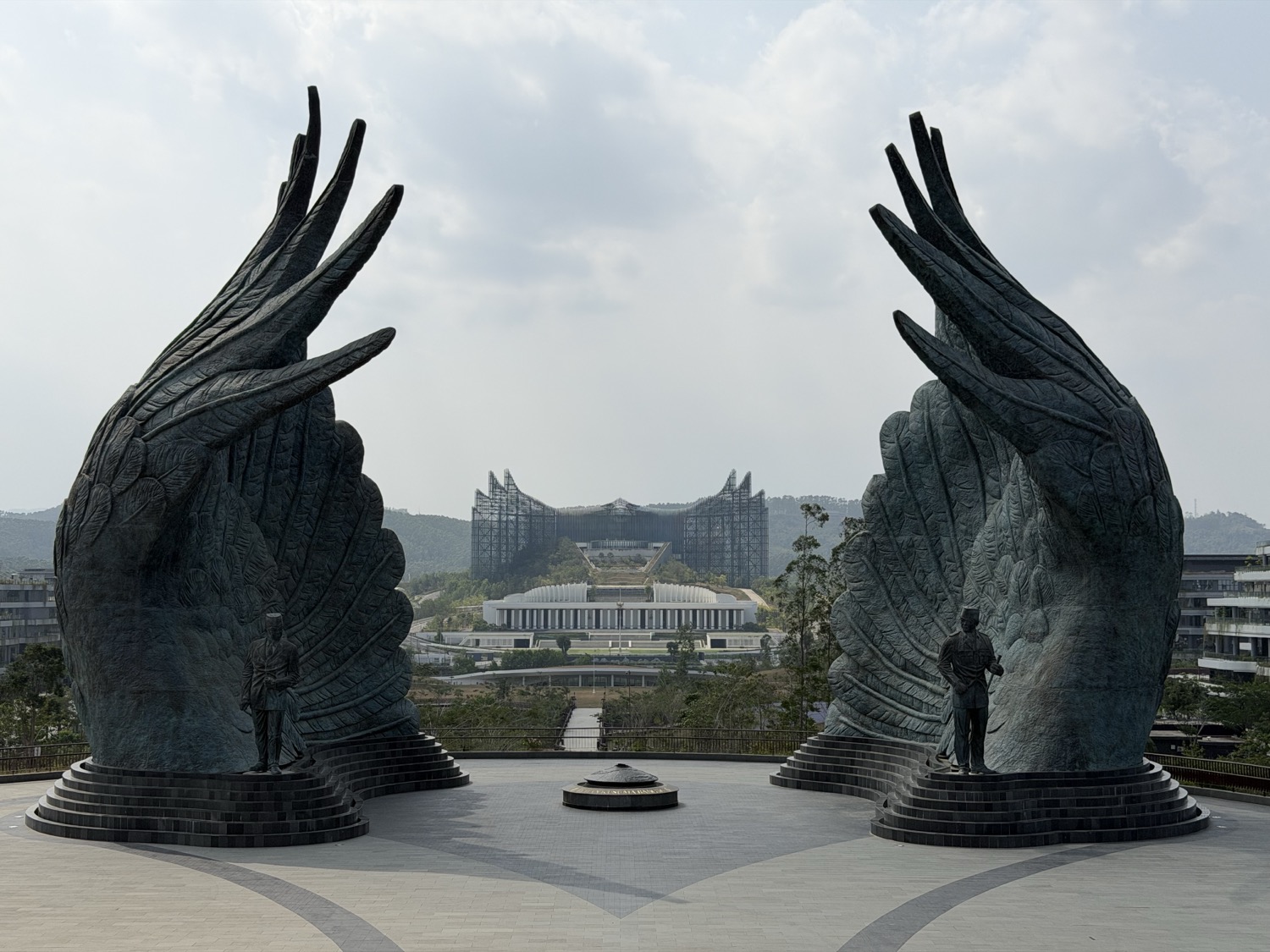
The Istana Garuda is without a doubt the most spectacular building to visit in Nusantara. This presidential palace takes its name from its shape, inspired by the Garuda, a mythical creature found in Hindu and Buddhist traditions and now Indonesia’s national emblem.
The building looks like it came straight out of the latest Batman movie. Indonesian sculptor I Nyoman Nuarta designed it. He is also behind several other works installed in the new capital. According to the designer, the Garuda was chosen as a symbol capable of representing the entire Indonesian population.
The interior of the palace did not appear to be open to the public during my visit. The exterior, however, is already a visit in its own right.


Embung Plaza Seremoni
Embung Plaza Seremoni lies at the heart of the government zone and offers several viewpoints over Istana Garuda.
The area includes several ponds and walkways around the landscaped spaces. A few shops and kiosks also let you grab something to eat. That is welcome in a city where commercial activity remains very limited.


Taman Kusuma Bangsa, the Former Memorial Park
Taman Kusuma Bangsa, previously presented as the Memorial Park, is a commemorative space located on the ceremonial axis of Nusantara. It was inaugurated on August 12, 2024.
The park pays tribute to Indonesian national heroes. It notably includes statues of Soekarno and Mohammad Hatta, the two figures associated with the proclamation of Indonesian independence. There is also an installation representing the wings of the Garuda and an eternal flame, not so eternal since it was out during my visit.
The site also includes a 79-meter flagpole, built for national ceremonies. I Nyoman Nuarta designed the park and created the concept for Istana Garuda.
This is one of the places where the symbolic dimension of the new capital is most clearly felt.


Titik Nol Nusantara
Titik Nol Nusantara, or the zero point of Nusantara, symbolically marks the center from which the new capital is organized.
It is part of a large park that seemed to be barely opening when I visited. Or perhaps the guard was simply very kind in letting me through.


Plaza Legislatif
Plaza Legislatif is part of the area intended to host the future legislative institutions.
I do not, however, recommend visiting this site in Nusantara, at least in the coming months. It is mainly a vast landscaped space in an area still largely under development.
National Mosque Nusantara
Masjid Negara IKN, or the National Mosque of Nusantara, is one of the main religious buildings in the new capital and is worth a detour.
It is located farther from the presidential palace area. Its construction is part of a vast religious district intended to host several places of worship representing Indonesia’s religious diversity. The mosque is notably meant to serve as a major Muslim religious center for the new capital. It began operating in 2026 and hosted Nusantara’s first Eid al-Fitr prayer in March 2026.


Next to it is Gereja Katolik Santo Fransiskus Xaverius, the Catholic church, still under construction during my visit.
Rumah Teknologi Nusantara
I also visited the technology museum, located near the bus terminal.
I honestly do not recommend this visit. This museum was where I began exploring Nusantara. I quickly wondered whether I had really traveled all that way for this.
Fortunately, the other sites turned out to be much more interesting!
Embung MBH
I also wanted to see Embung MBH, a reservoir developed in central Nusantara, but in the end I did not have time to go there.
The site is part of the network of reservoirs integrated into the urban project. It notably includes a path around the water and offers views of the surrounding buildings.
History of Nusantara
President Joko Widodo officially announced the new capital project in 2019. The goal is to gradually move Indonesia’s administrative center from Jakarta to Nusantara, officially called Ibu Kota Nusantara, in the province of East Kalimantan, on the island of Borneo.
The choice addresses several objectives. In particular, the government wants to reduce the concentration of economic and administrative activity on the island of Java and rebalance the country’s development. The project is also meant to address Jakarta’s difficulties.
Joko Widodo’s government even amended legislation to ensure the project’s continuity and facilitate its implementation. These changes notably strengthened the powers of the Otorita IKN, the authority responsible for Nusantara. They also clarified the planning and financing arrangements for the new capital and gradually organized the transition of Jakarta’s status.
In 2025, the government set 2028 as the target for making Nusantara the political capital. The timeline notably includes the construction of legislative and judicial infrastructure and the gradual transfer of civil servants.
However, the current government and several other actors seem particularly reluctant about the move. It therefore remains to be seen whether the project will actually materialize.
Why Move the Capital?
Jakarta faces intense urban pressure. According to data published by the UN in 2025, the metropolitan area had nearly 42 million inhabitants. It thus became the world’s most populous city under the statistical definition used by the organization.
The current capital faces pollution, congestion, flooding, and land subsidence. It also experiences significant seismic and volcanic activity. The government therefore sees moving the capital as a way to address several of Jakarta’s problems while rebalancing national development.
Critics of the project, however, highlight its cost, environmental impact, land issues, and consequences for local populations. They also point to the risk of leaving Jakarta in an ambiguous situation during the transition.
Ecology, Sustainability and Controversies
It is therefore easy to imagine that the choice to build a new capital is not unanimously supported. The project has been the subject of several controversies.
“Abandonment” of Jakarta
This choice is criticized in particular because, instead of trying to solve Jakarta’s difficulties, the government gives the impression of abandoning the city to its fate while investing in a new location.
Ecology and Sustainability
The government presents Nusantara as a forest city, with the ambition of building a greener and more sustainable capital. The law notably requires that 75% of the territory be devoted to green spaces.
On site, this ambition is already visible: vegetation occupies a significant place between buildings, while parks and water features are integrated into the main roads. It remains difficult, however, to know how much of these developments reflects a genuine ecological strategy and how much is simply the landscape of a city still under construction.
The Google satellite image below mixes images taken before and after the start of the city’s construction. It shows the forest, which already seemed largely secondary, gradually replaced by parks that are certainly very green, but not necessarily ecological for all that.

The project also raises questions. Nusantara is being built in a region of Borneo already weakened by natural resource extraction, including mining and palm oil monoculture. Constructing the city creates new needs for infrastructure, water, and materials.
Pressure and Protection of Local Ethnic Groups
It also comes with pressure on local populations, particularly the Balik and Paser. For example, the construction of the Sepaku Semoi Dam, intended to supply the new capital with water, affects the activities and resources of local residents. Its impoundment notably displaced some of them.
Fishing is also affected by changes to the river’s flow caused by the dam. Transporting materials needed to build the new capital also disrupts the river.
The Otorita IKN is also seeking to develop tourism based on natural heritage and local culture. The Balik Nan Living Museum program, for example, highlights the territory and traditions of the Balik community. This approach can create new sources of income, but it also raises a question: how can this culture be promoted without reducing its people to a mere tourist attraction?
My Opinion on the Project
I left with the impression of having discovered a fascinating but still deeply uncertain project. The large deserted avenues, unoccupied buildings, and some facilities already marked by wear gave Nusantara a strange atmosphere, almost close to dark tourism. As if the city were already aging before it had even begun to live.
In some ways, Nusantara reminded me of Singapore, which I discuss in more detail in this article: Singapore in 4 Days : Multiculturalism 2.0. In both cases, the role of vegetation seems to have been considered from the city’s design stage, rather than simply added afterward. It remains to be seen whether Nusantara will, in turn, manage to turn that ambition into a sustainable urban model.
If construction and the transfer move quickly, it could become a unique, vibrant, and original capital. If they drag on, however, this ghost-town impression may become permanent.


From an ecological point of view, I felt that the “damage” had already been done. Stopping the project at this stage might therefore be less relevant than trying to limit its consequences and improve its design. With the gradual shift of power toward Kalimantan, I also hope the new capital will help raise awareness of the consequences of deforestation in Borneo and slash-and-burn practices. These can cause smog episodes as far as surrounding cities.
Practical Tips for Visiting Nusantara
How to Get to Nusantara
For now, Nusantara remains a little difficult to visit. It is still relatively isolated compared with Indonesia’s other major cities.
From Samarinda
Having arrived from Samarinda, I tried to find a shared car to reach Nusantara. I could not find one. A private car would have cost me about 800,000 IDR per trip. Guided tours also allow you to combine discovering the capital with other nearby sites.
From Balikpapan
It seemed to be the only city offering easy access to Nusantara by public transport. The bus cost 43,000 IDR, or a little more when booked through Traveloka.
Another option is Cititrans, which offers particularly comfortable minivans. Tickets cost about 150,000 IDR.
Getting Around Within Nusantara
Once you arrive at the Nusantara bus terminal, free public buses regularly take you to the city center and the National Mosque. This makes it easy to reach the main sites without needing to rent a car. I then covered the rest of the central area on foot.
How Much Time Should You Allow for Visiting Nusantara?
A few hours are enough to discover the main sites of Nusantara.
A day trip from Balikpapan is therefore perfectly feasible. Bus frequency makes it possible to reach the city in the morning and leave after several hours of sightseeing.
Do You Need to Book to Visit Nusantara?
When visits first opened in 2024, you had to register in advance through the IKNOW app.
However, during my visit in September 2026, that reservation was no longer necessary. I could move freely around the city, on foot or by car.
What Is the Best Season to Visit Nusantara?
East Kalimantan generally has a drier period between May and October, although rain remains possible year-round in this equatorial region.
It is important, however, to take into account smog episodes linked to fires and slash-and-burn practices. In September, these can severely degrade air quality on some days and reduce visibility.
As for me, I came in September 2026 and was able to visit Nusantara in good conditions.
Leave a Reply