
This 3-week China itinerary through southern China crosses four provinces and autonomous regions, from the tropical landscapes of Xishuangbanna to the high plateaus of Yunnan, at the gates of Tibet. Along the way, it passes through the historic villages of Yunnan, the rice terraces of Guizhou, the karst landscapes of Guangxi and the metropolis of Guangzhou, before reaching Macao and Hong Kong.
This trip is mainly done by high-speed train, complemented by a few taxi and rental car journeys. It offers a glimpse of southern China’s diversity, between cultural heritage, natural landscapes and lively big cities.
After exploring the east of the country in winter, from Shanghai to Beijing (see my article: China in winter – from Shanghai to Beijing), I offer here an itinerary done in spring, which gives more room to traditional villages and natural regions, while keeping a few essential urban stops.


Article contents

My highlights
If I had to pick a few standout stops from this 3-week China itinerary in southern China, these are the places that won me over most:
- Dali : an ideal stop between lake, mountains and old town, with a very pleasant atmosphere.
- Shaxi : probably the most charming village of the trip, authentic and full of gentleness.
- Shuhe : my favorite near Lijiang, quieter and more authentic than its neighbor.
- Zhaoxing : a superb Dong village surrounded by rice terraces, perfect for soaking up another side of China.
- Xingping : spectacular karst landscapes along the Li River, among the most beautiful of the trip.
- Guangzhou : a big city that is surprisingly pleasant and cosmopolitan.
- Macao : Portuguese heritage and glittering casinos.
- Hong Kong : from concrete to jungle without transition.
Day-by-day itinerary
Day 1 – Jinghong (Xishuangbanna)
A taste of Southeast Asia at the gates of Yunnan
I begin this 3-week China itinerary from Laos, with a train journey from Luang Prabang to Jinghong, in the heart of Xishuangbanna.
On arrival, I notice that this region really feels like a little piece of Southeast Asia just across the border. Between its distinctive, sometimes almost kitschy architecture and influences from Thailand, Laos or Vietnam, Jinghong is a good transition before diving deeper into China.
The city is easy to explore on foot and the atmosphere is particularly pleasant in the evening.
Night market, temples and local atmosphere
The highlight of Jinghong for me is the Mekong River Xingguang Night Market (湄公河·星光夜市), one of the largest night markets I have seen. Entry is free. You just need to scan the QR code at the entrance with WeChat to get your ticket.
You will find an impressive variety of local and regional specialties: rojak (spicy fruit and vegetable salad), durian, mango sticky rice, Hong Kong or Japanese waffles, not to mention an endless array of skewers.
A beer stand adjusts its prices in real time according to demand. I bought a beer there and, in the second that followed, the price increased by 20%, a mini beer stock market.
Just next door, the Jinghong Dajin Tasi temple is especially worth a detour in the evening. Seen from outside, its lighting gives it a lot of charm and creates a very beautiful backdrop for the market. The interior, however, seemed less interesting to me. Entry costs 10 yuan.


What to do around Jinghong?
The other possible visit is the Garden of Tropical Flowers and Plants, accessible for 40 yuan. The walk is pleasant if you have some time, even if it is not the most memorable garden I have visited.

If you are in the region in April, ask about the Water Splashing Festival, a major traditional festival of the Dai people during which everyone splashes water on each other.
I had initially planned to explore the region more, but the logistics seemed complicated and the excursions quite expensive. In a single day, it is difficult to really get out of Jinghong. To discover rural areas, it is better to plan one or more nights in the surrounding villages.
I therefore take the train north again. The journey offers superb rolling landscapes and vast tea fields, especially around Pu’er.
Where to stay
I rented an apartment in Peacock City, one of the many kitschy buildings ideally located near the night market. I did not necessarily enjoy my apartment, so I just advise you to look in the area.


Day 2 and 3 – Kunming
Arrival in the capital of Yunnan
I continue this 3-week China itinerary north. After four hours by train, I get off in shorts and a T-shirt. The contrast is striking: you gain 2,000 meters in altitude and lose twenty degrees.
I chose a hotel near the central station to minimize travel with my backpack. After dropping off my things, I set out to discover downtown Kunming. To be honest, the first impression is mixed. The center seems fairly standard for a Chinese city. Only the Jinbi commercial district, with its reconstructed old architecture, and Cuihu Park are nice but not unmissable.
Very good surprise, however, on the food side. I find an excellent vegetarian restaurant: Juezhengjing Vegetarian (Minsheng Street Branch).
Jindian and the Xishan hills
On the second day, I start with the Dounan flower market. The visit is pleasant, without being unmissable, and above all quite far from the center.
I then continue with the Jindian Scenic Area, on the opposite side of the city, which I clearly preferred. The place is much more picturesque and really worth the detour. I spend about two hours there.


Xishan and the Longmen Grottoes
Missing nature, I then continue with Xishan, west of the lake. To save time, I take a taxi, but the site remains accessible by metro via Western Hills Park. I then take the green bus to the Longmen Grottoes for 12.5 yuan.
From the entrance, I continue on foot, passing several pavilions and temples. The path is very pleasant. The grottoes look more like tunnels and ledges carved into the cliff, which makes the visit particularly spectacular.


In hindsight, if I had to redo this stop in Kunming, I would focus on Jindian and possibly Xishan, before leaving more quickly for Dali, which in my opinion offers many more possibilities.
Day 4 and 5 – Dali
Arrival in Dali and market atmosphere
I take the train early to reach Dali, an essential stop on this 3-week China itinerary. During the two-hour journey, the atmosphere already sets the tone: a lady puts on makeup nonstop while several passengers wear outfits inspired by another era.
As soon as I arrive, I drop off my bag and discover that a market animates the city on Wednesdays. I take the opportunity to stroll between the stalls. You find as much food as tourist trinkets, with a few surprising scenes: flattened pig faces, dentures made on site, and above all the first beggar I come across in China, equipped with QR codes to receive donations via Alipay or WeChat. A fairly revealing image of a country where cash has almost disappeared.


Hike in Cangshan Geopark
I continue with the Cangshan Geopark, even if finding the entrance proves a little complicated due to closed or renovated sections. I am finally redirected to the Tianlong Babu Movie & Television Town, where the ticket office is. Entry costs 35 yuan.
The trail begins with a climb of about 500 meters through a fir forest and several graves, in a fairly singular atmosphere. Once higher up, you reach an almost flat path that runs along the mountain.
I decide to walk it from end to end. Despite some closed sections, the hike is really worth the detour. The views are superb and the walk remains one of the best memories of this stop.
The GPX track1 of my route is available here (20.92 km – 801 m ascent and 563 m descent).
Note: all paths leading to the summit are closed. Several signs mention the many disappearances each year. The summit is only accessible by cable car.


Old town, Erhai Lake and Three Pagodas
In the evening, I discover the old town of Dali. I climb the central tower, which is free, then have dinner in a vegetarian restaurant found on Happy Cow.
Dali also marks the first stop on the ancient Tea Horse Road, a common thread I will follow afterwards toward the Tibetan regions.


The next day, I revisit the old town before renting an electric scooter. Communication with the owner is not simple, but thanks to the help of a friend on the phone, I manage to rent it for a few hours.
I then reach Erhai Lake and quickly understand that it would have been more practical to come directly on site, as some areas do not accept outside vehicles. However, bicycles can be rented to visit the lakeside. The place is very developed, but remains pleasant.
I continue with the Three Pagodas of Chongsheng Temple, undoubtedly the most emblematic site in Dali. They are particularly impressive with the mountains in the background. By going around them to the right, you reach a pond offering a very beautiful reflection of the site. Higher up, the temples follow one another in an almost theatrical staging.
Most of the buildings are reconstructions after the Cultural Revolution, which explains their very recent appearance.


Evening in Lijiang
After the visit, I pick up my bag, return the scooter and head to the station to join a friend in Lijiang.
As soon as I arrive, we set out to discover the superb old town of Lijiang, a UNESCO World Heritage Site. If you have more than 3 weeks in China, I recommend spending at least a full day there.
Unfortunately, we only spend one night there, with the idea of coming back later when we stay in Shuhe.
Day 6 – Tiger Leaping Gorge
Viewpoint and scenic road
Having rented a car, and taking advantage of my Chinese friend to avoid all the paperwork related to the rental, we get up early to leave for the famous Tiger Leaping Gorge.
We first follow the crowds to the viewpoint located at the entrance of the gorge, in the lower part. To be honest, the place does not really impress us. The scenery is beautiful, but the whole thing is much too developed for my taste.
Ideally, I would have liked to hike in the upper part, which seems much more spectacular. Due to lack of time and not very clement weather, we settle for this short stop.
The car then becomes really useful, because we continue on the scenic road that crosses the gorge. This section offers magnificent panoramas and several photo stops, which ultimately makes it the best moment of the day.
We had also planned to visit the travertine pools located further on, but we arrived too late.
In hindsight, if I had to redo this stage of the 3-week China itinerary, I would clearly plan two full days. That would allow exploring the gorge on foot and getting further away from the most touristy areas.


Arrival in Shangri-La
We arrive in the evening at Shangri-La, the last major city easily accessible by train and a very popular base for exploring the surroundings as well as the high plateaus at the gates of Tibet.
Even if the city seems a little overrated to me and ultimately has little interest in itself, it remains a very practical stop. With an itinerary of only 3 weeks in China, it gives a taste of the Tibetan atmosphere.
After a hotpot, we set out to discover the Dafo Temple and its immense prayer wheel. All the tourists work together to turn it, which creates a fairly lively atmosphere. The temple, very recent, remains pretty, especially with its night lighting.
Thanks to the help of our hotel, we organize at the last minute the next day’s hike, perfect for exploring more of the surroundings of Shangri-La.


Day 7 and 8 – Shangri-La
Day 7 – Hike to Abuji Cuo Lake
The guide picks us up around 7:30 a.m. before about 45 minutes of driving to the start of the Abuji Cuo Lake hike (阿布吉措). Unfortunately, the weather is bad, with snow from the start, but it gives a magnificent atmosphere to the forest. The trail then crosses several camping areas used in summer. We reach the viewpoint in the middle of the afternoon, but the lake remains completely hidden by clouds. Fortunately, the sky begins to clear during the descent and finally offers us some beautiful views of the mountains.
The hike takes place between 3,700 and 4,400 meters in altitude. I strongly recommend spending a few days in the region before attempting this excursion in order to acclimatize better to the altitude.
We paid 150 CNY per person, transport included, without trying to organize the excursion on our own. I do not know if access is allowed without a guide and you also need to register at a checkpoint at the start of the trail. If you want to contact the guide used, here is his WeChat ID: 13988726983.
Here is the GPX1 track of the route taken (one way: 13.84 km – 856 m ascent, 162 m descent).
As we were a little behind schedule, we took a 4×4 to the halfway point for 150 CNY per person. A second vehicle then offered to continue for the same price, but we preferred to walk. For the last four kilometers, we finally accepted a quad for 30 CNY per person.
If you are well acclimatized and in good physical condition, it is entirely possible to do the round trip on foot without extra cost. The hike remains fairly busy, however, with several cars and quads on the track.


Day 8 – Sunrise and road to Shaxi
We get up very early again to try to watch the sunrise over the Ganden Sumtseling Monastery.
Thanks to my friend’s talents and her mastery of Chinese social media, we find an excellent viewpoint, with the monastery in the foreground and the mountains in the background. I share our route from where we parked: GPX1 (1.15 km – 47 m ascent).
Once again, the weather remains mixed. The view is magnificent, but the peaks remain hidden and the first rays of sun take their time.

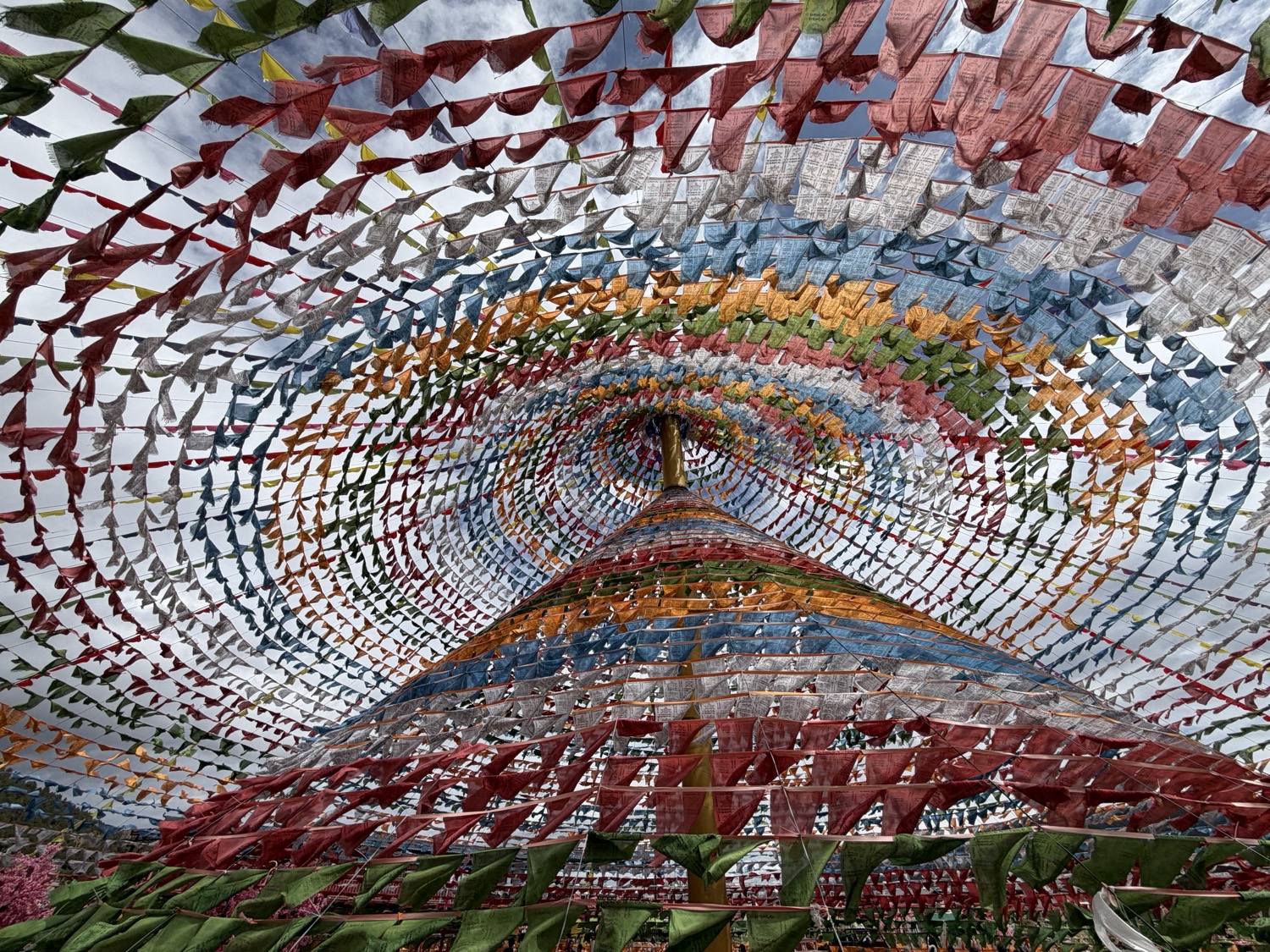
Then we stop at one of the many Lungta (coordinates: 27°47′46.76″N 99°42′06.01″E), these double conical structures covered with Tibetan flags. They are very popular for photos.


We then take the highway again to reach Shaxi, the next stop on this 3-week China itinerary.
Arrival in Shaxi
We explore Shaxi in the afternoon and I quickly fall under the charm of this beautiful little village.
Compared to other villages in the region, it remains reasonably touristy. Despite the many shops, the village keeps an authentic and particularly picturesque atmosphere.
The bridge, the Xìngjiào Sì Temple and the Ouyang House are worth a detour. But the most beautiful thing is ultimately to take the time to soak up the atmosphere of the place, simply strolling through its alleys.


Days 9, 10 and 11 – Shuhe and surroundings
Day 9 – From Shaxi to Shuhe
After enjoying the morning again in Shaxi, we head to Shuhe, very close to Lijiang. On the way, several stops are possible, notably Shíbǎoshān and its temples and caves, but we finally choose to stop at Lashihai Wetland Park. The place is pleasant, even if I found it a little too developed for tourism and not enough oriented toward wild nature for my taste.


We arrive in Shuhe in the late afternoon and immediately set out to discover this old village, which wins us over almost immediately. The place is particularly vast while remaining surprisingly peaceful, especially in the evening, because it seems most visitors prefer to stay in Lijiang. This tranquility contributes a lot to its charm.
What I particularly liked were the vegetable gardens integrated into the north of the old town, which fully contribute to the identity of the place. In the morning, seeing the villagers working the land reinforces this feeling of authenticity. In this 3-week itinerary across China, Shuhe is clearly one of my highlights.


Day 10 – Baisha and Yulong Xue Shan
We enjoy a quiet morning in Shuhe to stroll and simply relax before heading back in the early afternoon to Baisha, another old town located on the ancient tea road.
To be honest, the place does not charm me as much as the previous villages. The old town is quite touristy and lacks, in my opinion, the character of Shuhe or Shaxi. However, it offers beautiful views of Yulong Xue Shan, culminating at about 5,600 meters.
We then continue our exploration north of Baisha to the Dongbagu Scenic Area
(GPS coordinates: 27°00′23.8″N 100°14′40.9″E), where several artificial lakes in the foreground particularly highlight the mountains in the background.


Day 11 – Last stops around Lijiang
We start the day with the village of Wifang, accessible by a road in poor condition. Very honestly, we only stay there very briefly and I would not particularly recommend it.
We then go back down to the Black Dragon Jade Pool, whose park again offers very beautiful views of the mountains. If you are not driving and have little time around Lijiang, it is an excellent option.


We finally make a last detour through the old town of Lijiang. Despite the crowds, I would have liked to visit it longer during the day. In hindsight, we probably should have skipped Wifang to spend more time there, but that will be for another time.
I then take the train to Kunming, where I spend a night near the south station so I can leave early the next day.
Day 12 – Zhaoxing
An early train takes me to Guiyang, the main city of Guizhou province. I decide not to stop there, as I mainly want to quickly get back to nature for the rest of this 3-week China itinerary.
I therefore change directly to a train to Congjiang, then finish the last kilometers by taxi to the old Dong village of Zhaoxing.
The contrast with the villages of Yunnan is immediate. The architecture there is very different and the village stretches lengthwise at the bottom of a valley. Life seems to be organized around the five drum towers, these large wooden towers where inhabitants gather to talk. Despite almost omnipresent tourism, Zhaoxing keeps a real authenticity.
From the village, a well-developed path leads to Tang’an through the rice terraces. As it is not the season when they are a bright green, the path is relatively uncrowded, but despite a fairly thick mist, the walk remains very beautiful. I imagine that in full season, the landscape must be magnificent, with a much more intense green and probably many more visitors.
Although the path seems very clear to me, I share the GPX1 track of my route (one way: 6.42 km – 450 m ascent, 27 m descent).
From Tang’an, shuttles allow you to go back down to Zhaoxing for 10 CNY. Most tourists seem to do the route in the other direction.
In the late afternoon, I enjoy the village again and head to the very beautiful viewpoint located at its entrance.
I stay at Zhaoxing Dongzhai Miwu Homestay, a clean, quiet hotel with a lovely view. The owner speaks English, which is always appreciated, and her husband picks up and drops off tourists at the station for free.


Days 13 and 14 – Xingping (Yangshuo)
Day 13 – Arrival in Xingping
I had initially planned to stop in Guilin in order to reach the next stage by boat along the Li River. As the weather was particularly bad, I finally decide to go directly to Xingping.
I take the opportunity to spend a quiet afternoon in a hotel offering a superb view of the region’s karst mountains. These landscapes are clearly among the most emblematic of this 3-week China itinerary.
After several more fast-paced stops, this calmer break feels very good. Just the view from the room almost justifies the stop.
Day 14 – Hike around the Li River
The next day, I set out to explore the region following my hotel’s advice.
I start by climbing Laozhai Hill, a free viewpoint offering a superb view of the Li River and the surrounding mountains. The climb is steep and can become slippery in the rain.
I then reach the famous 20-yuan bill viewpoint, very busy, where many tourists have their photo taken on rafts with birds tied to a stick (the poor things). This is also where cruises depart.
Rather than following the crowd, I continue on foot along a trail beside the river. The landscapes seem similar to those from the river, but in a much calmer atmosphere.


From there, the trail becomes wilder and I quickly find myself alone, a fairly rare situation in this region of China. The path leads to the summit of Mashan, with another spectacular view.
I then turn back before crossing the river by ferry for 5 yuan to reach the Jiatanxia viewpoint.
To avoid retracing my steps, I use Maps.me to find a path leading to the fishing village facing Xingping. The return through the fields is particularly peaceful and contrasts sharply with the tourist areas of the morning.
Here is the GPX1 track of my route from my hotel (23.38 km loop – 888 m ascent, 878 m descent).
It is also possible to visit Xiang Gong Shan or Damian Mountain, but having left late and with ferries only running until sunset, I prefer not to take any risks.

Where to stay in Xingping
I stayed at the Yangshuo Mengyuan Shanju Hotel (Xingping Ancient Town Branch), which I recommend without hesitation.
The owners are particularly friendly and helpful. The room with its 360-degree view is quite unique. It is also possible to order at the hotel restaurant, with vegetarian options, and have it served directly in the room, ideal for enjoying the terrace.
I would gladly have spent one or two more days here, as the region deserves time in a 3-week China itinerary.

Days 15 and 16 – Guangzhou
Day 15 – First discovery of the city
I continue my journey by train and arrive in the early afternoon in Guangzhou, which immediately makes a very good impression on me.
Despite its immense size, the atmosphere is surprisingly relaxed and particularly cosmopolitan. This contrasts sharply with other large cities visited during this 3-week China itinerary.
After dropping off my bag at the hotel, I head directly to the eastern part of the city, to Ersha Island. I start with the Guangdong Museum of Art, free, which does not really convince me.
I then walk along the island to the impressive Canton Tower, then cross the pedestrian bridge before reaching the Guangzhou Opera House, designed by Zaha Hadid. To be honest, some architectural details and finishes are among the worst I have seen.


I continue with the Guangdong Museum, also free. Again, the visit leaves me mixed. Between the fairly generic geological history, stuffed animals and pottery collections, I sometimes feel like I am seeing exhibitions already seen elsewhere. The section devoted to lacquer is nevertheless particularly beautiful.
Despite these mixed visits, I really like the city and especially its atmosphere.
In the evening, I head to the Dongshan district. This neighborhood is very pleasant for walking. I then cross the park of the same name, which offers pretty views of Canton Tower.
I end the day at Shamian Island, whose remarkably preserved colonial buildings are beautifully lit at night.


Day 16 – Historic districts and temples
I start the day at the Qingping Traditional Medicine Market.
In my opinion, it is not essential to enter the large five-story central building. Indeed, the street shops sell roughly the same products: dried foods, herbs and an impressive variety of mushrooms.
From there, you can easily reach the historic Enning Lu district, even if most of the houses actually seem very recent.
I then visit the Bruce Lee Ancestral Home. It offers an interesting retrospective on the actor’s life and his role in popularizing kung fu around the world.


I continue on foot to the Chen Clan Ancestral Hall, then go on to Guangxiao Temple, the Temple of the Six Banyan Trees, the Huaisheng Mosque, the Big Buddha Temple and finally Yuexiu Park, to the north.
No visit truly amazed me individually. However, the whole route allows discovering a part of the city whose atmosphere I really liked. This stop brings beautiful diversity to this 3-week China itinerary.


Restaurants and accommodation
I recommend the Suxinfeng Vegetarian Cafeteria (Changshou Road Branch). Its vegetarian buffet at 38 yuan, a frankly unbeatable price, is excellent.
I stayed at Yimi Jingxuan (Guangzhou Hualin Temple Subway Station Branch), fairly standard and without particular charm, but very clean, comfortable and well located for visiting Guangzhou for a few days.
Days 17 to 21 – Macao and Hong Kong
From there, I go to Macao then Hong Kong, which I discuss in the following articles: 24h in Macau: between Portuguese heritage and oversized casinos and Hong Kong 4 days: hikes and city – Intensive itinerary.


Practical tips
5 essential apps
Here are the 5 apps I recommend downloading before a trip to China:
- Alipay : my favorite payment method, which allows paying almost everywhere (even giving donations to beggars!), using public transport, renting bikes, ordering a coffee, … More details in the payments section.
- Amap : the equivalent of Google Maps that includes the schedules of most public transport. Apple Maps also works well on site but not outside China.
- Railway12306 : the official train booking app. Details in the paragraph below.
- Trip.com : the reference app for foreigners to book hotels but also some tours. There are other apps that unfortunately are only in Chinese.
- WeChat : complementary to Alipay, WeChat allows paying, ordering coffees, etc. but also communicating and booking certain tourist attractions (entry to Tian’anmen for example).
I recommend looking for tutorials on YouTube to learn how to use Alipay and WeChat.
Don’t forget a translation app either.
Internet and VPN
If you want to keep using your usual services in China, you need to plan ahead before departure.
Many Western services are blocked: Google (Maps, Gmail, Drive, Translate), Meta (WhatsApp, Instagram, Facebook), YouTube, X, etc.
In my case, two solutions worked:
VPN
It is important to install a VPN before arriving in China, because once there, downloading or activating it can be complicated. I used Pandafan (account to create via their site) in combination with the Shadowrocket app on iPhone (paid on the App Store). It works generally well, but sometimes unstable depending on the time of day.
Foreign eSIM
I also used an international eSIM based in Singapore bought on Trip.com. In this case, no VPN was necessary: all Google and Meta services worked normally, because the connection came out of China. It is clearly the simplest and most stable solution, especially for a short stay.
Accommodation and location
Choose your accommodation based on the metro map. Cities are immense and connections make the difference.
Vegetarian food
Buddhist temples frequently offer vegetarian restaurants and large cities offer many meat-free options. Vegetarian buffets are fairly common and offer excellent value for money.
The Happy Cow app works relatively well for tourist places. Otherwise, by searching for “vegetarian restaurant” on Google Maps, you find a few options; you just need to then check on Amap whether the restaurant exists.
Orientation and urban travel
Amap replaces Google Maps and perfectly integrates public transport. Metros are efficient and punctual. Self-service bikes (and motorbikes in Xishuangbanna) are often faster than the metro for short distances.
Payments and money
AliPay and WeChat are essential. Payments, transport, museums, bikes, taxis, food. Link your credit cards before departure. Cash seems useless even in more rural environments. No commission is taken up to 200 CNY. Beyond that, prefer credit card payments if possible.
Recommended season
For this 3-week itinerary in southern China, spring (April-May) and autumn (September-October) are generally the most suitable periods. Temperatures are pleasant for visiting villages, hiking and exploring natural landscapes.
Note, however, that Xishuangbanna is tropical and has a rainy season from May to October. Rain is also frequent in mountainous regions in summer.
Avoid at all costs the Chinese Golden Week, from October 1 to 7.
Trains and stations
Long-distance trains should ideally be booked in advance (bookings open 14 days before departure).
- Railway12306 : official platform. Registration can take a little time, but it is possible without a Chinese number. Big advantage: cancellation fees are quite low and trips can be changed once for free.
- Trip.com : easier to use, but with a commission. It is possible to “book” trains earlier, but seats are only confirmed once official sales open.
There is no paper ticket: your passport serves as your transport ticket.
The stations are immense and operate like real airports (security checks, queues, distant platforms). It is advisable to arrive 30 to 45 minutes early.
(1)The GPX tracks mentioned in this article are provided for reference only. They should never be followed as an official guide or a safe route. Mountain conditions change constantly and can make a track unsuitable or dangerous.
Leave a Reply