
Traveling in China in winter is often seen as an unfavorable option. However, China in winter offers clear skies and fewer crowds.
This ten-day itinerary, completed in early December, provides a first, highly contrasting glimpse of urban and cultural China. It combines major metropolises, port cities, imperial heritage, and sacred nature, primarily using the high-speed train.
The route connects Shanghai, Qingdao, Tai’an, Tianjin, and Beijing. December turned out to be an excellent surprise: autumnal colors and still mild temperatures in Shanghai and Qingdao, dry cold and blue skies further north. Apparently, I got lucky.
This is a dense trip. I visit a lot and walk a great deal. The pace could easily be spread over more days, especially in the big cities.


Overview
- DAY 1 to 4 – Shanghai
- DAY 5 – Qingdao
- DAY 6 – Tai’an and Mount Taishan
- DAY 7 – Tianjin
- DAY 8 to 10 – Beijing and the Great Wall
- 5 essential apps
- Internet and VPN
- Accommodation and location
- Vegetarian food
- Getting around
- Payments and money
- Trains
What to visit after this trip?

Day-by-Day Itinerary
DAY 1 to 4 – Shanghai
Shanghai is often presented as the most “European” city in China. The Bund and its colonial buildings immediately evoke this history, inherited from the foreign concessions of the 19th and early 20th centuries. But the illusion doesn’t last long. Here, English quickly disappears and technology is omnipresent. Everything is done through your phone: payments, transport, cafes, museums, bikes, laundry. Human interactions are reduced to the bare minimum, and GDPR probably wouldn’t survive here.
The city operates with formidable efficiency. Ultra-modern, quiet for its size, perfectly connected, it combines contemporary art galleries, world-class museums, parks bustling from dawn, and a food scene that is surprisingly welcoming to vegetarians, provided you know where to look.
I initially thought about taking a day trip to Hangzhou, Suzhou, or Zhujiajiao, but with only three full days, staying in central Shanghai turned out to be an excellent choice.
Day 1 – First urban landmarks, Pudong and The Bund
First introduction to the city and its urban planning
I start with Jing’an Sculpture Park, pleasant to walk through in the morning when locals are practicing tai chi. The Shanghai Natural History Museum is in the park, but I skip it due to lack of time.
I then head to People’s Square, a huge public space and the true nerve center of the city. The square is surrounded by museums and administrative buildings. On weekends, part of the park hosts a “marriage market”, where parents display laminated sheets with the age, height, diploma, and sometimes income of their single children. A very rational approach to romance.
Right next to it, the Shanghai Urban Planning Exhibition Center is an excellent introduction to the city. Free to enter, it traces Shanghai’s rapid evolution and features a giant scale model. Through the eyes of an architect or urban planner, it’s fascinating. Allow at least an hour, much more if the subject captivates you. The other museums on the square were closed that day, so the choice was easy.
Characteristic neighborhoods and colonial heritage
I continue towards the old neighborhoods:
- The French Concession retains a lower-rise, greener, and more pedestrian-friendly urban fabric, a direct legacy of Western urban planning.
- Xintiandi is its luxurious, highly commercial, renovated version.
- Tianzifang is a more popular maze of workshops, cafes, and small boutiques.


Fuxing Park, with its autumnal colors and rose garden, offers a welcome break. I continue to the Yuyuan Garden Mall. The gardens themselves were closed on Monday, but the area remains interesting.
Shanghai’s icons at sunset: Pudong & the Bund
I then walk through Gucheng Park before heading to the Pudong business district by crossing the Huangpu River by boat. This ferry is part of the public transport network and costs almost nothing.
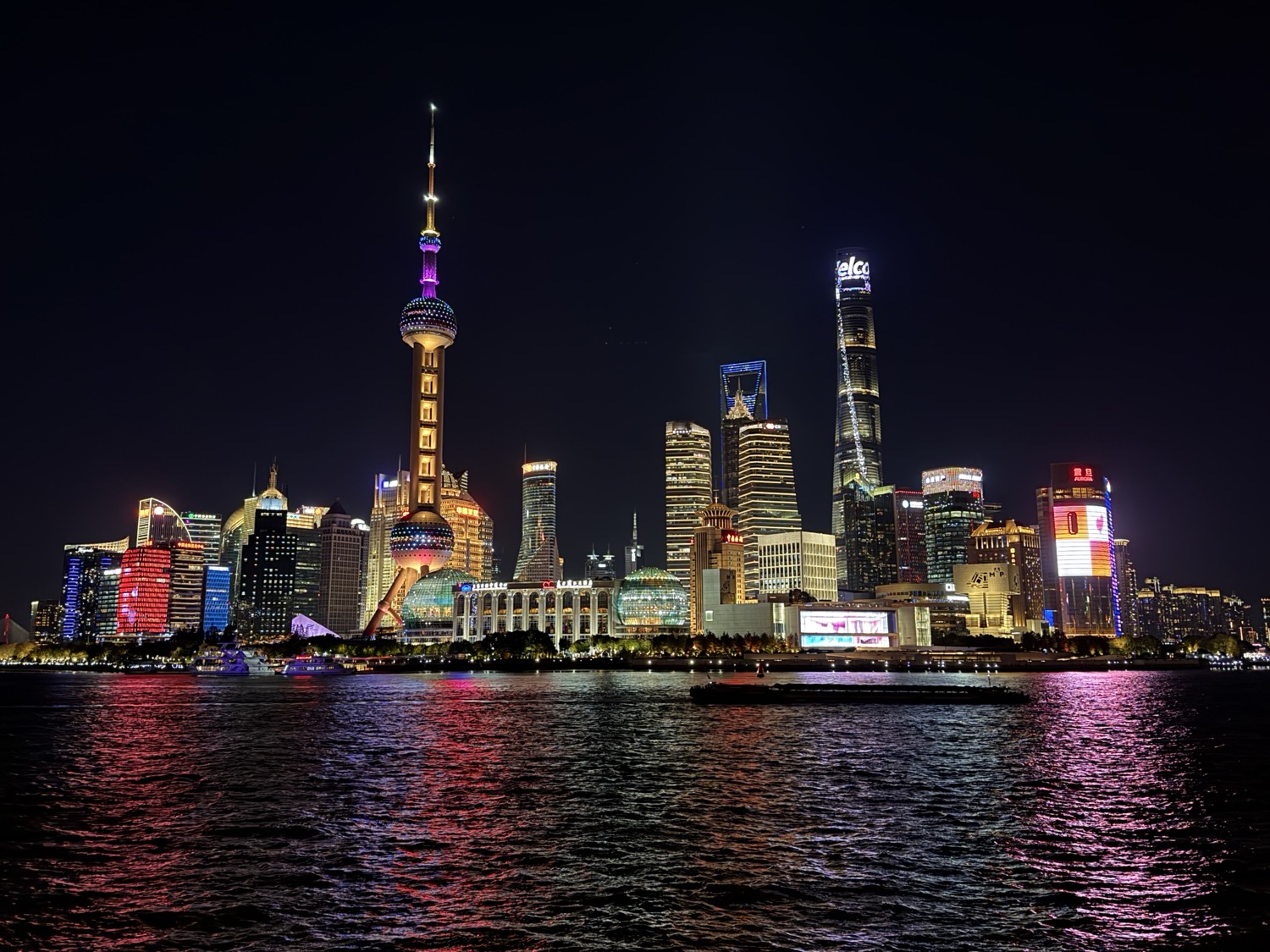
I walk along the river for sunset before entering the district to get a close-up view of the iconic towers, the Shanghai Tower, the Oriental Pearl Tower, the Shanghai World Financial Center, and the Jin Mao Tower, as the light fades and they begin to light up. Several have observation decks, interesting only on perfectly clear days. I prefer to stay on the ground.
I take the boat back to Puxi, on the west side of the river, to reach the Bund at the perfect time. The colonial buildings also light up, but the most impressive sight remains the view towards Pudong and its skyscrapers. Behind the Bund, Yuanmingyuan Road extends the experience with other historic buildings, including the Rockbund Art Museum, unfortunately already closed when I arrived. I end the day on East Nanjing Road, an iconic temple of consumerism, completely at odds with the communist image I had of the country.


Day 2 – Contemporary art, temples, and local life
I start the day at the Shanghai Public Security Museum. Free and a bit old-fashioned in appearance, it dives straight into the history and functioning of the Chinese police and the Communist system. Few explanations are in English, so a translation app is essential to understand some panels.
Next, I head to M50, a former industrial complex converted into a labyrinth of contemporary art galleries. Entry is free and the atmosphere is very open. My preference goes to island6 and its interactive digital installations.
The Jade Buddha Temple is a beautiful Buddhist temple, even though I didn’t manage to see the famous Jade Buddha, probably under renovation. Entry was free that day, although the site usually seems to charge an admission fee.
Back to the French Concession to stroll around with a Chinese friend, who introduces me to Shanghai’s nightlife, discreet but very real, often hidden behind ordinary facades.


Day 3 – Museums and architecture
This day is more contemplative and architectural. Jing’an Temple, squeezed between modern buildings, is expensive for its size but particularly photogenic with its yellow ginkgo trees in winter.
The Museum of Arts and Crafts, more modest, didn’t particularly impress me. I then walk through Yanzhong Park before reaching the Shanghai Museum. With several collections closed, the visit was quick and a bit disappointing.
The reason becomes obvious later. Many collections have been moved to the brand new Shanghai Museum East, in Pudong. Opened in late 2024, free, spectacular both for its architecture and the richness of its collections, it is by far the city’s must-see museum. Allow several hours and don’t miss the rooftop walk.
I end the day at a Christmas market near the Bund, an unexpected but rather pleasant cultural shift.


Day 4 – Last hours and train to Qingdao
I take advantage of one last stroll through the city before heading well in advance to the vast Shanghai Hongqiao Railway Station to get my bearings. From there, I catch a train to Qingdao and settle in near the beach, which allows for a first evening outing as far as the Huilan Pavilion, famous for appearing on the label of Tsingtao beer.

DAY 5 – Qingdao
I had trouble forming a mental image of Qingdao, a city I had never heard of. A port city of over seven million people, it nevertheless seems to be world-famous for its beer. Colonized by Germany at the end of the 19th century, it has preserved a unique European architecture in China, combined with a very pleasant maritime setting.
I start with a long coastal walk from the Huilan Pavilion to Little Qingdao, free in the off-season like most of the city’s parks, with beautiful views of the bay. I continue towards Beach No. 1, passing through Lu Xun Coastal Park. On the beach, locals dig in the sand looking for shellfish.
I then climb Little Fish Hill for a 360-degree view of the city and beaches. The Qingdao City Art Museum, visited next, didn’t particularly convince me.
By subway, I reach the large Zhanshan Temple with its many pavilions and pagodas. I arrive too late to eat at the vegetarian restaurant, as the kitchen closes early. I then walk through Zhongshan Park to reach the Tsingtao Beer Museum. A bit kitschy, but fun, with tasting included.
My discovery continues by Signal Hill Park to admire the sunset over the bay, then a stroll through the old town past the Protestant Church and St. Michael’s Cathedral, both more interesting from the outside than the inside. I finally end up on the coast, this time amidst the weekend crowds.


I take the train in the early evening to Tai’an and sleep near the station, a practical choice to avoid carrying my bag unnecessarily the next day.
DAY 6 – Tai’an and Mount Taishan
Mount Taishan is one of the most sacred mountains in China, a site of imperial pilgrimage for over two thousand years. Unlike many visitors who hike up at night for the sunrise, I opt for a good night’s sleep.
I take a taxi booked via AliPay (my first and only one of the trip, cheap and easy) to reach the south entrance and begin by visiting the Dai Temple, a magnificent listed complex. I then start the ascent following the central route from this temple, passing through the Red Gate (Hongmen). Approximately 7,000 steps later, punctuated by temples, pilgrims, and vendors, I reach the summit.
I attempt a descent via the east route, which seems wilder, only to discover it is closed. Translating signboards can sometimes prevent unpleasant surprises. Not having researched the other routes, I take no risks and descend via the main path, find a bus on Amap, pick up my bag at the station, and continue the journey.


I arrive in the evening in Tianjin amidst a display of illuminated skyscrapers. In winter, the projections seem visible between 6 PM and 10 PM, especially from the square south of the station.
DAY 7 – Tianjin
I start the day at the Century Clock, then walk down Jiefang Road, lined with buildings inherited from the former foreign concessions. I then arrive at Minyuan Square, a running track surrounded by European-style villas built in the early 20th century. The place perfectly symbolizes Tianjin’s unique history, long fragmented into foreign concessions.
Short on time, I skip the Tianjin Museum and head by bike to Ancient Culture Street. The area mimics traditional architecture and is filled with shops, snacks, and temples, including the Tianhou Temple, dedicated to the goddess of the sea. The Folk Art Museum, free to enter, is on the other hand uninteresting and has no English explanations.
I then make a detour to the Drum Tower, surrounded by a similarly styled neighborhood, before ending at the Tianjin Zhongshuge Library, remarkable for its highly theatrical interior architecture. A walk along the river, facing the modern buildings, brings me back to the station. Next stop: Beijing.


DAY 8 to 10 – Beijing and the Great Wall
Beijing was the city that surprised me most on this trip. I expected a gray, overwhelming, and polluted megacity, a legacy of brutal urban planning and a communism that had erased much of its past. This reality exists in part, but it is far from summing up the city.
As the political and symbolic capital, Beijing instead reveals a rigorous and legible urban structure, organized for over seven centuries around a north-south imperial axis, inherited from Confucian thought and feng shui. Far from having completely disappeared, the hutongs, those traditional alleyways lined with courtyard houses, still survive in several central districts. Many were destroyed or transformed over the decades, but those that remain give the city a surprisingly human scale, where neighborhood life contrasts strongly with the grand avenues and monumental complexes. Palaces, temples, parks, and today even some contemporary projects align themselves along this invisible line that structures the city.
In winter, with fewer crowds and often clear skies, this organization becomes particularly noticeable. These three days combine an iconic site outside the city, exploration of the imperial heart, then more spiritual and scenic places.
Day 8 – Mutianyu Great Wall
Even before exploring Beijing, I head to the Great Wall at Mutianyu, one of the best-restored sections and most accessible from the capital. I opt for an organized tour booked on Trip.com: the cost is reasonable and, above all, the time savings are considerable compared to public transport.
On site, despite the guide’s insistence on selling chairlift and toboggan rides, the site is easily explored on foot (keeping in mind that you have to climb many steps). In winter, despite the bare trees, the crowds are moderate, allowing you to fully enjoy the mountain landscapes and the monumentality of the structure, initiated as early as the 3rd century BC and remodeled over more than two millennia.
I descend leisurely and return to Beijing in the late afternoon. The bus drops us off at the Olympic Village, aligned on the imperial axis, just at dusk. It’s the perfect time to see the Bird’s Nest (Olympic Stadium) and the Water Cube light up, offering a striking contrast between contemporary monumentality and a millennia-old urban heritage.


Day 9 – Imperial Axis, Tian’anmen and the Forbidden City
This day is dedicated to discovering the historical and symbolic heart of Beijing. It follows the north–south imperial axis, the true backbone of the city.
Access to Tian’anmen
Even before accessing Tian’anmen Square, if you have some time or wake up early, the National Centre for the Performing Arts, designed by Paul Andreu, is worth a visit. This elliptical building set on a body of water creates a striking contrast with the surrounding monumental urbanism. It will delight lovers of contemporary architecture.
Access to Tian’anmen Square requires a mandatory prior reservation. This must be completed at the latest the day before via the WeChat mini-app “Tiananmen” (天安门广场预约). The process is relatively simple but requires some anticipation. You need to enter your nationality, which cannot be found via WeChat’s built-in translation tool. You therefore need to translate the word in a third-party app, then copy and paste the word in Mandarin into the relevant field.
Security checks are numerous and sometimes slow, so I recommend allowing plenty of time, especially if you want to attend the flag-raising ceremony. I personally made it just in time, after several queues and successive checks.
Once on the square, the impression is striking. The square is massive, almost overwhelming in scale, and easily absorbs the crowds. It is bordered by several major buildings of Chinese power and memory: the Mao Mausoleum, the National Museum of China, and Tian’anmen Gate, topped with the famous portrait of Mao. The whole creates a clear break between the imperial city and contemporary China.
Mao Mausoleum
Access to the Mao Mausoleum also requires a reservation via WeChat. QR codes placed around the building make access easy (there is very likely also a dedicated mini-app). Inside, bags are not allowed: they can be stored free of charge in lockers located on the east side of the square, on the other side of the pedestrian crossing.


Forbidden City
After Tian’anmen, it is quite easy to reach the Forbidden City by crossing Zhongshan Park, which is pleasant and not very crowded. The entrance is cheap and provides direct access to the south gate of the Forbidden City, where tickets can be purchased.
The Forbidden City, the symbolic heart of imperial China, impresses as much with its size as with its refinement. With its hundreds of finely decorated pavilions, vast courtyards and perfectly ordered axes, it still embodies the power of the Ming and Qing dynasties. Despite an annual attendance estimated at nearly sixteen million visitors, some areas still convey a sense of silent solemnity, almost outside of time.
Contrary to what is often read, it does not seem mandatory for foreign visitors to book in advance. I was able to buy my ticket directly on site at the south entrance. You should allow at least half a day for the visit. The site is vast, so I recommend following an itinerary or a detailed map to focus on the essentials. The Clock Museum and the Treasure Gallery are accessible for an additional fee; interesting, but clearly optional if time is limited.
An audioguide is available and helps understand the function of each building, although its automatic triggering based on location can sometimes be inconvenient. Indeed, the audio stops as soon as you move, which slightly disrupts the flow of the visit.
Views over the Forbidden City and the Drum and Bell Towers
Exiting through the north gate, you almost immediately reach Jingshan Park. This artificial hill marks the geographical center of Beijing. It offers one of the best views over the layout of the Forbidden City, perfectly readable from the top. Gaining elevation ideally complements the visit by providing an overall understanding of the imperial axis.
I then continue towards the Drum and Bell Towers, former regulators of urban time, once responsible for setting the rhythm of daily life in the capital. To efficiently connect Jingshan to this more northern area, cycling is clearly the easiest option.


Business District and Futuristic Architecture
As museums close relatively early, I take advantage of the end of the day to move away from the historical axis and head to the business district. The contrast is striking. From Jintai Xizhao metro station, you can directly access the foot of the spectacular CCTV Headquarters, designed by OMA. Its looped shape defies any conventional reading of a skyscraper. I then continue to the CITIC Tower, the highest point in Beijing’s skyline. The panoramic terrace of China World Mall, freely accessible, offers a great view of the CCTV Headquarters.


Day 10 – Temples, Summer Palace, and departure
The next day, I start the morning at the Lama Temple (Yonghegong), a major site of Tibetan Buddhism in China. A former princely residence converted into a monastery in the 18th century, the site remains very active today: worshippers praying, thick clouds of incense, monks in saffron robes. Some exhibitions and panels, however, emphasize the harmony between religions and the Chinese nation, a narrative that leaves a constant doubt hanging between sincere spirituality and official propaganda.
I then continue to the Summer Palace, a vast ensemble of imperial gardens classified as a UNESCO World Heritage site. Designed as a retreat for the imperial court to escape the summer heat of the Forbidden City, the site combines natural landscapes, architecture, and symbolic power. In winter, the frozen Kunming Lake creates an almost surreal setting, worthy of a Bruegel painting. The mix of nature, pavilions, hills, and the low-angle light completely charms me.
A half-day is enough to see the essentials, but if you really want to take your time, walk around the lake and soak in the different atmospheres, it is well worth dedicating a full day to it. The sunset, especially from the east side of the lake, is magnificent and ends the visit on a very gentle note.


After one last meal at Vege Tiger, without a doubt my favorite restaurant of the trip, I head to Daxing Airport. Inaugurated in 2019 and designed by Zaha Hadid, it too is aligned with Beijing’s central axis. One last time, the city reminds me how much this invisible line structures its territory. Two days are far too short to fully grasp such a dense and complex metropolis, but they are enough to leave a strong impression and, above all, a burning desire to return!


General Tips
5 essential apps
Here are the 5 apps I recommend downloading in preparation for a trip to China:
- Alipay: my preferred payment method, allowing you to pay almost everywhere (even give donations to beggars), use public transport, rent bikes, order a coffee, … More details in the payments section.
- Amap: the equivalent of Google Maps, which includes schedules for most public transport. Apple Maps also works well locally but not outside of China.
- Railway12306: the official train booking app. Details in the section below.
- Trip.com: the go-to app for foreigners to book hotels, some tours and cheap eSIMs. Other apps exist but most of them are unfortunately only in Chinese.
- WeChat: complementary to Alipay, WeChat allows you to pay, order coffees, etc., but also to communicate and book certain tourist attractions (entry to Tian’anmen, for example).
Don’t forget a translation app as well.
Internet and VPN
If you want to continue using your usual services in China, you need to plan ahead before departure.
Many Western services are blocked: Google (Maps, Gmail, Drive, Translate), Meta (WhatsApp, Instagram, Facebook), YouTube, X, etc.
In my case, two solutions worked:
VPN
It is important to install a VPN before arriving in China, because once there, downloading or activating it can be complicated. I used Pandafan (create an account via their website) in combination with the Shadowrocket app on iPhone (paid on the App Store). The performance was generally okay, but sometimes unstable depending on the time of day.
Foreign eSIM
I was also using an international eSIM based in Singapore (TSimTech). In this case, no VPN was needed: all Google and Meta services worked normally, because the connection was routed out of China. This is clearly the simplest and most stable solution, especially for a short stay.
Accommodation and location
Choose your accommodation based on the subway map. The cities are immense and connections make all the difference. People’s Square and West Nanjing Road work very well in Shanghai. Xidan is an excellent choice in Beijing.
Vegetarian food
Buddhist temples frequently have vegetarian restaurants, and large cities offer many meat-free options, especially in noodle shops.
The Happy Cow app works relatively well for tourist spots.
Getting around in cities
Amap replaces Google Maps and integrates public transport perfectly. Subways are efficient and punctual. Bike-sharing is often faster than the subway for short distances.
Payments and money
AliPay and WeChat are essential. Payments, transport, museums, bikes, taxis, food. Link your credit cards before departure. Cash seems unnecessary even in more rural environments. No commission is charged for amounts under 200 CNY. Beyond that, prefer credit card payments if possible.
Trains and stations
Long-distance trains should ideally be booked in advance (bookings open 14 days before departure).
- Railway12306: the official platform. Registration can take a little time, but it is possible without a Chinese number.
- Trip.com: easier to use, but with a commission. It is possible to “book” trains earlier on it, but seats are only confirmed once official sales open.
There is no paper ticket: your passport serves as your travel document.
Stations are immense and function like actual airports (security checks, queues, distant platforms). It is advisable to arrive 30 to 45 minutes early.
What to visit after this trip?
If you have time after this trip to China, winter is a good time to discover Hong Kong or Taiwan, for which I share my experiences here:
Leave a Reply