
This itinerary offers a way to discover Hong Kong in 4 days, combining urban exploration and hikes. Completed in mid-November 2025, this itinerary alternates between Hong Kong Island, Lantau, Kowloon, and Lamma, using ferries, metro, buses, and plenty of walking. The idea is simple: explore the heart of the city before escaping to surprisingly raw nature. To make the most of these 4 days in Hong Kong, you need to alternate between urban pace and natural escapes.


A contrasting metropolis
It’s one of the rare destinations where the image I had before arriving matched reality. You’ll find dizzying towers, a futuristic aesthetic with slightly anxiety-inducing retro accents, a superposition of viaducts, underwater tunnels, pedestrian footbridges, and buildings crisscrossed by traffic flows. The whole forms a very dense yet remarkably organized chaos.
A journey between tradition and modernity
Without transition, you move from a small temple squeezed at the foot of a skyscraper, drowned in thick incense smoke, to a luxury shopping mall serving as a pedestrian hub. Floating villages and fishing boats contrast with glass facades. Furthermore, air-conditioning units cover many 1970s buildings just as aerial banyan roots infiltrate wherever space allows. Parks house immense aviaries and offer real breathing spaces between the towers. As for construction sites, perched hundreds of meters above ground, they still rest on simple bamboo scaffolding.
And suddenly, without warning, the city fades away to make way for raw nature where spiders, snakes, and wild boars are very much part of the landscape.


Four islands, four atmospheres
Each island has its own personality.
Hong Kong Island concentrates the financial center, the racecourse, the Wan Chai markets, the Peak and its spectacular views. You’ll find Aberdeen, with its port mixing yachts and traditional fishing, as well as Stanley, offering a seaside resort atmosphere inherited from the colonial era.
Kowloon boasts top-notch museums, luxury shopping malls, and breathtaking views of the Central skyline.
As for Lantau, the largest, it’s wilder, dominated by the imposing Tian Tan Buddha.
Finally, Lamma offers a more rural atmosphere, between fishing villages, rustic beaches, and industrial areas.
In four days, I didn’t stop for a minute, and yet I’m left wanting more. I’ll have to come back. Ideally taking more time, because the itinerary was done at a breakneck pace. Meals were eaten on the go to maximize visiting time. Don’t hesitate to allow more time if you prefer a slower pace.
Overview of these 4 days in Hong Kong
- DAY 1 – Hong Kong Island
- DAY 2 – Lantau Island
- DAY 3 – Kowloon
- DAY 4 – Lamma Island (b), Aberdeen (a), and Stanley (c)

Day-by-day itinerary for 4 days in Hong Kong
DAY 1 – Hong Kong Island: from the financial heart to the heights of the Peak
Discovering Central
Staying at Discovery Bay with friends, I start with a morning ferry to Central, the financial heart of Hong Kong Island. The immersion is immediate among the office towers. I weave through and discover St. John’s Cathedral, a vestige of the British colonial era, and the Hong Kong Zoological and Botanical Gardens, free and surprisingly calm.


The Peak and its surroundings
I then join the trail leading to Victoria Peak. The Lions Pavilion offers a postcard view of the jungle in the foreground, followed by the skyscrapers of Central, Victoria Harbour, and Kowloon. It’s possible to go up by tram, while the trail offers a more athletic alternative. I continue my ascent and try to reach the Peak summit itself, but it’s not accessible.
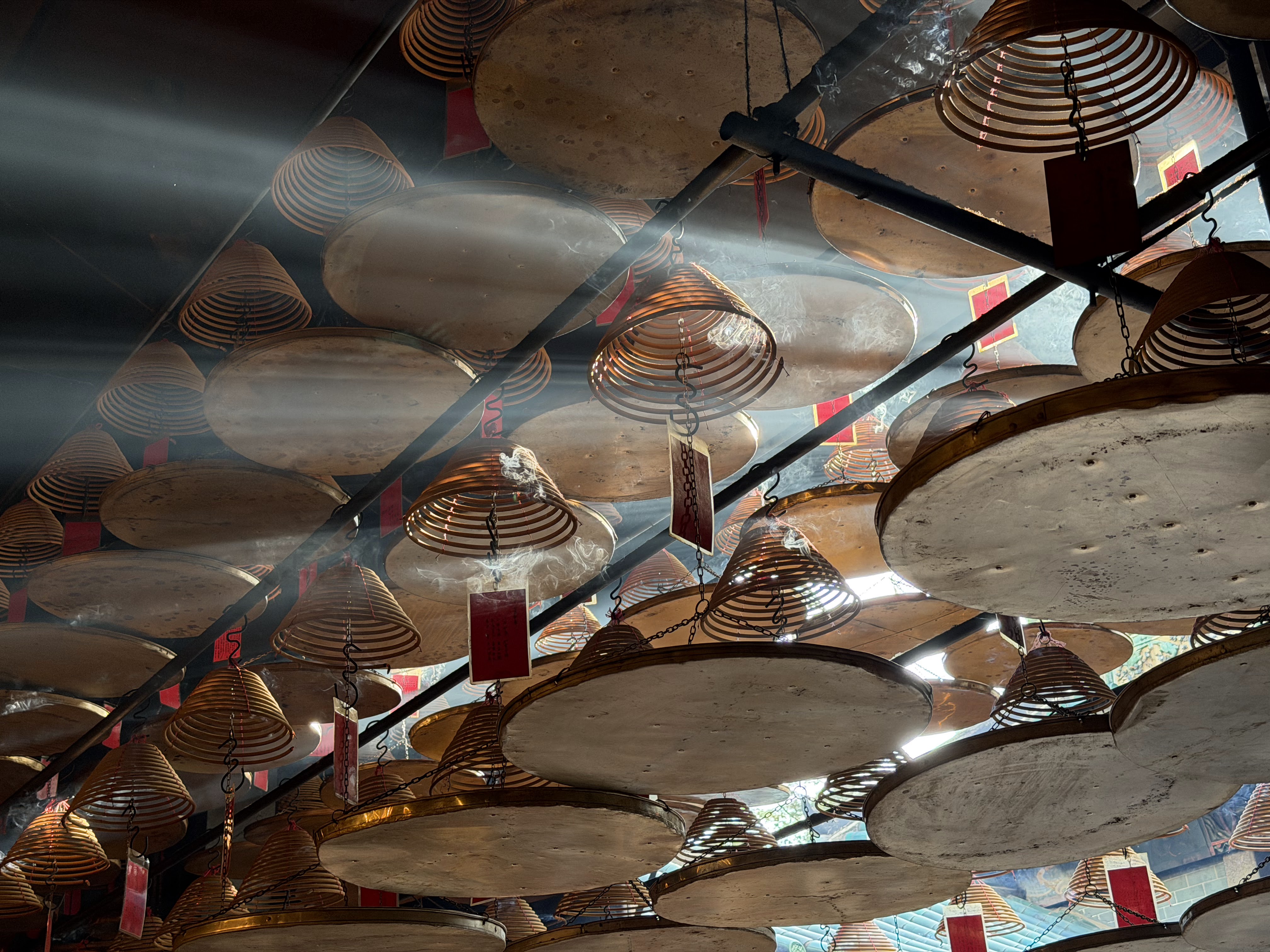
So I go back down towards Peak Tower and continue on Lugard Road Lookout. This flat path offers much more interesting panoramas. I follow it westward and descend towards Mid-Levels to explore Tai Ping Shan, with its more or less authentic antique shops around Cat Street and Hollywood Road. You’ll also find discreet temples like Pak Shing Temple. But above all, the superb Man Mo Temple, famous for its hanging incense coils.


I join the Mid-Levels escalator, the world’s longest outdoor covered escalator system. And the visit continues with Tai Kwun, a former police and prison complex converted into a cultural center. This must-see mixes galleries, courtyards, and colonial heritage.


The GPX track is available here1 (distance: 15.4 km, elevation gain: 595 m). I removed the part leading to the summit, which was uninteresting.
Evening in Wan Chai and Happy Valley
I continue exploring at night by crossing Hong Kong Park and its tower offering a viewpoint over the illuminated buildings. I then head to Happy Valley, famous for its racecourse. Races take place on Wednesday evenings and are worth a detour. Entry is free for foreigners with their passport.
I end with a long night walk in Wan Chai, passing by the Blue House, the impressive arch of the Legislative Council Complex, and the promenade along Victoria Harbour. The latter offers beautiful views of the Kowloon skyline before taking the ferry back.


DAY 2 – Lantau Island: great sporty crossing between temples, ridges, and sunset
From the fort to the Buddha
Late start to recover a bit from the previous day. I head to Tung Chung and visit Tung Chung Fort (free), a former Qing fortification built to fight pirates and defend the coast.
I continue on the Ngong Ping 360 Rescue Trail, a steep climb under the cable car cabins. It leads to the Tian Tan Buddha, one of the largest seated bronze Buddhas in the world, and Po Lin Monastery, founded in the early 20th century. The complex includes several richly decorated prayer halls and an impressive main hall.


The peaks of Lantau
I eat at the monastery’s vegetarian restaurant before continuing towards Lantau Peak then Sunset Peak. I reach them just in time for sunset. Unfortunately, the slightly overcast sky spoils the chances of seeing the end-of-day colors. Not being alone, I think the rest of the path should be fine to do at night. Indeed, the descent is without difficulty to Mui Wo (using a flashlight). From there, I should have taken a bus to go back.
However, on the map, a trail seemed to allow reaching Discovery Bay on foot in a similar time to the bus. This turned out to be a very bad idea! Indeed, the path progressively disappears, becomes barely visible. It turns into a real nighttime adventure punctuated by an impressive spider and an uncooperative wild boar. I finally arrive at my destination, safe and sound.


The GPX track is available here1 (distance: 24.4 km, elevation gain: 1,848 m). It includes the full day’s itinerary, except for the end of the route which was removed to save you from this misadventure.
DAY 3 – Kowloon: challenging ridges, museums, and skyline panoramas
Hike to Suicide Cliff
I head to northern Kowloon to start the day with the Suicide Cliff hike. This hike lives up to its name. Indeed, it begins with a very challenging climb on a sometimes poorly marked and particularly steep path. The route leads to the Kowloon Peak radio and television transmission station before continuing on a ridge path. The latter offers clear views on both sides, of the city and the surrounding hills, until reaching Lion Rock. I then descend towards Wong Tai Sin.
The GPX track is available here1 (distance: 10 km, elevation gain: 770 m, difficult path).


Urban walks and museums
A radical change of atmosphere after the ridges. The neighborhood offers fine examples of the dense, vertical architecture typical of Hong Kong, such as Plaza Roma. The Wong Tai Sin Temple, very busy, fully embraces its kitschy aesthetic and is worth a detour for its atmosphere.
I take the metro to Yau Ma Tei Wholesale Fruit Market, impressive for the impressive quality and almost unreal uniformity of the fruit. I then continue on foot south along Shanghai Street. Here you’ll find the Tin Hau Temple, bathed in dim light filtering through incense clouds, street vendors of sex toys, and the Yau Ma Tei Jade Hawker Bazaar.
I then head towards Temple Street, known for its night market, but it’s still too early and the atmosphere remains relatively calm. I then cross Kowloon Park to reach the Hong Kong Museum of Art (free), where I spend nearly an hour before closing. The museum is remarkable both for its collections and for the perspectives it offers on the Central skyline.


Evening in Tsim Sha Tsui and night visit to M+
I continue with a walk along the Avenue of Stars to Tsim Sha Tsui Waterfront Park, before detouring to the spectacular K11 MUSEA, a temple of window-shopping mixing contemporary art and luxury boutiques.
Back to Temple Street after nightfall. With lanterns lit, stalls, and street vendors, the atmosphere is completely transformed. I then glance at Hong Kong West Kowloon Station, whose monumental architecture is worth a look. I end the day at the M+ museum, open until 10 PM on Fridays. A must-see for contemporary art lovers, the museum is housed in a building designed by Herzog & de Meuron. Allow at least two hours for the exhibitions and don’t miss the rooftop spaces offering beautiful views of Central. I finally take the metro, passing under the luxurious ICC Tower, the tallest in Hong Kong, to close another very full day.


DAY 4 – Lamma Island, Aberdeen, and Stanley: fishing villages, historic port, and colonial heritage
Crossing Lamma Island
I start the day with a leisurely walk across Lamma Island, ideal for a slower pace after the previous days. From Yung Shue Wan Ferry Pier, I cross the island on foot, passing through fishing villages, some still partially floating, and more rural areas. Along the way, I discover the village of Sok Kwu Wan, before reaching Mo Tat Pier, from where I take the boat back.


The GPX track is available here1 (distance: 7.3 km, elevation gain: 180 m).
Aberdeen, the historic port
I then arrive at Aberdeen, a historic fishing port that was long the heart of the Tanka community, a community traditionally living on the water. Today, the contrast is striking between the huge residential buildings surrounding the port and the sometimes very rudimentary boats moored below. I walk along the Aberdeen promenade to observe the busy port activity, while locals play mahjong in the shade. I also venture into the boat repair workshops, quite rustic, before discovering the vast fish market. Having visited it in the mid-afternoon, it was already empty, which is probably just as well given how intense the atmosphere must be during peak activity.


I then take a sampan, a traditional boat, to cross the harbor to Ap Lei Chau and its Market and Cooked Food Market. The return is on foot across the bridge, which offers an overall view of the harbor and its tangle of towers and vessels.
Stanley, colonial heritage
I continue by bus to Stanley, a former British outpost turned quiet coastal village with a decidedly colonial atmosphere. I discover Blake Pier and Murray House, two historic buildings dismantled stone by stone in Central and rebuilt here.
My visit continues to Stanley Military Cemetery, a memorial dedicated notably to soldiers who fell during the Battle of Hong Kong and the Japanese occupation in World War II. The sober and moving site recalls the strategic role of Stanley, which also housed an internment camp during the conflict. I end the day watching the sunset at St Stephen’s Beach, before returning to Wan Chai a little earlier than the first day to explore the market, enjoy the urban atmosphere one last time, and head to the ferry terminal to close these 4 days in Hong Kong.


Practical tips for a successful 4 days in Hong Kong
Money
Bank cards (Visa and Mastercard mainly) are very widely accepted, including for transport, restaurants, and shops. However, it’s still useful to have some cash for certain taxis, markets, small local establishments, or more peripheral areas. I withdrew cash directly at the airport, with no withdrawal fees.
Budget
Expect around €50 per day, excluding accommodation, eating on the go and using only public transport.
Where to stay
For a first visit to Hong Kong in 4 days, I would recommend staying around Central or in southern Kowloon. These two areas are well connected and make getting around easy.
Recommended season
The best times to visit Hong Kong are from October to December and from March to April. These seasons offer ideal conditions to fully enjoy the hikes and urban visits.
- Autumn (October to December): ideal period with moderate temperatures, lower humidity, and excellent visibility. Conditions are perfect for hikes, long walking days, and panoramas from the peaks.
- Spring (March to April): similar climate, slightly more humid, with greener vegetation. Very pleasant for exploring the city and islands, even if views can sometimes be a bit less clear.
- Summer (May to September): intense heat and humidity, and risk of typhoons. This season is not well suited for hikes and long urban walks.
- Winter (January to February): mild temperatures but often cloudier and mistier, which can limit panoramas, especially from the Peak or Lantau ridges.
Transport
Metro and Octopus Card
Public transport is reliable, frequent, and well signposted in English. Google Maps works very well for planning routes in real-time. Taxis are relatively affordable, but having the address written down or pinned on your phone makes communication much easier.
Essential for getting around during your 4 days in Hong Kong, the Tourist Octopus Card, available on smartphone, allows you to seamlessly use the metro (MTR), buses, trams, and ferries, including connections to the islands. It’s slightly more expensive than the local Octopus, but the latter requires a Hong Kong phone number. Note that Octopus is also accepted for small daily payments: convenience stores, bakeries, markets, and even some restaurants.

For other travel inspirations in Asia, check out my guide to Taiwan by train.
1The GPX files shared here are for informational purposes only. They should not be considered an official guide or a recommendation to follow. Routes may contain errors, inaccessible areas, or be unsuitable depending on your conditions and equipment. Use them with caution and at your own risk.
Leave a Reply