
This travelogue offers a 14-day itinerary for discovering Taiwan by train. Completed in late November 2025, this route allows you to circle the island, alternating between major cities, countryside, mountains, and coastline, primarily using the rail network.
The recent political tensions between China and Taiwan strongly limit tourism from China, as Chinese citizens cannot visit the island. This situation reinforces the feeling of traveling off the beaten path, accentuated by the low presence of Western tourists. Thus, traveling around Taiwan by train offers a more authentic and unspoiled experience.
Following the April 2024 earthquake and the 2025 typhoons, several natural areas were partially or completely closed, including Taroko and some mountain trails. The itinerary was therefore adapted to make the most of the opportunities offered by the country.


Tour of Taiwan by train: itinerary overview
- DAY 0 & 1 – Taipei
- DAY 2 – Taichung & Tainan
- DAY 3 – Tainan
- DAY 4 – Fenqihu
- DAY 5 – Fenqihu & Kaohsiung
- DAY 6 – Kaohsiung
- DAY 7 – Kenting
- DAY 8 – Taitung & Chishang
- DAYS 9 to 12 – Taipei
- DAY 13 – Jiufen & Shifen
- DAY 14 – Taipei

- Access to Yushan (Jade Mountain)
- Budget
- Cash or cards
- EasyCard
- Bike and scooter rental
- Vegetarian food
- Navigation and transport
- Recommended season
Day-by-day itinerary for discovering Taiwan by train
DAY 0 & 1 – Beginning the journey through Taiwan by train: Taipei
First impressions
Apart from the iconic Taipei 101 tower and the recent tensions with China, I knew almost nothing about Taiwan before setting foot there. As soon as I arrived in Taipei, I found a vegetarian restaurant, an excellent start. While waiting for my friend, I opted for a quiet first day, taking time to recover from the journey.
Historical immersion
The next morning, after his night flight, we set out to explore the city. Heavy rain was pouring down on Taipei, but we still went to discover the Chiang Kai-shek Memorial Hall. This place pays homage to the former leader of the Kuomintang, a central and controversial figure in Taiwanese history.
To better understand the historical context: in February 1947, a popular uprising broke out in Taiwan against the Kuomintang administration, perceived as corrupt and authoritarian. This movement was violently suppressed, resulting in thousands of victims during the February 28 Massacre. Two years later, in 1949, Chiang Kai-shek, defeated by the communists in the Chinese Civil War, fled to Taiwan and established an authoritarian regime under martial law, marking the beginning of the White Terror. These traumas remain very present in contemporary Taiwanese society.
We then continued to the Lungshan Temple, one of the oldest temples in the city, where Buddhism, Taoism, and folk beliefs intertwine. We tried to visit the Bopiliao Historical Block, but the site was closed on Monday.
The afternoon ended in the lively Ximen district, with its bright neon signs and shops. As the rain didn’t let up, we went back to the hotel early. We decided to change the plan and head south the next day, hoping for more favorable weather.
With better weather, it would have been possible to visit more, but this calm start allowed us to begin without pressure. Besides, all these sites would be rediscovered during our second stay in Taipei.


DAY 2 – Traveling around Taiwan by train: from Taipei to Taichung and Tainan
We began this tour of Taiwan by train by leaving early for the station to head from Taipei to Taichung. The Taiwanese rail network is efficient, making the journey stress-free. We make a stop in this intermediate city to visit the National Taiwan Museum of Fine Arts.
The museum offers several high-quality temporary exhibitions, featuring both Taiwanese and international artists. It’s accessible by bus from the station in about thirty minutes.
At the end of the day, we take the train again to Tainan, where we settle in for two nights. The city is very pleasant in the evening. We stroll through Shennong Street, lined with old houses and lanterns, then pass by West Market before heading back.


DAY 3 – Tainan, the historical cradle of Taiwan
As the former capital of Taiwan, Tainan is considered the historical and cultural birthplace of the island. We walk along the river to the Eternal Golden Castle, a 19th-century fortification built to protect the south coast.
We then head to Fort Zeelandia, a remnant of the Dutch presence in the 17th century. This is where the Dutch East India Company established itself before being expelled by General Koxinga. Nearby, the Anping Tree House, an old abandoned warehouse gradually overtaken by banyan tree roots, offers a photogenic contrast between architecture and nature.
We then spend the afternoon on a long walking loop through the city’s many temples. The City God Temple and the Dongyue Temple reflect local folk beliefs. The Koxinga Shrine, dedicated to the historical figure, is my favorite.
We also pass by Lady Lin Shui Temple, the Confucius Temple (the only paid one), the God of War Temple, and the Tainan Grand Mazu Temple. This impressive density of temples earns Tainan its reputation as the spiritual capital of Taiwan.
To end the day, we go to the Wusheng Night Market, popular with locals and perfect for tasting local street food.


DAY 4 – By train to the mountains: Fenqihu
We then head back north. Ideally, it would have been more logical to swap the Tainan and Fenqihu stages to minimize travel time, but the weather decided otherwise. We leave Tainan early to reach Chiayi, the starting point for the mountains.
After several urban days, this change of scenery is welcome. From Chiayi, we board the famous Alishan Forest Railway, an old narrow-gauge logging train from the Japanese era. It winds slowly through tea plantations and mountain forests. Book your tickets in advance on the official website, especially on weekends.
The journey itself is part of the experience: slow pace, charmingly old-fashioned carriages, and the temperature dropping as altitude increases. We get off at Fenqihu, a peaceful little mountain village, an ideal stop before Alishan.
Hikes around Fenqihu
Upon arrival, we discover that many trails are closed due to damage from Typhoon Fung-Wong. We had hoped to hike the Fenqihu–Ruili Historic Trail, but a barrier blocks access from the start. We end up taking the picturesque Fenqi Trail, then a path leading up towards Dadongshan.
This improvised hike turns out to be an excellent surprise. The wooden boardwalks cross superb bamboo forests and, in places, open up to clear views of the surrounding mountains. On a clear day, you can even see Yu Shan (Jade Mountain), Taiwan’s highest peak at nearly 4,000 meters. The GPX track is available here1.


DAY 5 – From Fenqihu to Kaohsiung by train
Rather than continuing to Alishan, a very popular destination, we stay longer in Fenqihu to enjoy its tranquility. We go for a short walk on the Cedar Boardwalk Trail, a wooden boardwalk path, especially pleasant in the early morning. We are lucky enough to spot a group of Formosan rock macaques, the only noisy inhabitants of this silent forest. The GPX track is available here1.


Late in the morning, we head back down to Chiayi by bus. From Chiayi, we continue by train to Kaohsiung, a large port city in the south, which we reach in the mid-afternoon. The contrast is striking: after the quiet mountains, Kaohsiung welcomes us with a dynamic, colorful, and undeniably modern atmosphere.
Arrival in Kaohsiung
We check into the excellent Formosa Boulevard Garden Hotel (budget-friendly, clean, with free snacks and drinks) before heading out to explore the city. We start with the Dome of Light, a massive glass artwork in the metro station.
The visit continues by taking the metro to Gushan Ferry Pier, followed by a ferry to Cijin, a narrow barrier island bordering the port. We wander among its colorful houses, climb up to the Cijin Lighthouse and then to Qihou Fort, a military remnant built to defend the harbor entrance.
At the end of the day, we head down to the beach for a drink at the Cijin Sunset Bar, ideally located to watch the sun set over the sea and port infrastructure. We then take the ferry back to Kaohsiung and finish the evening around the old redeveloped docks turned into art galleries and cultural spaces. Walking across the Great Harbor Bridge, which pivots to let boats pass, perfectly concludes this action-packed day.


DAY 6 – Exploring Kaohsiung before taking the train to Kenting
We dedicate this day to exploring the northern outskirts of Kaohsiung. We start at Lotus Pond, a complex of temples and pavilions built around an artificial lake.
Don’t miss the Kaohsiung City Temple of Confucius, the monumental Statue of Xuantian God, the Spring and Autumn Pavilions, and the Dragon and Tiger Pagodas. The site is very popular with local visitors but remains interesting for observing religious practices and popular devotion.
The veteran villages of Zuoying
We pass through the park south of the lake (龜山登山步道) for a nice overview, then delve deeper into the Zuoying district, known for its former veteran villages such as Jiangye Village, Mingde Village, and the very photogenic Guomao Community, each with its own history and distinct architecture. The Zuoying Military Base Story Museum offers historical insight into the role of these villages and the life of military personnel and their families, although few explanations are in English. We would have also liked to visit the Farewell 886- Cultural Park of Taiwan Military Veteran Village, a museum we didn’t have time for. These clusters of modest houses were hastily built in the 1950s, and some still remain. Passing through on the weekend, we felt the neighborhood is very lively and distinct from the rest of the city due to its community feel.
The high hotel prices on Saturday night push us to move on, and we definitely leave feeling we didn’t have enough time. So we leave Kaohsiung in the early afternoon on the tourist shuttle towards Kenting, at the southern tip of Taiwan.
The evening ends with a stroll through the large Kenting Night Market, the best night market we had seen so far. Even the stinky tofu seemed less aggressive than in Taipei. We rest up to catch the bus the next morning towards Taitung.


DAY 7 – Kenting, the southern tip of Taiwan
We rent an electric scooter for half a day (several options available, we went here), a suitable means of transport for exploring the coast. This allows us to ride along the east coast to Longpan Park, a vast grassy plateau overlooking the Pacific Ocean. We ditch the scooter to scramble along the limestone cliffs plunging into the sea, offering spectacular panoramic views. The site is very exposed to the wind, which further enhances the feeling of being at the end of the world.
We then double back to the southernmost point of Taiwan (free entry) and Eluanbi Lighthouse. The park is photogenic and allows you to fully enjoy the coastal landscape. We pass by Chuanfan Rock on our way back towards town.
The Kenting National Forest Recreation Area is not accessible by electric scooter, and due to lack of time, we don’t go. We return the scooters and instead enjoy a swim at 小灣海水浴場 (Little Bay Beach), which has pay showers and a beach bar.
In the late afternoon, we take the bus to Fangliao, then the train to Taitung, where we opt for accommodation near the station to drop off our bags.


DAY 8 – Taitung and Chishang, key stages of the Taiwan by train tour
Morning in Taitung
We spend the morning exploring Taitung, particularly Taitung Forest Park and Taitung Seashore Park, which are best visited by bike due to their size, before passing through the Railway Art Village, which is not very interesting during the day.
We decide to leave Taitung sooner than planned to enjoy the afternoon in Chishang, which appealed to us more, especially since the weather forecast for the next day wasn’t very encouraging.
Falling in love with Chishang
As soon as we arrive in Chishang, we opt to rent simple bicycles (although some more extravagant options are available, as shown in the photos) and set off to discover the magnificent rice paddies, roughly following the small map provided by the rental shop. The agricultural landscapes, bathed in splendid light with the mountains in the background, offer a unique contemplative experience. This moment in Chishang is one of our trip’s highlights.


DAYS 9 to 12 – Return to Taipei by train
After one last morning stroll through the rice paddies, we take the train back to Taipei. We had considered a stop in Taroko National Park, but the previous year’s earthquake caused significant damage, and most of the park remains closed to the public.
DAY 9 – Northern Taipei
Under the bright sunshine, we rediscover the capital starting with the Datong district. First stop at the Taiwan New Cultural Movement Memorial Museum (free entry). The museum is housed in a former Japanese-era police station and detention center. The exhibitions, mainly in Chinese, trace the intellectual and political movements of the 1920s-1940s, a key period in the construction of modern Taiwanese identity. However, even without visiting the exhibitions, the architecture alone is worth a visit. The former detention center, designed on a panoptic plan, allowed a single guard to surveil several radially arranged cells. The whole place is striking for its rational efficiency and strangely chilling atmosphere. Next door, the former interrogation room, where methods including waterboarding were practiced, further reinforces this unsettling feeling.
We continue to the legendary Lin Hua Tai Tea, an institution founded in 1883. Here, no flashy packaging: tea is sold loose from large metal canisters.
The stroll continues on Dihua Street, perfect for finding souvenirs, traditional herbal shops, and fabrics (we didn’t check prices). At the end of the street, we reach the Dadaocheng Wharf Container Market for a drink by the river at sunset.
We end the day at Din Tai Fung, a Taiwanese chain famous worldwide for its xiao long bao, those emblematic soup dumplings prepared with almost surgical precision. You can even watch the chefs at work. Although prices are higher than elsewhere, the service is impeccable, and tea is free-flowing. Be prepared to queue: we waited an hour. Several vegetarian options are available. The evening winds down quietly in the neighborhood around Zhongshan.


DAY 10 – Urban hike and creative districts in Taipei
The day starts strong with the climb up Xiangshan, also known as Elephant Mountain. This short but steep hike offers one of the best viewpoints of Taipei 101 from every possible angle. Probably my favorite spot in the city. Instead of descending immediately, we continue towards other, much less crowded peaks that offer even more extensive views of the city, before descending further east. The GPX track is available here1.
We then head to the Xinyi commercial district, a sharp transition between nature and city. We continue to the Sun Yat-sen Memorial Hall, unfortunately closed during our visit, but still impressive from the outside for its proportions and monumental architecture. The walk continues to the Songshan Culture and Creative Park, a former industrial complex converted into a cultural space with shops, galleries, and cafes, right next to the Taipei Dome.
Next, we stop by Chuan-Der Buddhist Art, an Aladdin’s cave for lovers of Buddhist art, before wandering through the trendy Dinghao neighborhood. In the evening, we head back to Zhongshan, where we are staying, to eat at 禾苗素食, an excellent vegetarian restaurant that ends the day on a very high note.


DAY 11 – Biking through Taipei’s lesser-known neighborhoods
We start the day biking through the university district, a pleasant way to discover a more local Taipei. Next, we head to the artist village of Treasure Hill, interesting on paper but quite disappointing that day, as most spaces were closed.
We then cycle along the river through Guting Riverside Park, cross through Hakka Culture Theme Park, also a bit below expectations, before reaching Daan Forest Park, where we park the bikes to continue on foot.
A quick pass by the Taipei Grand Mosque, not particularly interesting but apparently worth a detour on Friday afternoons to observe the local Muslim community. We then head to Yongkang Street, famous for its desserts, and try the famous shaved mango. It’s a huge bowl of shaved ice topped with fresh mango and condensed milk. As delicious as it is ambitious. Even the two of us struggled to finish it.
We then return to the Chiang Kai-shek Memorial Hall, under a better sky and just in time for the changing of the guard (hourly), before visiting the 228 Memorial Museum. The museum delves deeply into the February 28, 1947 massacre, the historical facts of which are mentioned in DAY 1 section. A smartphone app provides access to an English audio guide.
At dusk, we cross the botanical garden to reach Bo-Pi-Liao Street, open this time, before finishing the evening at Ximen with its neon signs, passing by the Presidential Office Building, nicely illuminated.


DAY 12 – Last museums in Taipei and departure for Jiufen
The morning is dedicated to museums: the National Taiwan Museum and the Land Bank Exhibition Hall which hosts the Natural History Museum, whose ticket is combined. Both are located around 228 Memorial Park.
As in Kaohsiung, the weekend drives hotel prices up in Taipei. So we leave in the early afternoon for Jiufen, which allows us to climb Mount Keelung and enjoy the views at the end of the day. Jiufen, emptied of the tourist crowds in the evening, regains its calm.


DAY 13 – Jiufen and Shifen, last stops before the end of the journey through Taiwan by train
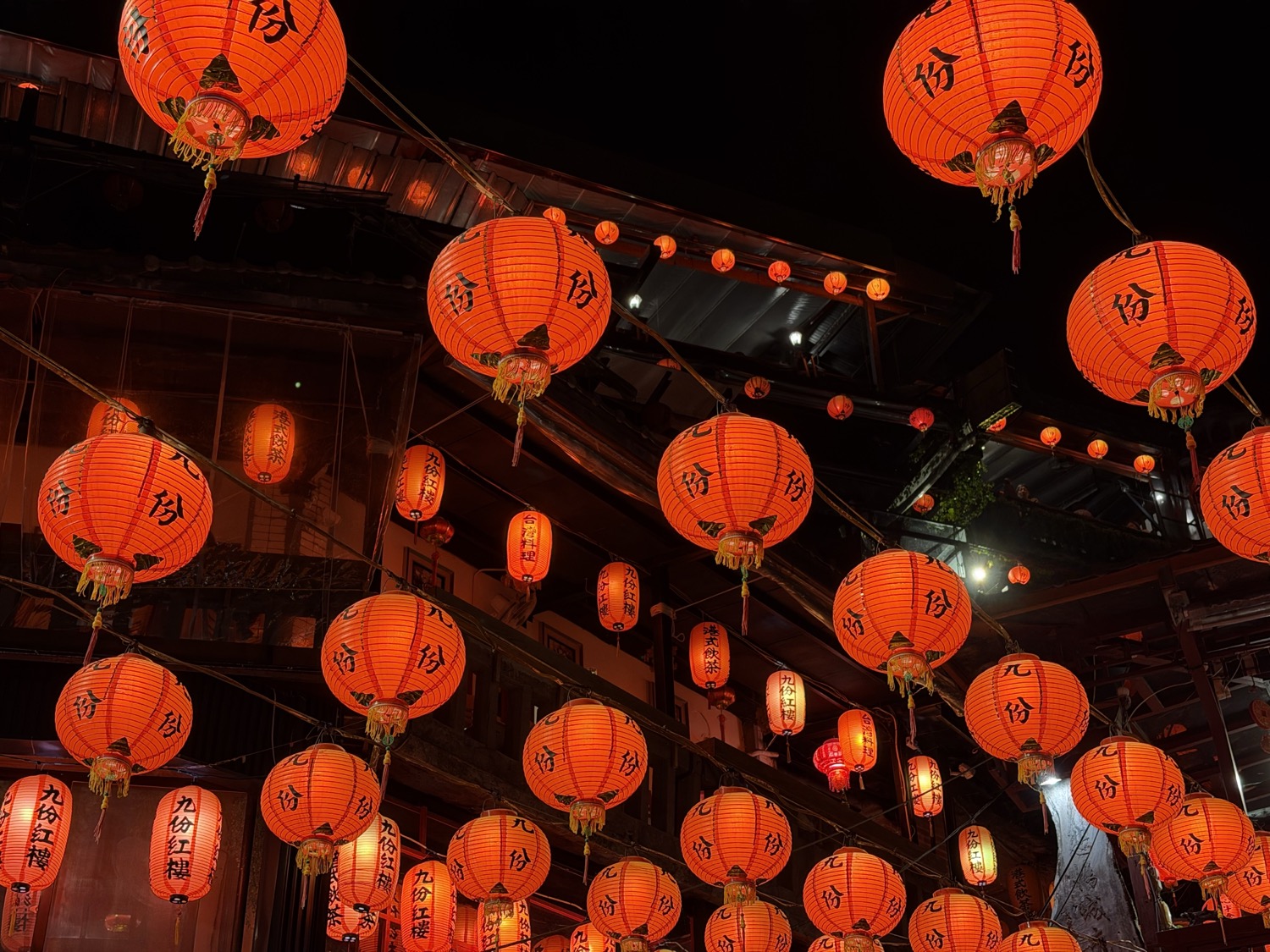
Jiufen charms with its lively old street lined with shops offering local specialties, all under the glow of lanterns. Shifen attracts visitors with its waterfall and the tradition of flying lanterns launched from its old street, on which people write their wishes before letting them soar. Given the number of squashed lanterns, I doubt the ecological aspect of the practice.
With the train to Shifen out of service following a typhoon, we have to take a taxi from Ruifang, which complicates logistics and limits the day’s activities.


DAY 14 – Last day in Taipei
Back in Taipei in the morning. We drop our bags near the airport express metro and use this last day for some shopping and to visit the small Museum of Contemporary Art. Nice, but expensive for its size.

Practical tips
Access to Yushan (Jade Mountain)
Access to Yushan (Jade Mountain) without a guide is via a lottery system, which must be applied for well in advance.
Budget
Around €50 per day per person (for two people) covering:
- Train tickets for traveling around Taiwan,
- Double rooms with private bathroom,
- Meals in simple restaurants or convenience stores,
- Entry fees to sites,
- Occasional bike or scooter rentals.
In Kaohsiung and Taipei, weekends are very busy and prices can skyrocket. To keep costs down, it’s better to avoid these cities during those periods.
Cash or cards
Taiwan still relies heavily on cash. ATMs rarely charge commissions. With a card like Wise or Revolut, withdrawing as you go works very well.
EasyCard
The EasyCard can be used to pay for almost all transport across the island, and even in supermarkets. Buy it at some metro stations or at convenience stores like 7-Eleven and FamilyMart (slightly more expensive but with unique designs). Recharging is only possible with cash. It’s possible to travel without one, but it definitely simplifies life, and in some cases, offers cheaper fares (e.g., the tourist shuttle to Kenting). We ended up spending our remaining balance at a 7-Eleven before leaving.
Bike and scooter rental
YouBikes are available in almost every city. Via the app, the Single Rental option (at the bottom of the login page) allows you to rent without a Taiwanese phone number, with a deposit of 3000 NTD refunded at the end of the rental period. It’s also possible to rent electric scooters without a license, but they have limited range and restricted access to certain roads. For regular scooters, an international driver’s license is required.
Vegetarian food
Vegetarian options are plentiful, including buffets where you pay by weight, such as Minder Vegetarian QSquare hidden on the third basement level of the shopping mall next to Taipei Main Station. In Taipei, we particularly enjoyed 禾苗素食 and 妙觀音素食-雙連錦西店.
Navigation and transport
The train network is efficient. I mainly used the HSR (High Speed Rail) and regional trains, supplemented by a few buses and metros. Book tickets on Taiwan Railways and Taiwan High Speed Rail. Outside of peak season, we almost never booked in advance, but had to take a later train once or twice.
Google Maps gives a good idea of routes, but transport schedules are rarely up to date. We used it as a base before checking exact times on official websites. Double-check your arrival station: HSR stations are often located far from city centers. It can be more practical to take a slower train that arrives closer to the center. Also, buses on expressways sometimes refuse passengers if the bus is full. In some cases, it’s possible to book tickets in advance. Ask locals for the best way to reach your destination.
Recommended season
The best seasons are spring (March to May) and autumn (October to November). These periods offer the best conditions for a trip to Taiwan by train.
- Spring (March to May): pleasant temperatures, lush vegetation, and occasional rain showers.
- Autumn (October to November): mild and mostly dry climate, often clear skies, ideal for hikes and sightseeing.
- Summer (June to September): hot and very humid, rainy season, high risk of typhoons from July to October.
- Winter (December to February): mild in the south, cooler and wetter in the north, especially in Taipei.
1The GPX files shared here are for informational purposes only. They should not be considered an official guide or a recommendation to follow. Routes may contain errors, inaccessible areas, or be unsuitable depending on your conditions and equipment. Use them with caution and at your own risk.
Leave a Reply