
In northern Morocco, the proximity to Spain is particularly noticeable. The region blends Moroccan and Andalusian cultures. It also shows colonial architectural influences. Spanish is also more present there. Tangier, Tetouan and Chefchaouen, which you will discover on this itinerary, are the most representative cities of this crossroads.
This Tangier Tetouan Chefchaouen itinerary lets you discover Tangier, Tetouan and Chefchaouen in 2 to 3 days. However, I recommend allowing 4 to 5 days to fully enjoy each place. You will also have time to explore the surroundings of Tetouan and Chefchaouen, especially the Moroccan Rif. This mountain range has several beautiful hikes.


Tangier Tetouan Chefchaouen itinerary: overview
https://goo.gl/maps/MoDx9hNF56RxLD5y5
Tangier: an inspiring city at the gates of Europe
Located only about thirty kilometers from the Spanish coast, Tangier overlooks the Mediterranean. Its relief offers several sea panoramas in the city center. It is easy to understand why artists such as Henri Matisse, Yves Saint-Laurent and the Rolling Stones made their home there.

The medina, heart of the city
The heart of Tangier lies in its medina. This maze of sloping alleys is ideal for soaking up the city’s atmosphere.
To discover it, as everywhere in Morocco, the best thing is to get lost in it. You will thus discover its secrets. You will probably end up back at a place you have already crossed.
What to visit in the Tangier medina?
If, however, you are short on time, you can head directly to some of the places of interest I recommend in the list below:
- Le Petit Socco: a small central square in the medina where it is pleasant to drink a mint tea while watching passers-by.
- Le Grand Socco or Place du 9 Avril 1947: located just outside the medina, it overlooks a market whose fish market is worth a detour. For a drink, Cinema Rif is a pleasant spot. This cinema regularly organizes interesting film series.
- The Dar Niaba museum reopened in late 2022. Located between Petit Socco and Grand Socco, it occupies a beautifully restored colonial mansion. It traces the history of Tangier and its special status. It also has a small collection of paintings.
- Jewish cemetery: this cemetery reflects the size of the Jewish community that lived in Tangier.
- The American Legation Museum: located in a beautiful mansion, it traces relations between the United States of America and Morocco.
- Concept stores: Tangier is full of artisans who use Moroccan craftsmanship to create new products. You will find clothing, furniture, artworks, tableware and cosmetics in particular. Several shops are on Rue de la Kasbah, including Las Chicas, which also has a rooftop café.
- Fendak Dar D’bagh: this former fondouk, once used by merchants on the trade routes of the Maghreb and the Middle East, has been renovated into a small local produce market and café.

The Tangier kasbah
The kasbah is the highest point of the medina. Its dazzling white walls, bougainvillea and small trendy restaurants make it an unmissable stop.


Coming from outside the medina, access is via Bab Kasbah. This imposing gate leads to a square surrounded by thick walls. There you will find Morocco Club, a trendy restaurant-bar.
A small museum dedicated to Ibn Battuta is also there. Ibn Battuta, although less known in Europe, was one of the greatest explorers of his time. He was originally from Tangier. In the 14th century, he traveled the equivalent of 44 contemporary countries. His tomb is also in Tangier, but it is not of great interest.
Not far from this square is the small Galerie Conil. Its manager will be happy to explain the story of each artist without any pressure to buy.

Continuing along one of the alleys, you will reach the kasbah square. Around it are Bab Al Bahr, opening onto the Mediterranean. Several restaurants also offer a view over the city. The kasbah museum is also here.
The ticket also allows you to visit the Museum of Mediterranean Cultures, housed in a very beautiful building. A contemporary art space completes the visit.
Phoenician tombs and Café Hafa
From Bab Al Bahr, you can take the path heading left. It leads outside the medina and to the Phoenician tombs, an ancient necropolis that mainly preserves cavities carved into the rocks. Their location above the Mediterranean remains remarkable, however. Not far away is the popular Café Hafa. This place is a true institution for breakfast or tea.
Cap Spartel, Rmilat Park and botanical garden
With a little more time, you can leave Tangier. The area west of the city is then worth exploring.
Rmilat Park, located between Tangier and Cap Spartel, offers beautiful views of the Mediterranean. Its vegetation is typical of the region.
Donabo Gardens, a little further toward Cap Spartel, also deserve a stop. There you can discover different plants grouped by theme. It is also possible to have lunch facing the Mediterranean.
Cap Spartel lies at the meeting point of the Mediterranean and the Atlantic Ocean. In my opinion, it is not of great interest in itself. However, the promenade south is pleasant and well laid out. It leads to several small cafés before reaching the beach and the Caves of Hercules.


Restaurants in Tangier
The choice of restaurants in Tangier is vast and reflects the city’s position at the gates of Europe. For most places, I recommend booking in advance.
- Tangerino €€/€€€ – Delicious and reliable. Varied menu. Alcohol available.
- Villa O Saveurs and Gusto e Sapore €€/€€€ – Very good French and Italian restaurants in the same place. Alcohol available.
- Morocco Club €€/€€€ – For a drink at the piano bar. Alcohol available.
- Kebdani €/€€ – Traditional Moroccan revisited with great finesse.
- Salon Bleu and Macondo €€ – Two rooftops in the kasbah, pleasant for their views.
- Café Hafa € – A popular haunt of Tangier residents, especially on weekends. There you can enjoy tea or a bissara, a thick soup of split peas or broad beans, for a very modest price.
- Saveur de Poisson €€ – One of the best fish restaurants.
- Donabo Gardens €€ – Fresh produce grown on site. View of the Mediterranean.
- Le Mirage €€€ – Sunset over the Atlantic and cocktails. Dress code enforced. Alcohol available.
Tetouan: a white medina off the beaten path
Often overlooked by travelers who focus on Tangier and Chefchaouen, Tetouan deserves a stop on this itinerary. Its medina lets you discover a quieter city, away from the main tourist circuits.
Its narrow alleys lined with white houses give it a peaceful, bright atmosphere. While strolling through the medina, you will very likely come across several artisans going about their ancestral occupations. This atmosphere gives the city an authenticity that is increasingly rare in Morocco.
The Jewish cemetery, with its 6 hectares and 10,000 tombs, is the largest in Morocco. Some tombs date from before 1492, when the Spanish expelled the Jews from Tetouan. Beyond its historical interest, the walk to the cemetery offers beautiful views of Tetouan and the surrounding mountains.

The coast around Tetouan
Tetouan stretches to the Mediterranean coast. Several seaside resorts there are very busy during the summer months. Martil, Mdiq and Marina Smir are close to Tetouan. In my opinion, they are mainly of interest to families. They suit those looking for a beach holiday without fearing crowds.
To enjoy views of the Mediterranean, Cabo Negro is a good option. Nature there remains preserved and it is possible to walk around.
To discover the Mediterranean coast, see my article devoted to this part of Morocco: Northern Morocco road trip: itinerary along the Mediterranean coast. There I detail the region’s cliffs, coves and Iberian bastions.
Chefchaouen: the blue pearl of the Rif
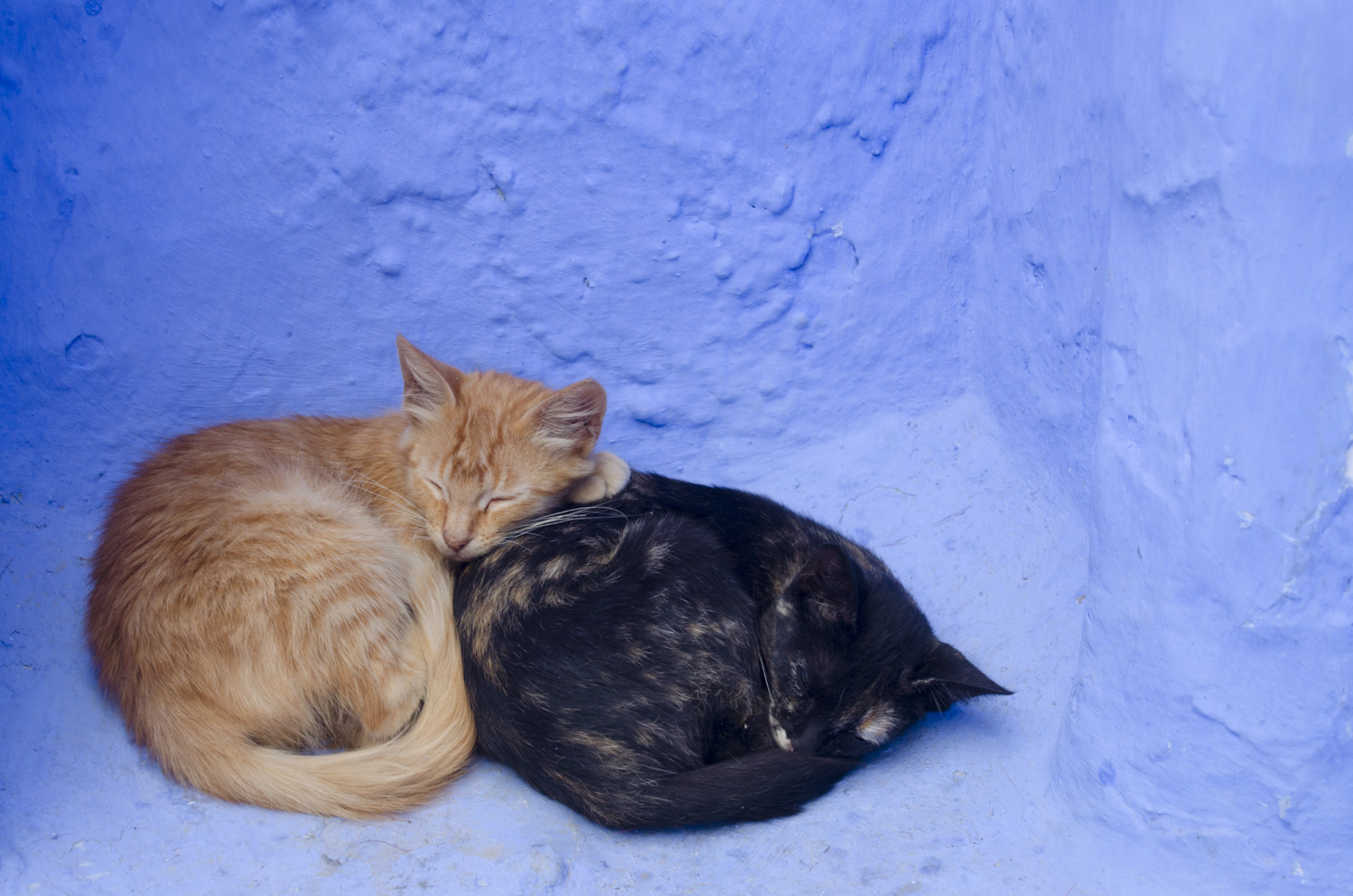
Nicknamed the Moroccan sapphire, this small town is famous for its blue medina backed by the mountain. It will delight photography lovers as well as hiking enthusiasts. It is a central stop on this Tangier Tetouan Chefchaouen itinerary, and provides access to Akchour.


Why is Chefchaouen blue?
The Jewish and Muslim town was once forbidden to Christians, on pain of death. This situation ended when Spain invaded the town in 1920. The origin of the blue that makes its medina distinctive is unclear. This color is said to have been introduced between the 15th century and 1930 (that’s vague!). Several hypotheses are put forward:
- It is the color representing, in the Jewish religion, the sky and, at the same time, paradise;
- It would help keep mosquitoes away;
- It would help keep things cool in summer;
- It would represent the Ras-El-Ma water source.
In any case, the continuous renewal of the blue paint now has a mainly aesthetic purpose. It serves in particular to attract tourists.
What to do in Chefchaouen?
As with Tangier and Tetouan, the best way to discover the small Chefchaouen medina is to venture into the alleys. You can simply get lost there. However, you will tend to always end up back at the central square Uta el Hamman.
This square takes its name from pigeons. They were attracted by the grain market held here until the 1970s. Around the square are the medina’s main mosque and its octagonal tower. The kasbah can also be visited.


Several restaurants in Chefchaouen are concentrated on the square. Some have terraces overlooking the town. However, I instead recommend the restaurant Asaada. It is slightly away from the crowds and remains inexpensive.
To enjoy a panoramic view of Chefchaouen, head to Bouzafar Mosque, located 1.5 km from the town. A small path visible on maps.me starts from Ras-El-Ma. The light is magnificent at sunrise and sunset. As the spot is well known, however, expect to encounter many people.


The view from the cemetery below is just as beautiful. Above all, it lets you get a little away from the selfie sticks.
Akchour: the turquoise-water gorges
Famous for its turquoise waters, large waterfall, natural bridge and monkeys, Akchour is a victim of its own success, especially in summer. Hordes of tourists are particularly visible around the parking area. However, the site is large enough to find quiet corners by heading deeper into the gorges.


Large waterfall or God’s Bridge?
The route to take varies depending on the season. Rain affects the flow of the large waterfall, which is the site’s main attraction. It is therefore better to ask at the start to avoid arriving at a dried-up waterfall (even if the walk is still nice).
The track available on maps.me starts from the parking area. After a few hundred meters, the path splits in two. If there is enough water, the left path leads to the large waterfall after 6 km. So allow 12 km round trip.
However, it usually dries up in early summer. It is then better to take the right path for 1.7 km. Allow 3.4 km round trip to reach God’s Bridge. It is the remains of an ancient cave, of which a natural arch still survives.


From the bridge, the more adventurous can continue. The route alternates walking and swimming and allows you to find more secluded spots. The water is cool, even downright cold. A hot day is therefore preferable.
Along the paths, you will find natural pools. It is possible to swim and jump in them. Small restaurants also offer tagines and tea that you can enjoy with your feet in the water.
Practical tips for the Akchour walk
The path does not present major technical difficulties. However, take good shoes with grip that can get wet. They are recommended if you continue past God’s Bridge. Also avoid taking equipment that is sensitive to moisture. If you do, protect it in a waterproof pouch.
To get to Akchour, you need to drive or take a shared grand taxi. These leave from outside the Chefchaouen medina. The drive takes about 45 minutes and offers beautiful views of the Rif.
Depending on the season, you may also see the region’s many cannabis plantations. Despite being illegal, some are not hidden.

Hike from Chefchaouen to Akchour
For hiking enthusiasts, this crossing takes a day and a half. It links Chefchaouen to Akchour and gives a good overview of Talassemtane National Park. It is a more athletic extension of this Tangier Tetouan Chefchaouen itinerary.
Day 1: Chefchaouen – Afeska
The first day mainly follows a track between Chefchaouen and Afeska. It is 18 km, with 1,200 m of positive elevation gain. Also allow 600 m of negative elevation gain. The path crosses several cannabis plantations, the region’s economic engine.
The illegal cannabis trade creates an unstable security context. It is therefore inadvisable to pick anything. Farmers may chase after you. Even if the track is available on maps.me, I strongly recommend taking a guide to avoid any mishap. They can also take you along some alternative paths instead of the track.
Unfortunately, our guide was not amazing. I therefore prefer to let you search for yourself for this part.
We did this hike at the end of September, during the harvest period. Farmers then punctuated the hike by beating the harvested bundles to extract the resin. It is commonly called hashish or shit. It is then mixed with tobacco to prepare kif.


We spent the night at the Afeska guesthouse, perfectly integrated into the local economy and quite decent.
Day 2: Afeska – Akchour
On the second day, we left early. We covered the remaining 12 km to Akchour, with 860 m of negative elevation gain. The path follows the valley lined with plantations. It then reaches God’s Bridge, before joining the walk described above.


Practical information for this Tangier Tetouan Chefchaouen itinerary
When to go to northern Morocco?
Although this itinerary can generally be done year-round, the best period to visit Tangier, Tetouan and Chefchaouen is between April, May, June, September and October. Temperatures are then more moderate. The risk of rain remains low. The tourist crowds have also thinned somewhat.
How to get around between Tangier, Tetouan and Chefchaouen?
There are good bus connections between Tangier, Tetouan and Chefchaouen. The company CTM in particular lets you buy tickets online via its app. For Akchour, several shared grand taxis leave from Chefchaouen and Tetouan.
To continue your trip in Morocco
If you have time to explore other regions, also discover my other Morocco guides. After living there for six years, I share all my tips to keep discovering the kingdom, between road trips, hikes in mountain ranges, magnificent beaches and city visits.
From the north, I especially recommend a trip to Rabat and Marrakech, which are connected to Tangier by train, before heading to the southern mountains. Here are a few articles that might interest you:
- What to do in Rabat, Morocco’s cultural capital?
- What to do in Marrakech: from the medina to the mountains
- 15-Day road trip in Morocco: between mountains and Sahara
- Anti-Atlas road trip in Morocco: 9-day itinerary
Find the complete list of my articles devoted to Morocco on this page: Morocco.
Leave a Reply