
Vibrant and chaotic, Marrakech holds a multitude of secrets that will leave no one indifferent. Some love it, others flee it. Yet, given the city’s many facets and the region’s diversity, it is all about finding the right balance. In this guide, I show you what to do in Marrakech and around it, from the medina to the first foothills of the Atlas, with a few practical tips to make the most of your stay.
I lived in Morocco for 6 years and had the opportunity to visit Marrakech several times during my years in the country. This experience allowed me to discover the city beyond the main tourist attractions and to get a better feel for its different neighbourhoods and surroundings. In this article, I share my personal advice on what to do in Marrakech, how to avoid some unpleasant surprises and how to make the most of the many day trips and excursions around Marrakech.


Overview
What to do in Marrakech: visiting the medina
The medina of Marrakech concentrates many of the must-sees in Marrakech. It is also the best place to feel the city’s special atmosphere. Most visits are done on foot, taking time to get lost in the alleys, observe the crafts and make a few detours away from the main tourist routes.
Jemaa el-Fna and the Koutoubia
Jemaa el-Fna square, whose name means “the mosque of the dead”, is the nerve center of the city. Located at the junction between the medina and the Hivernage district, it is one of the best access points to the old town. Unlike many tourist sites, the square is lived more than visited.
During the day, it is not necessarily of great interest, apart from its central location. In the late afternoon, however, sit on one of the panoramic terraces of the neighboring rooftops, such as Café de France or Café Argana, to drink tea at sunset. You will then gradually see the square come alive. After nightfall, its atmosphere comes into its own with snake charmers, storytellers, grilled food and juice sellers.

Not far from Jemaa el-Fna is the Koutoubia Mosque. Standing 77 meters high, it is an emblematic landmark of Marrakech and deserves a quick stop, especially if you then continue to the Menara gardens.
Souks, alleys and crafts in the medina
Do not hesitate to get lost in the alleys to discover the surprises this maze can offer. It is probably one of the best ways to visit Marrakech without trying to see everything at a rushed pace.
The spice souk, located near Jemaa el-Fna, is a square lined with a multitude of spice shops. In the center, vendors also offer basketry, pottery and all kinds of products. Some particularly polished stalls are clearly aimed at tourists.


However, do not hesitate to enter one of them: the vendor will often happily show you the cosmetics, “natural” remedies and spices he has. Buy a small something to thank him if you wish, but avoid doing your main shopping there, as you risk paying a high price. If the vendor starts grinding spices or preparing something for you, be clear about what you intend to buy. In any case, there is no obligation to buy (see the Marrakech scams section).
Palaces and monuments to see in Marrakech
Marrakech’s various paid tourist sites suffer from the city’s popularity. Prices have risen sharply in recent years for non-residents, and rates are not always proportional to the content. A large, well-maintained site and a smaller one left almost abandoned can sometimes cost the same. I therefore recommend doing your research before choosing the places to visit.
Several buildings offer magnificent examples of Moroccan craftsmanship. Among my favorites are:
- The Bahia Palace, dating from the late 19th century, particularly vast and offering a beautiful showcase of the diversity of Moroccan craftsmanship;
- The El Badiî Palace is now largely in ruins, but its dimensions still allow one to imagine the splendor of this former Saadian palace. Built at the end of the 16th century by Sultan Ahmed al-Mansour, it is organized around a huge central basin surrounded by gardens and pavilions. Less richly decorated than the Bahia Palace, it is mainly worth a detour for its monumental ruins.
- Dar El Bacha / Glaoui (Museum of Confluences), the house of the Glaoui, governor during precolonial Morocco, dating from the early 20th century. The architecture blends several influences with Moroccan craftsmanship. The palace also contains a small café straight out of a Wes Anderson film. For small budgets, it is possible to access it for 10 dirhams, even if the wait for a table can be long. This access allows you to see a beautiful part of the palace.


- Ali Ben Youssef Madrasa, former Quranic school fully renovated between 2017 and 2022. It offers an impressive example of the level of detail of local craftsmanship. As it is on tour operators’ radar, it is better to go early in the day to avoid tour buses;
- Saadian Tombs, a small, beautifully decorated cemetery whose price may seem high given the size of the site.


Museums, gardens and lesser-known places
- Boucharouite Museum: this small museum takes its name from rugs made from worn clothes cut into strips. Initially intended to become a hotel, this small house displays several rugs along with their stories. Located off the beaten track, it is a small haven of peace;
- La Mamounia: this luxury hotel will paradoxically also suit low-budget travelers. With an appropriate dress code, it is generally possible to visit the palace for free. The complex houses several small lounges, pavilions and a large garden;
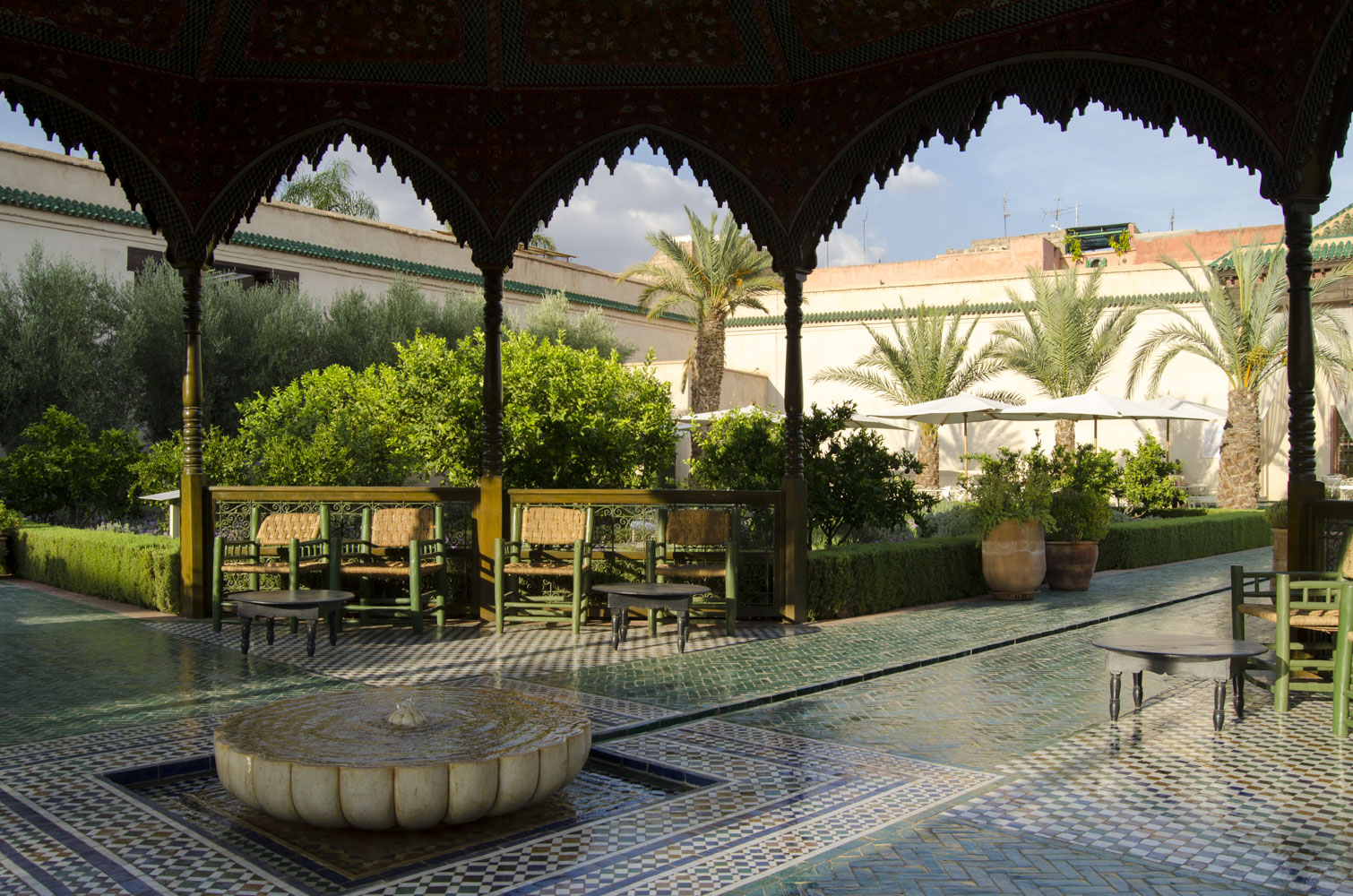
- Le Jardin Secret: a very pretty garden with a central pavilion that can be visited quickly, but whose price is extremely high compared to its content.

If you arrive in the tannery district, you will probably be approached to visit the tanneries. The approach can sometimes seem so natural that it feels like kindness. However, if you agree to follow someone, know that they are generally touts looking to bring you to a partner merchant’s shop in order to earn a commission. What you visit will not resemble the postcard tanneries of Fez. If in doubt, refer to the Marrakech scams section.


Marrakech’s popularity has also attracted many artists and craftspeople, who have created a series of concept stores, particularly around the large Le 14 complex. These shops blend Moroccan craftsmanship with European tastes, sometimes in a decor close to that of luxury boutiques. They are pleasant for window-shopping; however, expect to pay a high price to buy certain items.
What to do around the medina of Marrakech
What to do in Marrakech should not be limited to the medina. A few kilometers away, other districts and gardens reveal a more modern or peaceful side of the city.
Majorelle Garden and Yves Saint Laurent Museum
The Majorelle Garden, known for its eponymous blue, was created in 1931 by Jacques Majorelle. After being abandoned for several years, it was bought, restored and completed by Pierre Bergé and Yves Saint Laurent.
The garden is now a victim of its success, with a high entry ticket and many visitors. To avoid the crowds, come at opening. It is also possible to buy your ticket in advance online. A combined ticket provides access to the Berber Arts Museum and the Yves Saint Laurent Museum.
Adjacent to the garden, the Yves Saint Laurent Museum is a small architectural gem blending brick and tinted glass. The exhibition devoted to YSL is very condensed, but high quality.


Guéliz and the Menara Gardens
Located not far from the Majorelle Garden, Guéliz is Marrakech’s modern district. It has several trendy restaurants, art galleries and fashionable shops. It is a different atmosphere from the medina and a good way to vary your discoveries.
Continuing south, the Menara Gardens offer an escape from the buzz of the city. You can stroll through a peaceful little olive grove or sit around the central basin. On clear days, it is possible to glimpse the Atlas Mountains.

What to do around Marrakech?
The city is an excellent starting point for discovering its region. In its immediate surroundings, a few cultural sites and places to relax are easily accessible. Further away, day trips allow you to reach the Ourika Valley, the High Atlas and several mountain valleys.
In the outskirts of Marrakech
The Beldi Country Club, located 10 km from the center, is a hotel complex organized around a traditional hand-blown glass factory. You could watch the artisans at work, but unfortunately they have moved the factory a little further away. However, it is still possible to buy their work at more than reasonable prices. The complex also includes several craft shops (very expensive), a restaurant and a spa. It is possible to spend the day there and enjoy the many pools spread throughout the gardens by paying a day pass. I recommend calling to book.

The Al Maaden Museum of Contemporary African Art (MACAAL), located about 5 km from the center in the Al Maden golf course, is also worth a detour. If you go, the golf restaurant is pleasant for a drink with an open view of the Atlas Mountains.
The André Heller Garden / ANIMA blends nature and modern art with great taste. Located about thirty kilometers south of Marrakech, on the Ourika road, it is possible to combine this visit with a day outdoors in the Ourika Valley.


The Water Museum, located at the start of the road to Casablanca, offers a complete and very well-presented exhibition. It begins with the molecular basis of water, explains its current use in Morocco and ends with the challenges the country faces today. Allow easily two hours for the visit.
Day trips around Marrakech in the High Atlas
To go further, Marrakech and the High Atlas can easily be combined during the same stay. Several valleys and natural sites are accessible for the day by public transport or private taxi, although a car offers more freedom to explore the surroundings.
Ourika Valley
The Ourika Valley, located about fifty kilometers south of Marrakech, stretches over more than twenty kilometers. It is one of the easiest accesses to the foot of the High Atlas. Several hikes start from there. The most popular is the Seven Waterfalls hike, starting from Sti Fadma.
The path is steep, but well marked, despite the many guide offers in the village. This route is also visible on Maps.me. For hiking enthusiasts, note however that the place is heavily exploited and may prove disappointing compared to the many other hiking possibilities in the region.
The path starts in an area overrun with shops and cafés. After this first part, the route offers beautiful views of the waterfalls, and the higher you go, the fewer people there will be. Start early to avoid the crowds. Allow about an hour to reach the last waterfall, from which you will have to turn back. At the café with a view of the tiered waterfalls, another trail allows you to slightly extend the loop.
Finally, by moving away from Sti Fadma, for example toward the village of Amlougui, where cherries are grown, it is possible to walk in the surroundings away from the crowds. You will notably find this route on Wikiloc.
The valley also has a wide range of hotels. For those seeking high-end accommodation, Kasbah Bab Ourika is one of the exceptional places in the region.


Lalla Takerkoust and its lake
The lake created by the Lalla Takerkoust dam has created a center around which several hotel establishments have gathered. It is a good base for exploring the region or simply relaxing for a weekend. The guest farm Jnane Tihihit, run by Belgians, is perfect for disconnecting.
Ouirgane and Tizi n’Test
The Ouirgane dam has also attracted many hotel establishments. Unlike Lalla Takerkoust, Ouirgane is located in the High Atlas and several hikes are possible in the area.
Located at the start of the Tizi n’Test pass road, Ouirgane is a good stop for those who wish to cross between the Marrakech plain and the Taroudant plain. An itinerary crossing the Anti-Atlas and ending with this road is available here: Anti-Atlas & Souss-Massa.
Terres d’Amanar and Imlil
The Terres d’Amanar complex allows you to practice several outdoor activities, including treetop adventure courses for all levels, mountain biking and hiking. It is also possible to stay there.
Imlil is probably the most easily accessible point from Marrakech for hiking enthusiasts. This large village is located at the foot of the Jbel Toubkal National Park, whose summit rises to 4,167 meters. Toubkal is the highest peak in North Africa and therefore attracts many hiking enthusiasts.


Restaurants in Marrakech
Marrakech is full of restaurants, and the offering is constantly changing. Among those I have tried, here are a few addresses to remember:
- Café Arabe €€€ — rooftop in the medina, beautiful place to have a cocktail;
- NOMAD €€ — in the medina, healthy and vegan friendly, with a beautiful terrace;
- La Trattoria €€/€€€ — in Guéliz, Italian cuisine;
- Grand Café de la Poste €€€ — in Guéliz, French or even gastronomic cuisine;
- La Paillote €€€ — south of the city, French cuisine, good wines and careful decor.
Where to stay in Marrakech
Marrakech has one of the largest hotel offerings in Morocco. There is something for every taste and budget. To choose where to stay in Marrakech, three types of accommodation stand out.
Riads in the medina
A traditional accommodation in the region, the riad is a house organized around a shaded patio, often with a water feature that helps maintain a certain coolness in summer. This type of establishment has a lot of charm and is an excellent option for immersing yourself in Marrakchi hospitality.
Estates on the outskirts
Most are located amid wasteland, away from the main tourist attractions. However, once through the gate, you often discover a palace surrounded by a lush garden, with pools, tennis courts, mini-golf, etc. These small oases are excellent bases for enjoying the region for a few days if you have a car.
Luxury hotels
Those looking for an experience straight out of the tales of 1001 Nights will not be disappointed. Marrakech has a high concentration of high-end hotels, where the price can exceed €2,000 per night for a double room. The most iconic is probably La Mamounia, one of the oldest luxury hotels in the city. For low-budget travelers who simply want to discover this palace, it is generally possible to enter to explore its patios, lounges and gardens, provided you respect the dress code.
Scams in Marrakech: my tips
Marrakech is known for its scams, unfortunately with good reason. Marrakchis excel in the art of bargaining and will often tell you the right story to try to get a few bills out of you. This is one of the aspects of the city that you have to adapt to when visiting Marrakech.
To avoid finding yourself in embarrassing situations, here are a few simple rules:
- Always negotiate the price before using a service or consuming something. In Marrakech, almost everything is negotiable. Remember that the fair price is the one that suits both the seller and the buyer.
- Stay friendly. Even if you feel you are being ripped off, it is often more of a commercial game than a real scam. A dose of humor can help.
- Know how to say no. If you do not want to proceed with the transaction, walk away. If the person insists, be firm, but only raise your voice if you feel in danger.
- As a last resort, call the tourist police: +212 (0)5 24 38 46 01 or +212 (0)5 24 88 86 80.
Morocco does everything possible to make tourists feel safe, especially because tourism is an important source of revenue for the country.
Practical information for visiting Marrakech
Duration
Allow at least one day to visit the medina. However, by staying a few days in the region, you can easily enjoy the surroundings, which are full of activities of all kinds.
Transport
Central Marrakech is easily accessible by train (ONCF) and bus (CTM, Supratours). However, driving around it is a sport that requires the greatest attention to avoid hitting a horse-drawn carriage, knocking over a motorcycle or, quite simply, finding a place to park. Conversely, to explore the outskirts, a car can be practical. It remains possible, however, to reach most sites by public transport, shared taxis or small taxis. In the latter case, negotiate the fare before getting in and insist on using the meter when applicable.
Season
Marrakech is known for its dry and sunny climate for much of the year. In summer, temperatures can climb very high. During this period, Marrakchis take refuge in the cooler mountains. The rest of the year is generally suitable for visiting Marrakech. In winter, temperatures drop at night, but the days remain mild. However, some roads to the mountains may be blocked by snow intermittently from November to March.
To continue your trip in Morocco
If you have time to explore other regions, also discover my other Morocco guides. After living there for six years, I share all my tips to continue discovering the kingdom, between road trips, hikes in mountain ranges, magnificent beaches and city visits.
Find the complete list of my articles devoted to Morocco on this page: Morocco.
Leave a Reply