
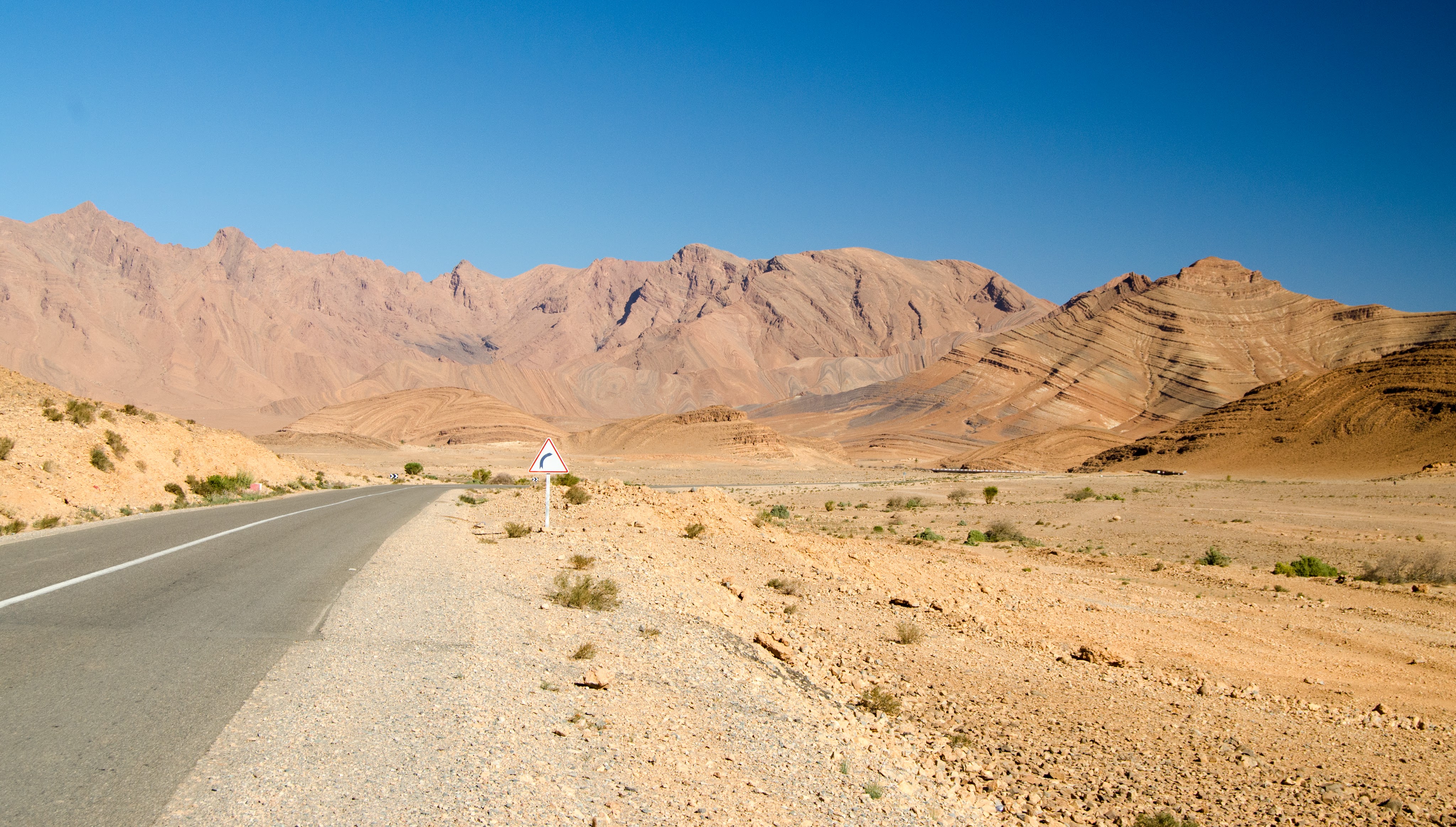
Dreaming of discovering a Morocco far from the main tourist circuits, between traditional villages, high mountains, green valleys, surprising geological formations and dunes stretching as far as the eye can see? This 15-day road trip in Morocco crosses some of the most varied landscapes in the south of the country, from the High Atlas to the Sahara, before reaching the Anti-Atlas.
For this southern Morocco itinerary, we set off in early March 2021 from Rabat. In 15 days, we covered around 3,400 kilometres behind the wheel of a Toyota Prado. The 4×4 was particularly useful for crossing certain rivers and taking the many mountain and desert tracks. An itinerary rich in landscapes, encounters and a few great adventures!


Overview
From Rabat to Marrakech
DAY 0 – Rabat to Marrakech
This first stage of our 15-day Morocco road trip can easily be removed if you start your journey in Marrakech. You will gain a day and a few kilometres. You can also check out my guide dedicated to the city and its surroundings: Marrakech and its surroundings.
Accommodation in Marrakech
Apartment with 3 bedrooms outside Marrakech and on our route. The place is efficient and clean. 415 MAD, breakfast included. However, it is difficult to get breakfast before 9am.
https://goo.gl/maps/86yemzGHmqadRMNg7
Route of the 1000 kasbahs: from Marrakech to the Dadès Gorges
DAY 1 – Marrakech to Tamdakhte
We leave Marrakech early to cross the Tizi n’Tichka pass. The road passes through several villages and already offers beautiful landscapes. Here are our main stops:
- Telouet and its kasbah;
- Anmiter;
- Tazlaft troglodyte agadir: a short walk to get there with a really great guide, Abdessadik Aounil (+212 0671 33 26 81). 100 MAD for an “express” one-hour visit and a small tea at his home.


Accommodation in Tamdakhte
Riad Tamdakhte, 737 MAD for a triple room, breakfast included. Very friendly host, cosy rooms and a warm welcome. We would meet him again the next day at his brother’s place in Boumalne Dadès.
https://goo.gl/maps/mA2LzaSds5z5MpqVA
DAY 2 – Tamdakhte to Boumalne Dadès
The Route of the 1000 kasbahs continues towards the Valley of Roses. We string together several sites before arriving in Boumalne Dadès:
- A walk around the Tamdakhte Kasbah, through almond orchards in bloom;
- A visit to the famous ksar of Ait Benhaddou and its many film locations, including Gladiator, Babel and Game of Thrones;
- Amridil Kasbah in Skoura, with a picnic table;
- Bou Tharar, where we were invited to a wedding reception;
From Bou Tharar, one of the most beautiful tracks of this 15-day road trip in Morocco heads east. It is visible on Google Maps and leads towards the Dadès Gorges. However, I recommend asking in Bou Tharar about the state of the track and avoiding it in bad weather. A 4×4 or SUV is recommended to drive it.


Accommodation in the Dadès Gorges
Porte du Dadès, 800 MAD half-board for a triple room, run by the brother of the owner of Riad Tamdakhte. Nevertheless, I found the place a little less nice than the previous accommodation.
https://goo.gl/maps/oYR47RDGhKq5Dj6u9
DAY 3 – Boumalne Dadès to Tinghir
We leave Boumalne Dadès for a day of short walks, tracks and gorges. Several stops are worth the detour:
- Hôtel des Cascades, from where a short walk through the fields leads to small waterfalls. Pleasant to stretch your legs, but not essential. I rather recommend exploring the monkey fingers canyon;
- Continuing north, the road towards Msemrir passes through the gorges, with a beautiful panorama from the Café-restaurant Timzzillite Chez Mohamed;
- I recommend a short walk to the beautiful viewpoint from the phone mast, accessible on foot from the GPS point 31°39’06.2″N 5°50’36.1″W;
- We then have lunch in Msemrir, at Hamid Achour’s place, a very valuable guide who would later help us remotely;
- From there, a beautiful track leads to Tamtatouchte (Wikiloc link). You need to ask about the state of the track and the weather conditions: rain can fill the oued very quickly;
- We end the day with the road to Tinghir through the impressive Todra Gorges.


Accommodation in Tinghir
Auberge Retour au calme in Tinghir. Very friendly host, 80 MAD per person in a 6-bed dorm, breakfast included. At that price, you shouldn’t be too demanding about the quality of the beds!
https://goo.gl/maps/vVQ6sJ5q9d7CF6mS6
High Atlas: from the Todra Gorges to the Ziz Valley
DAY 4 – Tinghir to Imilchil
From Tinghir, we take the road we covered the day before in the opposite direction. We pass through several points of interest before reaching Imilchil:
- The Todra Gorges in the morning light offer a different spectacle;
- Then comes the authentic weekly market of Tamtatouchte;
- Akka n’Ougoulzi salt mines (31°50’48.2″N 5°29’01.2″W) north of Tamtatouchte with Hamid, a serious, reliable and interesting guide, accompanied by his girlfriend Sandrine. He runs the Auberge Amazigh in Tamtatoucht, which is a great place to stay. His contact is available on Google Maps;
- The road continues towards Imilchil and offers magnificent landscapes;
- We end the day at sunset over the Isli and Tislit lakes. Legend has it that Isli and Tislit, from two rival Berber tribes, fell in love. Their families prevented them from marrying, so they took refuge in the mountains to weep, giving birth to the two lakes.


Accommodation in Imilchil
Auberge des lacs in Imilchil, 360 MAD for a triple room with breakfast. Heated by a wood fire, which is not a luxury at this time of year, and very cosy.
https://goo.gl/maps/YG9mYQz311rX4j6L7
DAY 5 – Imilchil to Taouraout
The road from Imilchil to Midelt is very beautiful, but this stage also brings us the main mishap of the trip.
We first stop at Tirrnist for tea at Hadou’s place, whom we had met while hitchhiking. Then we take the track towards the Cirque de Jaffar. Unfortunately, the road is in very bad condition and ends up blocked by mud and snow. We are therefore forced to abandon the car and get rescued.
This mishap reminds us that it is essential to ask about the state of the tracks before venturing onto them. In this area, it is better to ask for advice in the surrounding villages. An alternative road also allows you to go through the valley.
Finally, we end this day with a night-time descent to the Taouraout guesthouse.


Accommodation in Taouraout
Gîte de Taouraout. The accommodation is very basic, but the family is adorable. We also owe them a debt of gratitude for rescuing us during our mishap on the track. Expect 150 MAD per person half-board. The owner, Mohamed Oujanda (+212 677 94 67 83), can also offer hikes in the region, including towards Jbel Ayachi.
The arrival point on the map indicates where we had to leave the car for the night. To avoid this track, you need to turn left here and not follow the Cirque de Jaffar.
https://goo.gl/maps/UCCmeGmwBDL7HemQ8
DAY 6 – Taouraout to the Ziz Valley
We start the day by walking back to the car to turn around, with the help of our makeshift friends. We then take the road to the Ziz Gorges, with two stops at water sources. Once we arrive at the hotel, we set off on foot to explore the beautiful palm grove.
Accommodation in the Ziz Gorges
Luna Del Fuego, 170 MAD per person half-board. Very pretty house in the heart of the gorges.
https://goo.gl/maps/UbLjyxFr2Na8nUPT7
On the road to the desert
DAY 7 – Ziz Valley to Merzouga
From the Ziz Valley to the Merzouga dunes
We enjoy the palm grove a little longer in the morning before hitting the road to Merzouga. This part of the 15-day road trip in Morocco gradually takes us into more desert-like landscapes.
Along the way, we make a short round trip between Erfoud and Rissani in search of the khettaras, these canals accessible through wells. Unfortunately, we fail to find them. A few kilometres after Erfoud, on the R702, several inscriptions on the mountain then indicate the track to a fossil quarry. It leads to a dusty shop run by two brothers, who will be happy to show you their discoveries. If you are interested and have some time, it is worth a look.
As you approach Merzouga, it is also better to stay alert to the 4×4 touts. Some can follow you quite insistently. The simplest thing is to ignore them and continue on your way.
We finally end the day with a walk on the Erg Chebbi dune to enjoy the sunset. Unfortunately, the clouds deprive us of the spectacle this time.
Erg Chebbi or Erg Chegaga?
Paradoxically, the Erg Chebbi is quite busy for a desert landscape. Its accessibility and the large number of accommodations around the dunes make it a very lively place. You come across visitors on foot, on camelback, on quad bikes or in 4x4s.
Conversely, the Erg Chegaga, near M’Hamid El Ghizlane, is more difficult to access and therefore less frequented. However, to truly seek solitude in the Sahara, you need to devote several days to the journey and venture further from areas accessible by car.

Accommodation in Merzouga
Auberge des roches, 200 MAD per person half-board. Correct accommodation, but nothing more.
There is a large number of “camps” around the Merzouga dune. The camps are therefore small islands surrounded by barbed wire, with very variable services.
Hoteliers can also charge unexpected extras, such as camel transfers, water or food. It is therefore better to find out about the camp before going there and, as far as possible, favour eco-friendly accommodations.
https://goo.gl/maps/s3rSfsPEg5Paf6jN8
DAY 8 – Merzouga to Ouarzazate
From Merzouga, we head towards Ouarzazate, where we have to drop off a friend at the airport. To limit the kilometres, we choose to follow the Drâa Valley and stop over in Agdz. Along the way, several stops allow us to discover this region:
We start with the rock engravings (30.930906, -5.928653). To be honest, the interest remains fairly limited, unless you are really passionate or accompanied by a captivating guide.
We then continue towards Nkob and its 45 kasbahs, which we visit with Younès. We take the opportunity to eat a good tagine at his place (+212 624 80 88 41).
Further on, the ruins of the Tamnougalt Kasbah offer very beautiful views over the Drâa and Mezguita Valley. We also make a stop in Agdz, with a visit to the small café and the central souk. It is the ideal place to buy some dates. We would actually come back the next day.
Finally, we take the road again to Ouarzazate, with a beautiful stretch of road through the landscapes of the valley.


Accommodation in Ouarzazate
Lot of Stars. Very kind host, but dirty accommodation and “surprise” hot water. 170 MAD per person half-board. The location suits us because we want to stay outside Ouarzazate which, in our eyes, is not of great interest. However, it is possible to visit the Atlas Film Studios there.
https://goo.gl/maps/bdDwvYwJjqoXjEWr8
DAY 9 – Ouarzazate to M’Hamid El Ghizlane
Our initial itinerary planned to return to Bou Tharar, then take the mountain road to Aït Bouguemez, with the ascent of Jbel M’Goun and exploration of the surroundings of Zaouiat Ahansal. However, a snowstorm and road closures forced us to change our plans. This trip was made at another time and the details are available in this article: Moroccan High Atlas: 9-Day Itinerary and M’Goun Ascent.
Kasbah du Caïd Ali
We leave early to reach Agdz via the road we covered the day before. We take the opportunity to visit the Kasbah du Caïd Ali, a centre for the restoration of rammed-earth monuments.
Rammed earth is a construction technique based on clayey earth. It is used for buildings in the region, but is often replaced by concrete. Concrete requires less maintenance, but it is less insulating and offers less inertia to keep cool in summer and warm in winter.
The centre is run by Manfred Fahnert (+49 160-5532901), a passionate German who will be happy to show you around. If you find beautiful minerals on your way, do not hesitate to bring them to him to complete his collection. Website: www.lehmexpress.de
Road to M’Hamid
We continue our journey towards M’Hamid and stop along the way at several places that are worth a break:
- Grande Kasbah Oulad Otmane;
- Ksar de Tissergate;
- Village of Tamegroute, known for its typical green pottery. It is possible to visit the manufacturing site. The Zaouia, accessible only to Muslims, and the library were closed during our visit.


Desert tour from M’Hamid Al Ghizlane
We arrive in M’Hamid El Ghizlane where we meet Ismail (+212 6 70 84 21 16, www.desertbivouac.com). We booked a desert tour with him.
The tour includes 4×4 accompaniment to the dried-up Iriki lake over 1.5 days, 2 nights half-board in his two camps and a picnic on the way to the Erg Chegaga. The price was 2500 MAD for two people. We had a good time with Ismail despite his touting and flirting side, as long as you take it with humour.
To do this tour, you need a Toyota Prado or an equivalent model. The route is, overall, not complicated for anyone used to driving in sand. It could therefore be done without a guide, but it is preferable to have two cars in case one of them gets stuck in the sand. We did this route during the COVID-19 pandemic, which allowed us to be almost alone on the dune. According to the guide, in normal times, there are more people. An alternative, supposedly less frequented, is the Erg Lihoudi.
Accommodation
Desert Bivouac by Ismail, near M’Hamid. Kitsch, somewhat dirty toilets but, for being in the desert, you can’t complain.
https://goo.gl/maps/B68avHqMJMDwqrxq5
DAY 10 – M’Hamid El Ghizlane to Erg Chegaga
We set off gently towards the Erg Chegaga along a beautiful 69 km track, passing a ruined fondouk. After settling into the bivouac, we drive to the foot of the dune, then walk up for the sunset. The spectacle is breathtaking!


DAY 11 – Erg Chegaga to Tata
We take the Erg Chegaga track back towards Foum Zguid, passing through the dried-up Iriki lake. From the lake, Ismail more or less indicates the route to follow. Fortunately, we follow a GPS track that keeps us from getting lost.
Once back on the road, we head towards Tata with several interesting stops along the way:
- Old ksar of Foum Zguid;
- Gorges north of Akka n’Ait Sidi;
- Kasba ej Joua;
- Agadir (granary) of Akka Iguirene.


Accommodation in Tata
Hôtel La Renaissance. Double room with breakfast, 300 MAD. Not luxurious, but very correct for the price. Breakfast a little basic.
https://goo.gl/maps/eQejDZZZkmPs4jix8
Anti-Atlas
DAY 12 – Tata to Tafraout
The final part of this 15-day road trip in Morocco takes us towards the Anti-Atlas. We take the very beautiful road to Tagdicht, passing through Imitek and Tizgui Ida Ou Baloul. Before Issafn, we take the small road on the left.
We arrive in the early afternoon in Tagdicht, from where a beautiful hike starts towards Jbel Lkest, which culminates at 2359 metres. The summit offers a 360° view over the region. You can notably see Tafraout and its painted rocks in the distance.
We did the hike without a guide, but the GPS track was very valuable for reaching the summit safely. The hosts of the traditional house can put you in touch with local guides if necessary. We were a bit tight on time and had to hurry to avoid coming back in the dark. A full day is probably more reasonable to enjoy this hike.


Accommodation in Tafraoute
Traditional house in Oumesnate, in the Ammeln Valley. 440 MAD per person half-board. Good welcome, clean accommodation, pleasant terrace with a view over the valley and good food. The accommodation is next to the “traditional house” museum, which can be visited with a descendant of the inhabitants of this house. It is worth the detour.
https://goo.gl/maps/d3dkopws6fLMoD7u7
DAY 13 – Tizerkine Gorges
We take the car to reach the start of a hike in the Tizerkine Gorges.
https://goo.gl/maps/cNgYANRbuomfgeLx9
The hike starts in the Tizerkine Gorges and reaches the Ait Mansour Gorges in two days. We did it with Brahim (+212 615 72 82 79), a really great guide, for 1600 MAD for two people. Most of the itinerary is on a drivable track, with very little traffic. It is quite possible to do the hike on your own.
We pass through the Zaouia of Timguidcht, where a moussem has been organised every year since 1880. People flock from all over Morocco and gather to climb to the summit of a nearby mountain.
According to the tradition mentioned around this pilgrimage, if it is repeated 7 times, it can replace the Hajj for people who do not have the means to go to Mecca. A series of “cells” used to accommodate pilgrims in a very rudimentary way. A new Quranic school capable of welcoming them has recently been built. Visiting this place is theoretically reserved for Muslims.


Accommodation in Ait Tiouadou
Chez Sahnoun: really nice welcome, clean accommodation and a pretty little garden. It is run by the wife and children of a man very active in the development of the village, who died tragically a few years ago.
DAY 14 – Aït Mansour Gorges
We continue the hike to Gdourt, where we stop for a delicious couscous at Rachid’s place (+212 677 73 15 48). We then make a refreshing stop at the exit of Agoudim, “Chez Messaoud” (+212 670 79 35 67), shortly before the end of the hike. A driver is waiting for us to take us back to Oumesnate.
We stop in Tafraoute where we will spend our last night. We take the opportunity to buy some Amlou, very typical of the region.


https://goo.gl/maps/NjhMRzdjE2nbMHzT9
DAY 15 – Tafraout to Rabat
We decide to leave at dawn with a first stop at the Tizourgane Kasbah, currently being renovated. Further on, the road climbs up to the Paradise Valley. We quickly understand the origin of its nickname, even though the site has unfortunately turned into an open-air landfill. In our eyes, the detour is therefore really not worth it.
To finish this 15-day road trip in Morocco, all that remains is to head towards Rabat via the motorway. With more time, an alternative is to go back up along the coast and enjoy a more pleasant journey.
https://goo.gl/maps/UKwSpoFNT6chJ6248
Practical tips for a 15-day road trip in Morocco
Which season to choose?
I recommend doing this 15-day road trip in Morocco between April and June or between September and October.
Nevertheless, we did it in early March, however there is a higher risk of passes blocked by snow or valleys blocked by floods, especially in the High Atlas.
Which car to choose?
A 4×4 is strongly recommended for this itinerary. Some tracks are difficult and several sections can become impassable after heavy rain. A vehicle like our Toyota Prado allowed us to travel through the most isolated areas.
Check the state of the tracks
Before each off-road section, ask locally about the state of the tracks and the weather. Oueds (rivers) can rise very quickly after rain.
Plan for an offline GPS
Some tracks are poorly signposted and network coverage can be limited. Download your GPS tracks in advance and keep them accessible offline. The maps.me app is particularly useful.
Allow time for the unexpected
With 3,400 km in 15 days, the days are sometimes long. So allow a little margin for detours, difficult tracks or unexpected encounters. That is also what makes this type of road trip in Morocco so charming.
Continue exploring Morocco
If you have time to explore other regions, check out my other Morocco travel guides. Having lived here for six years, I share all my tips to help you discover more of the kingdom, from road trips and mountain hikes to beautiful beaches and city visits.
Find the complete list of my Morocco travel guides on this page: Morocco.
Leave a Reply