
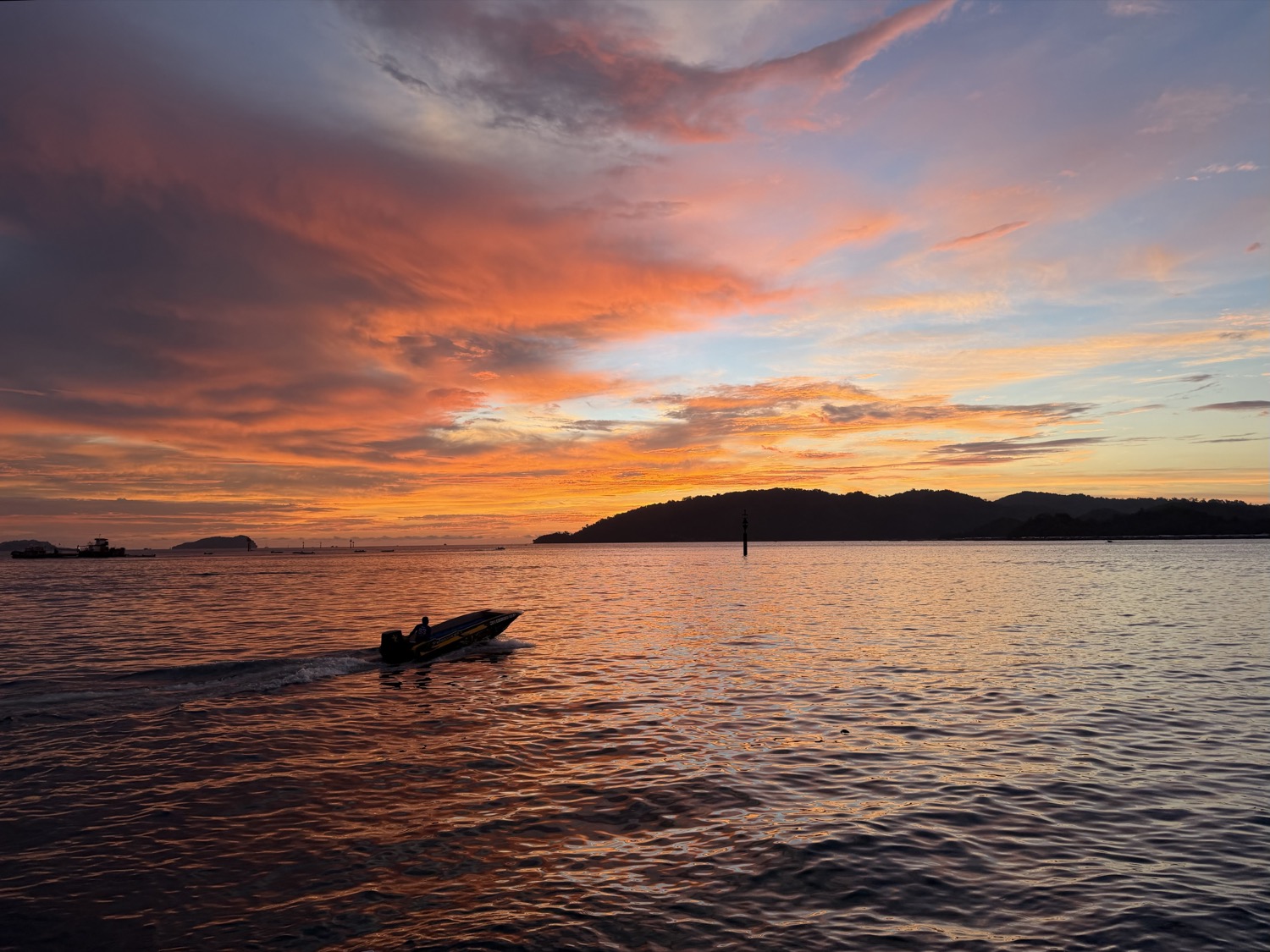
Borneo on a budget and without a car is entirely possible, even if several regions of Sabah seem, at first glance, reserved for luxury tourism and difficult to reach by public transport.
This roughly 10-day itinerary focuses on Kota Kinabalu, Sepilok, the Kinabatangan River and Semporna. It combines diving, snorkeling, beaches and jungle, where you can observe particularly varied wildlife, including the famous orangutans and proboscis monkeys. Travel is mainly by bus and boat, with a few short taxi rides and organized excursions when necessary.
This route through Malaysian Borneo can be extended with the Brunei, Kundasang and Mount Kinabalu, before continuing to Tawau and Kalimantan, on the Indonesian side of the island. It can also be combined with a visit to Peninsular Malaysia, which I discuss in my article: Malaysia by public transport: 2 to 3 weeks itinerary.


Overview
Itinerary
Here is an overview of the main stops on my Borneo itinerary, with the durations I recommend for each destination.
| Stop | Recommended duration |
|---|---|
| Kota Kinabalu | 1 to 2 days |
| Brunei (optional) | Optional – 4 days |
| Kundasang and Mount Kinabalu (optional) | Optional – 2 to 3 days |
| Sepilok | 1 to 2 days |
| Kinabatangan | 3 days |
| Semporna | 1 to 3 days |
| Tawau | Optional – 2 days |
This Borneo itinerary without a car remains flexible and can last between one and three weeks, depending on the stops chosen and the time spent on excursions. I recommend allowing at least 10 days to get a good overview of Sabah, between jungle, wildlife, beaches and snorkeling. Allow more time if you want to include Brunei or continue your trip on the Indonesian side of Borneo, toward Kalimantan.
Kota Kinabalu
Duration: 1 to 2 days, or a little more if you want to do a few excursions around KK.
A convenient arrival in Sabah
After spending a month and a half in South Korea, which I discuss in my following articles: 2 weeks in South Korea: my ideal itinerary, 5 Days in Seoul: Hiking, Architecture, and Culture and What to do in Busan: guide to neighborhoods, sights and hikes, I found a relatively affordable direct flight to Kota Kinabalu, on the Malaysian side of Borneo.
For most travelers wanting to explore Sabah without a car, Kota Kinabalu is the most obvious entry point thanks to its international airport.
The city did not particularly impress me at first, however. Part of that impression can be explained by its recent history. Jesselton, the name given to KK by the British, was bombed in 1945 by Allied forces to liberate North Borneo from Japanese occupation. Jesselton was then hastily rebuilt and chosen as the capital of North Borneo in 1946. Shortly after Sabah and Sarawak joined present-day Malaysia in 1963, it was renamed Kota Kinabalu.


Night markets and local food
Fortunately, the city becomes much more interesting once the sun goes down. The many night markets make it easy to discover local food in Borneo on a budget.
On Friday and Saturday evenings, the Api Api Night Food Market sets up on Jalan Gaya, where the street is closed to vehicles from 6 p.m. to midnight. It is therefore a good place to eat, stroll and try several specialties in a lively atmosphere.
Diving around Pulau Sepangar
I took advantage of my first day to go diving around Pulau Sepangar. This excursion was probably the most expensive of my trip. To visit Borneo on a budget, it is therefore better to look at the snorkeling options I mention below. The seabeds near Kota Kinabalu are somewhat damaged by pollution, and visibility did not exceed 10 m during my visit. There is still enough life, however, to make the dives interesting.
My favorite dive was Mari Mari Wreck, around three wrecks where we encountered a large school of barracudas. From the boat, we even caught a glimpse of Mount Kinabalu through the clouds.
I dived with New KK Holiday Travel, which offered the most interesting rates I had found, at 380 MYR for 3 dives. My experience with them was very good.


Sapi and Mamutik Islands: Beaches and Snorkeling
Island excursions are very popular from Kota Kinabalu. I initially wanted to go to Pulau Gaya, which seems to be the only island where you can hike.
The day before, while diving, I asked at the information point at the Jesselton Point Ferry Terminal, South Jetty, where the boats leave from. I was told that I just needed to buy my ticket the next morning. So I arrived the next day with two friends I had brought along on my adventure, and at the counter, new information: without a prior reservation and without a guide, it was impossible to leave.
In short, a big flop.
If you want to try the Pulau Gaya experience, I recommend checking the conditions directly with the tourist office before heading there.
Instead, we fell back on Pulau Sapi and Pulau Mamutik. The combined trip costs about 50 MYR and the first boat leaves Jesselton Point at 8 a.m.
The beaches are pleasant, and it is possible to scramble around a bit on the islands. However, I did not fall in love with them. There were a lot of people, and the swimming areas were limited to a 50 cm paddling zone. At the slightest crossing of the limit, the lifeguard’s whistle immediately called you back into line.
Suffice it to say that snorkeling from the beach was pointless. I recommend paying a little more to join an organized excursion, which seems to offer more interesting snorkeling spots.


What I Did Not Do in Kota Kinabalu
I did not visit the Kota Kinabalu City Mosque, which looked impressive but was a bit away from the city center. In the end, I was too lazy to go there.
I also did not choose the Mari Mari Cultural Village. This kind of visit generally interests me only moderately, and I thought I would find part of the cultural and natural experience elsewhere on the trip.
Same for the Bongawan River, which seemed quite similar to what I was going to discover in the Kinabatangan region.
Finally, the train between Beaufort and Tenom seems interesting. However, doing it as a day trip from Kota Kinabalu means spending an enormous amount of time in transport. In my opinion, it is better to stay overnight in Beaufort or Tenom and take the time to explore the region.
Where to Stay in Kota Kinabalu
I stayed at Concrete Jungle Cabin, ideal for this first stop on a trip to Borneo on a budget. It is well located, clean and the beds are comfortable. The common areas are also pleasant. The bathrooms are not amazing, but you make do.
Brunei
Duration: optional – 4 days (journeys take time)
The proximity of Brunei naturally made me want to make a detour there. So I left my big backpack at the hostel in Kota Kinabalu and took only the essentials for a short city trip. This extension is particularly interesting for travelers who want to add a cultural and political dimension to a Borneo itinerary focused mainly on nature and wildlife.
I detail this stop in my article dedicated to Brunei : [article coming soon]. I also share a few tips there for incorporating this visit into a Borneo on a budget itinerary.
Both the outbound and return journeys take up a good part of the first and last day. The boat trip is quite nice, however, and lets you discover other things along the way without feeling like you are losing a day. If you are planning your itinerary, avoid leaving on a Friday, because most tourist sites are closed that day.

Kundasang and Mount Kinabalu
Duration: optional – 3 days. I personally skipped this stop because it did not fit my budget for a Borneo on a budget trip.
The Highest Peak in Borneo
I had initially planned to climb Mount Kinabalu, which rises to about 4,095 meters and is the highest point in Borneo and Malaysia. Located near Kundasang, between Kota Kinabalu and Sandakan, it would have been an ideal stop on my itinerary.
However, according to my research, the cheapest option costs more than 1,500 RMB (about €320) for two days and one night as a foreign tourist.
It is therefore clearly not the most suitable stop for a Borneo on a budget itinerary.
Note that places are particularly limited and booking well in advance is essential.
And Around Kundasang?
Instead of climbing the summit, I looked into hiking possibilities around Kundasang and Kinabalu Park. However, I got the impression that independent hiking options were fairly limited in the park, and the logistics for getting to the park were a bit complicated.
River Junkie also offers a shuttle between Kota Kinabalu and Sandakan, with several stops allowing you to explore the park. This option remains quite expensive, however, visiting times seem relatively short, and it is better to book well in advance. Nevertheless, if this option interests you, here is the link: River Junkie – West to East Shuttle.
Sepilok
Duration: 1 to 2 days. I personally spent an afternoon and a morning there, which was perfect for what I wanted to visit.
Getting to Sepilok by Bus
To continue my route through Sabah without a car, I took the first bus to Sandakan from the Inanam terminal in Kota Kinabalu. I recommend choosing a seat on the left side of the bus, which allows you to glimpse Mount Kinabalu in clear weather.
If your accommodation is in Sepilok, the bus can drop you at the junction about 2 km from the site. There I met another traveler, Raphael, who was getting off at the same place. So we shared a Grab for the last few kilometers.
Sepilok seems to me clearly more interesting than Sandakan, because its location is particularly convenient for exploring the jungle and then continuing to the Kinabatangan River.
It is also an essential stop on a car-free Borneo itinerary in Malaysia, because it allows you to combine several natural sites without having to rent a vehicle.
There are also night buses to save a night in a hotel, which can be interesting for visiting Borneo on a budget. However, they do not seem very comfortable. So I preferred to take the first bus and make the most of the late afternoon and the next morning to visit Sepilok before continuing to my next destination.
Rainforest Discovery Centre
After dropping off our bags, we quickly set off for the Rainforest Discovery Centre, which is the site that closes latest and therefore lets you make the most of the afternoon.
Several trails allow you to discover a piece of preserved tropical forest. We were lucky enough to spot several monkeys and even an orangutan !
During my visit, entry cost 30 MYR and the site closed at 5 p.m. Yet once inside, no one particularly rushed us to leave. So we were able to take our time and enjoy the forest peacefully.
There also seem to be organized night walks.
Orangutan Rehabilitation Centre
The next morning, we started with the Sepilok Orangutan Rehabilitation Centre. This centre takes in rescued and rehabilitated orangutans, which live in the forest and can move freely away from the facilities.
The feeding platforms offer two daily sessions, at 10 a.m. and 3 p.m. The supplementary food is intended to support rehabilitation rather than make the animals dependent on the centre. Sightings are therefore not guaranteed.
The place is still quite popular. During my visit, the crowds were large, even though the organization limited their impact fairly well.
Part of the viewing takes place outdoors. Another part allows you to watch the animals from a glassed-in, air-conditioned building. This second setup also helps further limit visitors’ intrusion into their environment.
The ticket costs 30 MYR for foreigners and the site is fairly small. Personally, if you have already observed orangutans in the wild, I am not sure this visit adds much more.


Other Wildlife Centres
In Sepilok, there is also the Bornean Sun Bear Conservation Centre, dedicated to the Malayan sun bear. The reviews I had read about the place’s animal welfare standards were more mixed. Some visitors appreciate the conservation work, while others find the experience more like a zoo visit, since the animals remain in captivity.
I did not visit the Labuk Bay Proboscis Monkey Sanctuary or the Sandakan Crocodile Farm. The information I had found about their facilities convinced me even less from an animal welfare perspective.
Where to Stay in Sepilok?
There are few accommodations in Sepilok, so it is better to book in advance.
As for me, I stayed in a dormitory at Sepilok Jungle Resort. The dormitory is clearly dated, without air conditioning and fairly basic, but it does the job for visiting Borneo on a budget. Breakfast was good and the setting was really nice, in the middle of the jungle, with walkways where you can spot orangutans and other animals. I even saw a small snake there!
Bonus: the pool, very pleasant for cooling off after a day of sightseeing.
Right next door, Sepilok Forest Edge Resort seems to offer a bit more comfort, but it was full when I was there.


Kinabatangan
Duration: 3 days. Departure is at 12 p.m. on the first day, which lets you enjoy a bit more of Sepilok. On the last day, returning at 12 p.m. allows you to reach the next destination the same day.
A Jungle Excursion in Borneo on a Budget
From Sepilok, several excursions allow you to explore the Kinabatangan River, whose floodplain was officially recognized as a UNESCO Biosphere Reserve in late 2025. After my research, I came across Uncle Tan, which seemed to be one of the most affordable ways to discover this region.
All the information was presented very transparently on their website, which reassured me when booking: Uncle Tan – Kinabatangan. During my visit, the stay cost 622.40 MYR, making it an interesting option for visiting the Borneo jungle on a budget.
The history of the place is also worth reading before you go.
A Deliberately Rustic Experience
The Uncle Tan experience is deliberately very simple. Six of us shared a “room” without a door. Mosquito nets made up our personal space. Showers were taken collectively with a bucket, in underwear.
On the other hand, these conditions foster unforgettable encounters and give the experience a real sense of adventure. In addition, the guides were good and the food excellent.
If you are looking for a more comfortable experience, I heard good things about Sukau Riverside Homestay, particularly for excursions that may allow you to observe Borneo pygmy elephants. I do not know their rates, however, and I did not test this option myself.


Tip: choose light, breathable clothing that protects against mosquitoes. During jungle walks, I saw three quarters of the group, including myself, wearing a jacket, gloves, trousers and a buff to avoid bites. One look at the photo is enough to understand that we quickly got very hot!
Encountering Kinabatangan Wildlife
The various outings allow you to look for very diverse wildlife. We notably observed proboscis monkeys, macaques and several crocodiles.
But my best memory remains the night walk. We learned to spot animals in the forest ourselves, which makes wildlife watching much more fun than a simple guided walk.
Spoiler alert: if you want to know how to spot animals in the dark, just line up a flashlight (a smartphone light works only moderately well) with your line of sight to see animals’ eyes shine! Those between 0 and 1 m from the ground are generally insects, those between 1 and 2 m are reptiles, and those above 2 m are mammals.
We then observed a greater mouse-deer, a civet, a slow loris, a tortoise, as well as a multitude of spiders and birds.


A Forest That Is Not Isolated from the World
You should nevertheless have a realistic view of the place. This is not an intact primary forest surrounded only by wild nature.
Logged and agricultural areas are very present around the river. Personally, this did not ruin the experience for me. On the contrary, I found it interesting to see how this mosaic of forests, agricultural areas and villages could still offer spaces favorable to wildlife.
Continuing to Lahad Datu and Semporna
The last day does not really include a new excursion. The program mainly ends with the boat trip.
It is possible, however, to ask to be dropped off at a convenient place to then take a bus to Lahad Datu. From Lahad Datu, it then becomes fairly simple to continue by bus to Semporna.
Semporna
Duration: 1 to 3 days
A Town That Contrasts with Its Archipelago
I had read a lot about Semporna before arriving. And indeed, it is probably one of the poorest and dirtiest towns I saw in Malaysia. That said, I had already seen much worse elsewhere, and it did not prevent me from finding my happiness there, especially at that night market.

The contrast with the surrounding archipelago is spectacular, however. Around Semporna, the waters become magnificent.
Bohey Dulang, Sibuan and Mantabuan
I booked a day of hiking and snorkeling directly with my hostel for about 200 RMB, or €40. Among the excursions offered, this one seems the most interesting to me, because it combines a beautiful viewpoint and several snorkeling spots.
The excursion included the short hike on Bohey Dulang, followed by snorkeling sessions around Sibuan and Mantabuan.
It starts with the climb up Bohey Dulang, which is quite steep but offers a spectacular view over the archipelago. The official trail takes you to the island’s summit, located at about 180 meters, in 20 to 45 minutes depending on your fitness. Do not forget to bring closed shoes, otherwise you will have to rent some on site.
The excursion is popular, it must be admitted. Fortunately, we left early and thus avoided the biggest crowd at Bohey Dulang. The snorkeling spots were large enough for everyone to swim relatively peacefully.
We were also able to disembark at Sibuan, whose beach is magnificent. Unfortunately, barely a hundred meters further, the scenery changes radically with a large accumulation of plastic.
Tourism is developing rapidly in this region. I hope it can also help improve environmental management and conservation of the archipelago.


What About Sipadan?
I had planned to spend several days diving in Semporna, including a day at Sipadan, whose reputation is well established.
Access to Sipadan is strictly regulated by a reservation and permit system managed by Sabah Parks. Operators can book up to six months in advance, and access depends on permit availability.
I was in contact with Borneo Speedy Dive, which is still among the operators registered with Sabah Parks. At the time, their rate was about 1,150 RMB, including 450 RMB in taxes, for a day at Sipadan, which is the cheapest rate I found. They still had spots a few days before. So I hesitated for a long time, because, being already there, I told myself it was now or never.
In the end, a minor ear infection got the better of my diving plans. It also allowed me to preserve my Borneo on a budget ! And without regret, since I would continue my diving adventures in Indonesia.
Where to Stay in Semporna
I stayed in a dormitory at Island Backpacker Hostel. The place is very basic, but the staff were friendly and helpful.
Above all, the price was very reasonable and the activities organized by the property seemed to be offered at interesting rates. For a stop like Semporna, where most of the budget easily goes on excursions.
Tawau and Departure to Kalimantan, Indonesia
Duration: optional – 2 days
After Semporna, I continued to Tawau.
I had planned to visit Tawau Hills Park, which seemed much more financially accessible than some of the big Sabah excursions. Located about 24 km from Tawau, the park offers several trails to discover the forest, waterfalls and hot springs. The entrance fee for international visitors is currently 20 RM.
In the end, I did not have time to visit the park, but it can be an interesting stop for discovering Borneo on a budget.
Tawau also allows you to continue to Kalimantan, on the Indonesian side of Borneo. That is exactly what I did next, discovering cultural experiences and magnificent islands. I tell the rest of my trip in the following articles: [article coming soon].

Practical Tips for Visiting Borneo on a Budget
Budget
My goal was to visit Borneo on a budget. In the end, I managed on about 255 MYR, or €55 per day.
This budget includes nights in basic but decent hostels, with a few nights in a private room. I mainly ate in kopitams and did most of my travel by bus and boat, including to Brunei, where journeys cost a little more.
In the end, activities represented a significant part of my expenses, especially the diving day and the Semporna excursion. However, I absolutely do not regret these expenses!
Recommended Season
In Borneo, the period from March to October generally offers the best conditions, although rain is still possible. From November to February, the sea often becomes rougher and rainfall increases.
Also be careful of slash-and-burn fires, particularly in September and October. Smoke sometimes degrades air quality and disrupts flights.
Finally, avoid local and Chinese holidays, especially Golden Week. These periods attract more visitors and make some destinations more crowded.
Transport
Most transport options do not appear online. Yet Sabah remains fairly well served on the proposed itinerary. Once you are there, getting around is relatively simple.
You can book some journeys from Kota Kinabalu on Easybook.com, for a small commission. For the journey between Sandakan and Semporna, use Redbus.my.
Leave a Reply