
South of Honshu lies Kyushu, Japan’s third-largest island and an ideal destination for a road trip. Crowds are thinner, sights are less saturated, and you often discover a more authentic, less formulaic, and sometimes rawer side of Japan. Between port cities open to the world, potters’ villages, spectacular volcanic regions, traditional hot spring towns, and grand natural landscapes, Kyushu reveals a facet of Japan that is well worth lingering over.
This nine-day itinerary took us from Fukuoka to Nagasaki, then through the regions of Unzen, Mount Aso, Takachiho, and Kirishima. On the program: historical heritage, craftsmanship, volcanic hikes, breathtaking gorges, thermal baths, and some of the most scenic roads in southern Japan.


Overview

Day-by-day itinerary
DAY 1 – Fukuoka
We arrive in Fukuoka late in the morning via Shinkansen from Hiroshima. After dropping our bags at the hotel, we set out to explore the largest city in Kyushu at a leisurely pace. Rather than rushing from sight to sight, we choose to take time to soak up the local atmosphere, and the city lends itself well to that.
The day begins at Lanvin café, which seems to be frequented almost exclusively by regulars. Tourists are rare, making it easier to connect even though the language barrier is very much present. The place serves only coffee, but the human experience is well worth the detour.
We continue our stroll to Kushida-jinja, one of the city’s most important shrines. Notably, you’ll find a Japanese version of the Manneken Pis statue here.
Right next door, we explore the Hakata Machiya Hometown Museum, which showcases local traditions, including the famous Hakata Gion Yamakasa festival. The visit is also a chance to sample some delicious mochi.
In the evening, we head out to explore the famous Nakasu yatai – the iconic street food stalls of Fukuoka. However, with limited vegetarian options, we eventually look for another restaurant.


DAY 2 – Fukuoka to Imari
We spend the morning in Fukuoka to visit the remarkable Fukuoka Asian Art Museum. The temporary exhibition was my favourite visit in the city.
Late in the morning, we pick up our rental car near the airport. The actual Kyushu road trip can finally begin.
Our first stop is Okawachiyama, a small village renowned for its porcelain. I must admit I wasn’t particularly enthusiastic about visiting pottery workshops. Yet, this village ended up being one of the pleasant surprises of the trip.
The highlight of the visit is actually a little off the beaten path. A short walk leads to the discreet Take Shrine, nestled in the forest. The path is visible on “maps.me” and starts at this point: 33°14′02.57″N 129°53′43.51″E. The setting is particularly peaceful and photogenic.
Back in the village, we explore the surroundings as well as the pretty cemetery. Don’t miss the old hydraulic mechanism used to grind clay for porcelain production. It gives a better understanding of the craftsmanship that made the region famous.


We then head to Imari, another historic ceramics town. Unfortunately, despite our attempts to explore the centre late in the day, the town felt dead and left us with the impression that it had little to offer.
For the night, we choose Hotel WIN, which has no particular charm but offers excellent value for money.
DAY 3 – Arita to Nagasaki
Arita
This third day of the Kyushu road trip remains dedicated to the world of porcelain, with a visit to Arita, the birthplace of Japanese ceramics exported to Europe as early as the 17th century.
We start with the impressive Kyushu Ceramic Museum, which provides a good understanding of the overall historical context and the evolution of this prestigious craft. Even if you’re not a pottery enthusiast, the visit is genuinely interesting.
We then drive off in search of a viewpoint over the famous rice terraces of the region. As the season wasn’t yet ideal, the landscapes probably weren’t at their peak. Still, the country roads already give a taste of the area’s potential.
The afternoon is spent visiting several active pottery kilns. We stop at China on the Park for a lunch break, then Genemon-gama and Kouraku Kiln. The latter offers an original activity where you fill a basket with as many ceramic pieces as possible – a fun treasure‑hunt concept. However, the quality of the pieces seemed inferior to other workshops, and the price felt a bit steep, so we decided not to participate.
The workshops often display magnificent works, but largely out of budget for most travellers. I recommend avoiding weekend visits, as you won’t see the artisans at work.
We finish our discovery of Arita at the Tōzan Shrine, famous for its porcelain torii gate. In the nearby historic centre, also take time to observe the “Tombai” walls built from old kiln bricks – the blackened traces left by fire are still visible today.


Mifuneyama Rakuen
Before reaching Nagasaki, we make a detour to the spectacular Mifuneyama Rakuen. In spring, the azaleas create an impressive floral display, among the most beautiful we have seen in Japan.

Evening in Nagasaki
We arrive in Nagasaki early in the evening and check into Ryokan Koyotei. Despite a rather dated building, the establishment immediately charms with its beautiful traditional rooms and spectacular view over the city.
The onsen also offer a superb night‑time panorama. Note that the neighbouring ryokan Baishokaku seems to offer rooms at a more affordable rate while granting access to the same baths.


This city offers a chance to take a short break in our Kyushu road trip by leaving the car at the hotel for two nights.
We go down to the city for dinner, and to round off the day, we enjoy a pleasant stroll along the waterfront between Nagasaki Seaside Park and Dejima Wharf. The area is particularly enjoyable after dark.
DAY 4 – Nagasaki
Atomic bomb
We get up early to explore the most well‑known aspect of Nagasaki: its history linked to the atomic bomb.
We start with the Atomic Bomb Museum, then continue with the moving Peace Memorial, the Hypocentre, and the Peace Park. Together, they provide a deeper understanding of the human and material consequences of the bombing on 9 August 1945.
Even after visiting the Hiroshima museum, the one in Nagasaki is well worth the detour. It is more recent, allowing it to cover in greater depth, among other things, the nuclear context in the decades following the war.


Christianity in Nagasaki
We then head to the Monument of the 26 Martyrs. While the monument itself may not be a must‑see, it introduces another important facet of local history: Christianity in Nagasaki.
Historical context:
From the 16th century onward, Portuguese and Spanish missionaries introduced Christianity to Japan. The Nagasaki region quickly became one of the country’s main Christian strongholds. When Christianity was banned in the early 17th century, many believers continued to practise their faith in secret for over two centuries. These communities are now known as the “hidden Christians”.
The Monument of the 26 Martyrs commemorates one of the most notable episodes of that period. In 1597, twenty‑six Christians – foreign missionaries and Japanese converts – were arrested by order of regent Toyotomi Hideyoshi. After being forced to march across much of Japan, they were crucified on a hill in Nagasaki as a warning to deter the spread of Christianity. Their execution marked the beginning of persecutions that would progressively lead to the total prohibition of the religion across the country.
We delve deeper into the subject at Ōura Cathedral and its particularly informative museum. Listed as a UNESCO World Heritage site along with several other sites related to Nagasaki’s hidden Christians, it is one of the most important places in the history of Japanese Christianity.


Relations with the West
We then head to Glover Garden, a pleasant collection of Western‑style villas overlooking the port. Built in the late 19th century for foreign merchants settled in Nagasaki, they bear witness to Japan’s gradual opening after centuries of isolation. The current buildings have been carefully preserved or reconstructed and offer beautiful views over the city.
Historical context:
After more than two centuries of isolation, Japan gradually opened up to the world from the mid‑19th century onwards. Among the first ports authorised to receive foreigners were Nagasaki, Yokohama, and Hakodate, which quickly became gateways to modern Japan. This opening still leaves a visible legacy today in the old foreign quarters, churches, Western‑style buildings, and the many testimonies of trade and cultural exchanges with the West.
We then descend towards Dejima, one of Nagasaki’s major historical sites. During the Edo period, when Japan almost entirely forbade contact with foreigners, this small artificial island was virtually the only point of authorised trade with Europe, mainly through Dutch merchants. Today, several buildings have been reconstructed to recreate the atmosphere of that era.


Sunset at Suwa Shrine and Chinatown
The afternoon ends at Suwa Shrine, which offers both a peaceful setting and nice views over the city.
To return to the centre, we walk along the Nakashima River, known for its many stone bridges. The most famous is undoubtedly the Megane Bridge (Spectacles Bridge), whose arches reflect in the water to form a pair of glasses.
We finish this full day with a good meal in the Chinatown, which is three centuries old.
In the end, this visit completely changed our perception of the city. Before this trip, Nagasaki mainly evoked the atomic bomb. Now, we remember above all a charming port city, marked by unique foreign influences in Japan and offering superb sea views. In hindsight, one or two extra days would certainly not have been too many.


DAY 5 – Nagasaki to Kurokawa Onsen via Unzen
Mount Unzen
We set off early in the morning to reach one of Kyushu’s most impressive volcanic regions: Mount Unzen.
First stop: the tourist information office to get some advice on the day’s conditions and hiking possibilities.
Following the advice, we start with a walk around Unzen Jigoku – literally “Unzen’s hells”. This network of fumaroles, boiling ponds, and sulphur springs testifies to the region’s intense geothermal activity.
We then do a return trip to Shirakumo Lake. The site is pretty, but it didn’t seem remarkable enough to justify the detour on its own.
We then drive towards Nita Pass, where the ropeway starts. Unfortunately, it is closed due to wind.
We decide to explore the area at our own pace. Taking advantage of relatively favourable weather, I go for a hike towards Mount Fugen. The ascent is particularly beautiful, offering clear views over the surrounding volcanic terrain. Some sections are closed due to landslides, so I do an out‑and‑back. The GPX track1 is available here (one way 2.5km – 433m ascent, 138m descent).
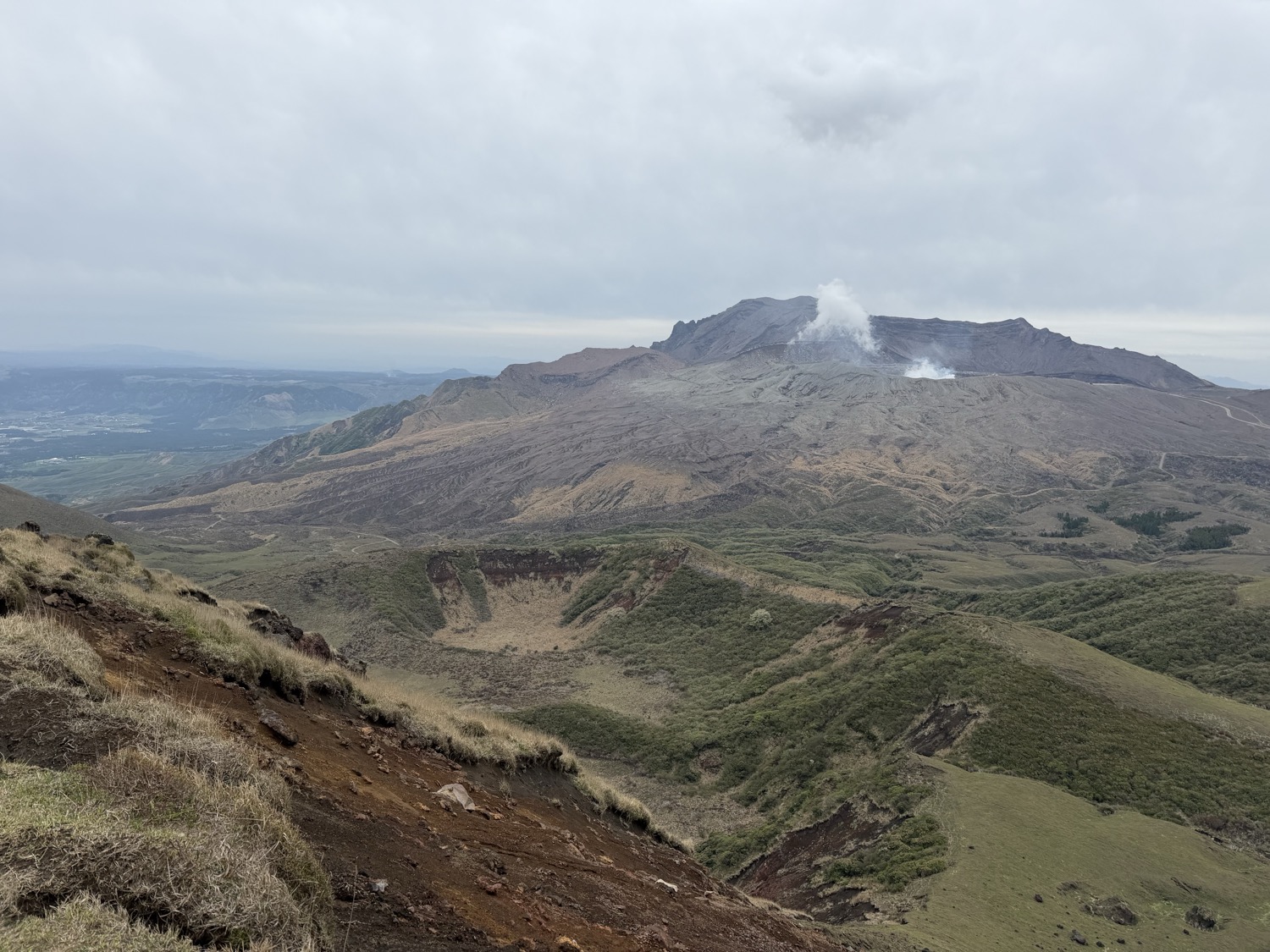
From the summit, we can clearly see Mount Heisei Shinzan, which appeared following the eruptions of Mount Unzen between 1990 and 1995. This volcanic activity profoundly reshaped the landscape and remains one of the major geological events of contemporary Japan.


Ferry crossing and road to Kurokawa Onsen
After the hike, we head to the port of Taira to board the ferry to Nagasu. Not having booked in advance, we worried we might have to change our entire itinerary. But there is enough space! We board without issue for the roughly one‑hour crossing.
Once on the other side, we make a detour to the Kikuchi Gorge. Unfortunately, the site is already closed when we arrive.
The road then climbs gradually towards the vast caldera of Mount Aso, already offering magnificent panoramas over the surrounding plains and mountains.
At the end of the day, we reach Kurokawa Onsen, one of Kyushu’s most renowned hot spring villages. Its lanes lined with traditional inns and peaceful atmosphere immediately make you want to stay longer and try a few onsen.
However, we only have the evening to discover the village and have dinner. Note that few restaurants are open in the evening, as most tourists eat at their hotels. We find this restaurant specialising in eel, but fortunately they agree to prepare a vegetarian dish for us.


We end this magnificent leg of the road trip by reaching our accommodation, Oitakuju kuoritei, located in Ōita Prefecture in north‑eastern Kyushu. Given its high price, our expectations were high. The experience remains pleasant thanks to the private bath and views of the surrounding nature, but overall it didn’t fully convince us.


DAY 6 – Mount Aso
This day is dedicated to one of the most impressive natural sites of this Kyushu road trip: Mount Aso, the largest active volcano in Japan. Its caldera is among the largest in the world, measuring about 25 kilometres north‑to‑south and 18 kilometres east‑to‑west.
As we cross this vast volcanic depression, we make an unexpected stop at Senbatsurushika Park, which features numerous trimmed shrubs. The place is as quirky as it is photogenic.
We then head to the volcano museum, where the huge car park testifies to the site’s popularity.
From the viewpoint next to the car park, we discover the spectacular smoking crater of Nakadake. However, at the time of our visit in April 2026, access to the crater rim is closed. A helicopter crashed there a few months earlier, and recovery operations are not yet complete.
With rain forecast for the afternoon, we head straight for a hike towards Kishima‑dake, whose relatively short but steep ascent offers magnificent panoramas over the entire volcanic complex.
On the way down, we pass alongside a vast grassy crater where we gradually spot several dozen deer.
The GPX track1 is available here (loop 4.68km – 284m elevation gain).
The rain starts to fall as we reach the volcano museum. Its exhibition clearly explains the formation of the caldera, the different eruptive phases of the volcano, and the geological evolution of the region.


DAY 7 – Mount Aso to Kirishima via Takachiho
After a quiet morning enjoying our private onsen, we hit the road south with only one tourist objective for the day: the famous Takachiho Gorge.
Though very crowded, the site remains spectacular. The high basalt cliffs topped with lush vegetation frame the river, dominated by the beautiful Manai waterfall.


We explore the paths along the gorge, then make a detour to the nearby shrine and return to town for lunch at the authentic Café Marchen, a great spot for a break.
The afternoon is mostly spent on the road.
We then discover a surprising peculiarity of the Japanese expressway network: some toll gates seem to be reserved for vehicles equipped with an ETC card. This mishap forces us to take a significantly longer detour than planned.
We finally reach the southernmost point of our Kyushu road trip, in the Kirishima area. We stay at a welcoming guesthouse: Coco Garage, with a very cosy wood stove to end the day.
DAY 8 – Ebino and Kirishima
We set out in thick fog to discover the volcanic landscapes of the Ebino plateau, famous for its lakes and hiking trails.
The fog stays with us all day, severely limiting views. Nevertheless, we do the loop connecting the lakes Byakushi, Rokkannonmi, and Fudo. After the last lake, the path is blocked due to volcanic activity, so we turn back.
Despite the lack of panoramas, the atmosphere remains pleasant. Occasionally, the clouds briefly part to reveal the silhouettes of the surrounding volcanoes.
Although the path is very clear, I share my GPX track1 here (one way 3.49km – 156m ascent, 93m descent).
To make the most of the day despite the weather, we ask for advice on accessible sites. This leads us to the beautiful Maruo Falls, probably our favourite discovery of the day.
We then continue to Hanabusa Falls, accessible from Ryokojin Sanso Hotel (follow Google Maps to the ryokan, not to the falls, as the road to the latter is incorrect). A particularly friendly ryokan employee allows us to use the hotel parking and even lends us umbrellas. The GPX track1 is available here (one way 0.68km – 42m ascent, 17m descent).


In hindsight, this leg is probably the only part of the itinerary we would change. Given the time we had, we would probably have preferred to spend more time in northern Kyushu rather than make this long detour down to the Kirishima area.
DAY 9 – Kirishima to Fukuoka
On this final day, we hit the road at dawn towards Fukuoka.
Initially, we planned to stop at Kumamoto to see its famous castle. However, time is tighter than expected, so we prefer to drive straight to the airport.
After returning the rental car, our Kyushu adventure already comes to an end.
A few hours later, we find ourselves back in Tokyo, between Shibuya and Omotesandō – a stark contrast to the calm of the previous days.
Practical tips
Budget
We were 3 people and spent an average of 20,000 yen per day per person, including the rental car (which was quite economical), hotels of very varied standards (nights between 20,000 and 60,000 yen/night for 3 people), simple restaurants, and several paid visits.
Distance and duration
For this Kyushu road trip, we covered just over 1,000 kilometres in about 20 hours of driving. In hindsight, we should have either skipped Kirishima or allowed a few more days in the south.
Recommended season
Spring (April and May) and autumn (October and November) seem to be the best times for this Kyushu road trip. We did it in April, and it was still quite cool with a few rainy days.
Transportation
I believe a car is the best way to discover Kyushu in depth.
Some areas, especially Unzen, Kurokawa Onsen, Aso, and Kirishima, are much easier to explore with a car.
Also check that your car is equipped with an ETC card to avoid being refused entry or exit at some toll booths.
We rented the car through Times, a widely available agency in Japan, via Trip.com, and had no issues.
What to visit after Kyushu?
If you pass through Tokyo again, I recommend reading my article Contemporary architecture and iconic toilets in Tokyo, devoted to an original facet of the Japanese capital.
For those who wish to extend their nature‑focused discovery of Japan, Michinoku Coastal Trail north: 10 days between Iwate and Aomori presents a superb hiking route along the Tōhoku coast.
Finally, if this trip inspires you to explore other Asian destinations, you will also find inspiration in the following articles:
- China in winter – from Shanghai to Beijing
- Hong Kong 4 days: hikes and city – Intensive itinerary
- Taiwan by train – 14‑day island tour without car (itinerary + tips)
(1)The GPX tracks mentioned in this article are provided for reference only. They should not be followed as an official guide or a safe route. Mountain conditions constantly change and may render a route unsuitable or dangerous.
Leave a Reply