
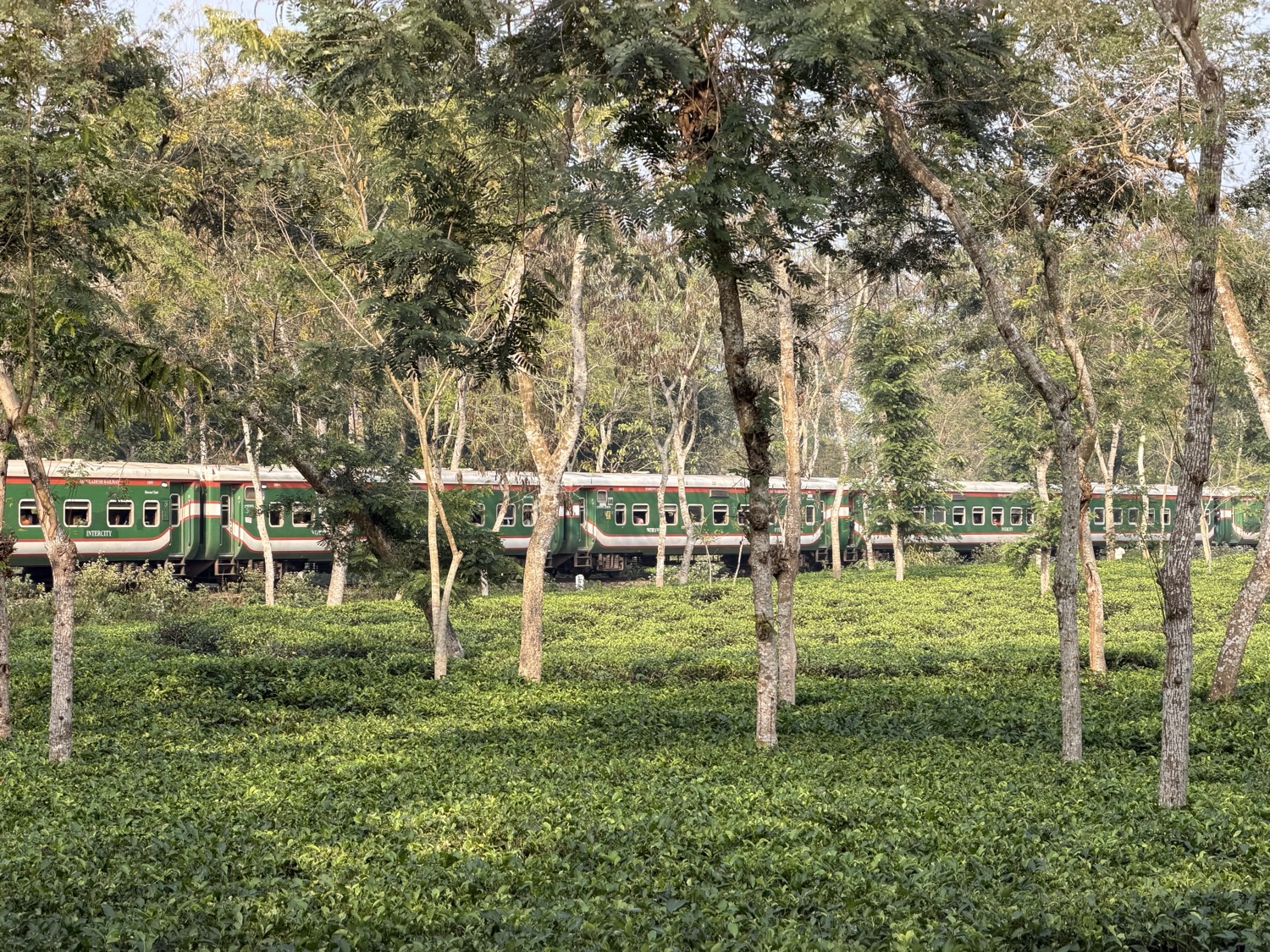
This Bangladesh itinerary offers a progressive 11-day immersion in a deeply disorienting country, where water shapes both landscapes and travel. By local buses, rickshaws, night ferries (launches) and river cruises, the route links the Sundarbans mangroves, the tea plantations of Srimangal, the wetlands of Sylhet, before returning to Dhaka, one of the densest megacities in the world.


Tourist infrastructure remains limited and occasional dirt can be shocking, but these drawbacks are largely offset by exceptional hospitality and spontaneous encounters. With international tourism still discreet, it is common to be among the only foreign travelers, which naturally encourages conversations and help from locals. During this 11-day Bangladesh itinerary, I met only a handful of Western tourists.
Overview
- DAY 1 – Arrival in Dhaka and transfer to Khulna
- DAY 2 – Bagerhat (1) and Mongla (2)
- DAY 3–5 – Sundarbans (3)
- DAY 6–8 – Srimangal (4)
- DAY 9–10 – Sylhet (5)
- DAY 11 – Dhaka (6)

- International airport
- Money
- Budget
- Duration
- What to pack
- Vegetarian food
- Local SIM and network
- Sundarbans – planning ahead
- Transport
- Best season
Day‑by‑day itinerary
DAY 1 – Arrival in Dhaka and transfer to Khulna
I land at 3:30 pm in Dhaka, my visa already approved and printed. I first go to the payment counter, where cards are accepted for a small fee. Barely three minutes of waiting and I think I will get out quickly—until I am sent to a second queue to finalize the visa. Despite preparing in advance, you must present a hotel booking and an onward ticket, ideally printed. The wait lasts nearly an hour.
Once formalities are done, my Bangladesh itinerary can finally begin! Outside, I meet the agency representative who organized my first days toward the Sundarbans. We head to the port by rickshaw for a first intense immersion in Dhaka: constant horns, sudden braking and even a minor collision with another rickshaw—apparently routine here.
At the port, bad news: the boat is cancelled because of fog after a recent accident. We therefore have to reach Khulna by bus. We leave around 6:30 pm and arrive late in the evening. The hotel leaves much to be desired: questionable cleanliness and a room full of cockroaches. After a quick spray and being too tired to look elsewhere, I accept the situation. At least the bed seems spared.
DAY 2 – Bagerhat and Mongla
After a finally decent night, I head for Bagerhat, a former Muslim city founded in the 15th century. I visit the famous Sixty‑Dome Mosque, a UNESCO World Heritage Site (500 taka). It actually has 77 domes but sixty columns, probably due to a translation error between Arabic and Bangla. Inside the paid enclosure, a pond is bordered by beautiful lotus flowers.
I then meet two teenagers, one of whom speaks perfect English. With no ulterior motive, they accompany me for the rest of the visit, introduce me to part of their family, and take me to more discreet mosques such as Bibi Begani and Chunakhola, before heading to the mausoleum of Khan Jahan Ali.


They then help me find the right bus to reach Mongla. After changing in Katakhali, I arrive in this lively little port where I meet another agency employee. I drop my bag on the boat and stroll around Mongla, pleasant and animated. Saint‑Paul’s Church is closed, so I return to the boat where I meet three other travelers. The adventure can begin.
DAY 3 to 5 – Sundarbans and its mangroves iconic
Preparing the mangrove cruise
I set off for three days of river cruising in the Sundarbans, the largest mangrove forest in the world. It is undoubtedly the best way to explore this still‑wild region and, without question, the highlight of this Bangladesh itinerary. The boat is far from luxurious—there even seems to be a mouse on board—but the experience is exceptional. Organization is complex: few agencies, high prices and strong demand. Despite starting my search only two weeks in advance, I manage to join an existing group thanks to a local guide. I explain this in more details in the practical tips.


Navigation and wildlife watching
Life on board quickly settles into a rhythm of slow navigation and long evenings on deck. It was also here, during nights drifting through the mangroves, that I discovered the card game Hearts, which I also wrote about in a dedicated article explaining the rules.
We slowly navigate between rivers and mangroves toward the Bay of Bengal, spotting spotted deer, wild boars, monitor lizards, crocodiles, dolphins, otters and countless birds, including egrets and kingfishers.
We constantly scan the banks hoping to glimpse a Bengal tiger, unsuccessfully. Even our guide, who has worked in the region for twenty years, has only seen four. Only 126 are said to remain in the entire mangrove forest.


Villages visited and memorable encounters
The final day includes a visit to Jaymanirgol, a fishing village where we spot huge bats, and, optionally, to a brothel village. After the guide assures us that the women are there by choice, we decide to go. Some hide to avoid photos and one confides that her family is unaware of her work. Despite NGOs ensuring their safety and freedom, an uneasy feeling remains.


Return to Dhaka
We get back to Mongla, from where I reach Khulna and then detour to Barisal by bus so I can still catch the night launch to Dhaka. As expected, buses take longer than planned and I reach Barisal just before the last boat departs. I cross a lively city by electric rickshaw, pay the 10‑taka pier fee and board just as the ropes are cast off. The journey is an experience in itself—leaving at 9:10 pm and arriving at 7:30 am. For 1,000 taka I get a private cabin where I sleep very well.


DAY 6 to 8 – Srimangal
Arrival in Srimangal and first encounter
I take an early bus to Srimangal and arrive mid‑afternoon. At the hotel I meet Tanvir, a student who spontaneously approaches me and offers to show me around.
Ramnagar Manipuri village and tea plantations
We start with the Manipuri village of Ramnagar, where women weave magnificent colorful textiles. We then taste the famous seven‑layer tea. Visually impressive, it is nevertheless extremely sweet, which makes it hard to distinguish each flavor clearly. We pass several tea plantations before heading back.


Sunrise at Baikka Beel Lake
The next morning, departure at dawn for Baikka Beel Lake. The countryside is beautiful, between fish ponds and rice fields. Water levels are low and the site quiet, but the sunrise atmosphere is pleasant.


Walk around the Finlay Tea Estate
I continue alone toward the Finlay Tea Estate, which I walk around on foot through pretty paved alleys and along the railway line. If you are short on time, this is the easiest place to see tea plantations.

Hiking in Lawachara National Park
In the afternoon I go to the Lawachara National Park, a small nature reserve known for hosting the country’s largest population of hoolock gibbons. Entrance is expensive for foreigners (1,150 taka) and the site poorly maintained near the gate, but the forest becomes wilder as you go deeper and rubbish becomes rarer. Without a guide or GPX track, navigation can be tricky due to poor signage (at least on the three‑hour loop). I spot a shy jackal and a few monkeys.
Trip to Hum Hum Falls and Madhabpur Lake
On the third day, Tanvir helps me organize a CNG—motorized rickshaws running on compressed natural gas—to reach the Hum Hum Falls and the Madhabpur Lake (1,800 taka).
In the morning I discover the Hum Hum Falls. Entry to the waterfall park costs 30 taka and I choose to hire a guide for 400 taka. Although the path is mostly clear, the final section in the river is less so and the guide proves useful to avoid getting too wet. He even cuts a piece of bamboo to use as a walking stick. The waterfall flows timidly outside the monsoon, but the setting remains magnificent. The GPX track(1) is available here.


In the afternoon I continue with the Madhabpur Lake, surrounded by hills and tea plantations bathed in soft late‑day light. Moving gradually away from the entrance, visitors and rubbish disappear and I find myself completely alone. At the north end of the lake, fishing nets are set up and offer great photo opportunities. Without hesitation, this is my favorite spot in the region and probably in the northern part of this Bangladesh itinerary.


Onward to Sylhet
I then take a tom‑tom—the local name for rickshaws around Sylhet—to return to town, collect my things and continue to Sylhet, which I reach in the evening. From the station I cross the city on foot via the Keane Bridge, the longest pedestrian bridge in Bangladesh, with a constant stream of people and motorbikes. I then cut through the very dense center before reaching my hotel.
DAY 9 to 10 – Sylhet
From Sylhet I organize a CNG excursion to Ratargul and Sada Pathor for 1,800 taka.
Ratargul, flooded forest
I first discover Ratargul. Entrance, boat fees and rental (2,500 taka for a solo traveler) are expensive compared with the rest of the country, as are the most touristy places on this Bangladesh itinerary. The ride is pretty, but low water confirms that the season is not ideal. Above all it is an opportunity to chat with locals, as the place is popular.


Sada Pathor, Indian border
We continue to Sada Pathor, a white‑pebble beach on the Indian border, which costs me another 1,500 taka (although I suspect I paid more than the tourist price). The site suffers from pollution and domestic mass tourism, but the experience remains interesting. The driver, delighted to accompany me, even improvises a photo shoot. I have never posed so much.
If I had less time in the country, this would be the stage of the Bangladesh itinerary I would cut.


Back to Sylhet and Shah Jalal mausoleum
Back in Sylhet, I explore the city at night and stumble by chance upon the beautiful Shah Jalal Dargah mausoleum, whose peaceful atmosphere contrasts sharply with the surrounding bustle.


Local markets and departure
The next day I leave the main roads to explore several markets near the clock tower, including the rice market, the livestock market and Bandor Bazar, famous for fish and poultry. I then take the bus back to Dhaka in the early afternoon.


DAY 11 – Dhaka
I plan my exploration of this megacity in advance in order to optimize extremely energy‑consuming travel.
Kawran Bazar, total immersion
Early in the morning I take a rickshaw to reach Kawran Bazar, one of the most impressive markets I have ever visited and a must‑see on this Bangladesh itinerary. The place is huge and seems endless. Absolutely everything is sold, from spices—whose chili roasting immediately hits the nose—to car‑bumper vendors (much needed given local driving), to chaotic fish stalls, plastic barrels and the traditional fruit‑and‑vegetable market. Lime scents eventually soften the stifling chili heat. You could easily spend hours there without seeing it all.


Suhrawardi Park and national memory
I continue along one of the main avenues, where several murals depict recent protests, and reach Suhrawardi Park, a highly symbolic place where nearly a million people gathered on March 26, 1971—an event that led to Bangladesh’s independence. Sadly, the park is now in rather poor condition, as is the three leaders’ mausoleum to the south.


Dhaka University campus
I then cross part of the University of Dhaka campus, relatively sheltered from the incessant horns. Organized around a pond with handsome red‑brick buildings, it offers a welcome pause. The respite is short‑lived, however, as I soon plunge back into the maze of Old Dhaka.


Old Dhaka: fort, church and palace
I discover the unfinished Lalbagh Fort (400 taka), a true oasis of calm in the heart of the city. The well‑kept gardens are worth the visit. I then return to Old Dhaka to visit the Armenian Church (free), followed by the Ahsan Manzil Palace (500 taka), former residence of the nawabs. Despite occasionally dusty rooms, the visit remains interesting.


Sadar Ghat and shipyard
At the end of the day I reach Sadar Ghat, where I board a boat at sunset to cross the Buriganga River (30–50 taka). On the other side I discover the shipyard where large boats are repaired in dry dock—a lively place, great for interaction, especially with children. From Sadar Ghat it is also possible to organize longer boat rides.


Shakhari Bazar and rickshaw workshops
I then return to the north bank to explore Shakhari Bazar, the Hindu heart of the city, where a ceremony is taking place directly in the street. I finally go in search of the district of rickshaw workshops, famous for the colorful paintings seen all over the country. After several unsuccessful attempts, I head back to my hotel—an intense immersion to conclude the journey and close this Bangladesh itinerary on a high note.


Practical advice
Aeroport international
Dhaka airport is particularly disorganized. Arriving at least three hours early is strongly recommended.
Covering the final 500 meters by CNG took me over 30 minutes, followed by an initial checkpoint to enter the terminal, often with long queues.
On site, some people offer a “fast track” for payment. Best avoided: these informal services clearly exploit travelers’ stress and the sums requested are high. The simplest solution is to head to the right‑hand entrance, apparently reserved for business‑class passengers and foreigners, which is much faster.
Inside, even when the check‑in line seems short, waiting times can exceed an hour. In my case, staff only called passengers for my flight urgently less than an hour before departure. Security checks were, however, fairly quick.
Money
The local currency is the Bangladeshi taka. Payments are almost exclusively in cash. ATMs exist in major cities but can be unreliable. The lack of withdrawal fees nevertheless allows you to take money out gradually along your Bangladesh itinerary. Always keep cash on hand in case a machine does not work, and favor small bills.
Budget for a route to Bangladesh
Bangladesh is very affordable for the accommodation, food and transport. The main exception to this is the Sundarbans, where the costs are high because of the permits, taxes, and the low number of operators. On average, I spent 45 euros per day, with about 70 euros per day for the Sundarbans (which was particularly cheap) and 35 euros the other day.
As a guide, a hotel, a very basic one costs about 500 takas. However, in Dhaka, it will up to 2 to 3 times more. The long-distance bus, ‘comfortable’, but without air conditioning cost about 100 takas per hour. A CNG for the day back to about 1800 takas but depends on the distance travelled. A vegetarian meal in a local restaurant costs about 100 takas and a cup of tea 5 takas.
Duration
Eleven days give a good overview of the country, but travel times are long. As a result, it is best to avoid overly packed itineraries.
What to pack
For this Bangladesh itinerary, I recommend bringing the following specific items:
- Sleeping‑bag liner for questionable‑cleanliness hotels;
- Mosquito repellent, even in the dry season;
- Earplugs—the country is noisy and calm is rare, even in good hotels;
- Towel, as basic hotels often do not provide one.
Vegetarian food
It is relatively easy to eat vegetarian: rice, lentils (dal), vegetables, eggs (dim) and flatbreads (parathas or naan) are everywhere.
Local SIM and network
Outside the airport, Airtel and Grameenphone sell SIM cards and eSIMs. I opted for Grameenphone, reputed to be more expensive but offering the best coverage.
For 800 taka I got 35 GB of data and 300 minutes of calls, valid for one month.
Except in the Sundarbans, where the connection was more limited, coverage was generally good across the country.
Sundarbans – organisation
Why book in advance
This is probably the hardest part of the trip to organize, and one for which it is clearly advisable to plan ahead. I contacted several agencies about three weeks before departure—already an achievement for me—but the few replies were unanimous: my request came too late. Quotes were exorbitant, around USD 750 for a program including a visit to Dhaka, one night on a steamer to Barisal, the visit of Bagerhat and two nights with a day and a half of cruising in the Sundarbans.
A more local alternative
One agency, unable to suggest an alternative, nevertheless passed me the contact of a more local and less luxurious operator, which it did not particularly recommend. I took the risk of traveling with them for USD 250, including three nights and two and a half days all‑inclusive in the Sundarbans with a private cabin, plus an extra USD 15 for a non‑VIP private cabin on the steamer to Barisal. Transfers from Barisal to Mongla and the visit to Bagerhat were at my expense, totaling under USD 10.
Transfers and negotiations
The agency manager, based in Khulna, even came to pick me up directly at the airport to take me to the steamer departure point, asking an extra USD 15 for the CNG ride to the port—clearly excessive, but which I accepted since he had traveled to meet me. He later tried to negotiate a bit more, unsuccessfully.
Conditions on board
In the end I found myself on a somewhat spartan but decent boat, with only three other tourists and ten crew members. It seems the price I got was below average and was offered because I joined an existing group at the last minute. If you would like the guide’s contact, feel free to ask.
Transport
- Long‑distance buses: cheap, frequent, variable comfort.
- Rickshaws: ideal for short distances, slow but immersive.
- CNG: small taxis running on compressed natural gas; very common, cheap and practical. In Dhaka available via Uber.
- Night ferries (launches): large public riverboats linking cities by waterway, often overnight. Cabins or dormitories, punctual and widely used by locals.
Recommended season
The best period for a Bangladesh itinerary is from October to March (dry season). However, around Sylhet, March to November seems better for green rice fields and higher water levels at Ratargul.
(1)The GPX tracks mentioned in this article are provided for reference only. They should not be followed as official or safe routes. Mountain conditions change constantly and can make a track unsuitable or dangerous.
Leave a Reply