
A one-week road trip in Saudi Arabia through iconic sites combining ancient heritage, desert landscapes and rapidly changing cities. This itinerary connects Al Ula, the Red Sea, Wadi Disah and Riyadh, blending ancient civilizations, spectacular nature and modernity.
I chose to time my arrival with the Soundstorm festival in Riyadh. Overall, the atmosphere was surprisingly open, with a young crowd and a vibe very different from the image usually associated with the country. Moreover, it challenged many of my own expectations. As a result, this experience strongly shaped my perception of Saudi Arabia and gave me a first glimpse of its cultural transformation. If you are traveling in December and enjoy festivals, this is an interesting time to discover this side of the country. These days are not included in the detailed itinerary; however, I come back to them later in the practical tips section.


Overview
DAY 1 & 2 – Al Ula
DAY 3 & 4 – Red Sea
DAY 5 & 6 – Wadi Disah
DAY 7 – Riyadh
- Al Ula – Planning site visits and accommodation
- Duration
- Social changes
- Festivals
- Recommended season
- Transport, distance and driving
Itinerary day by day
DAY 1 & 2 – Al Ula
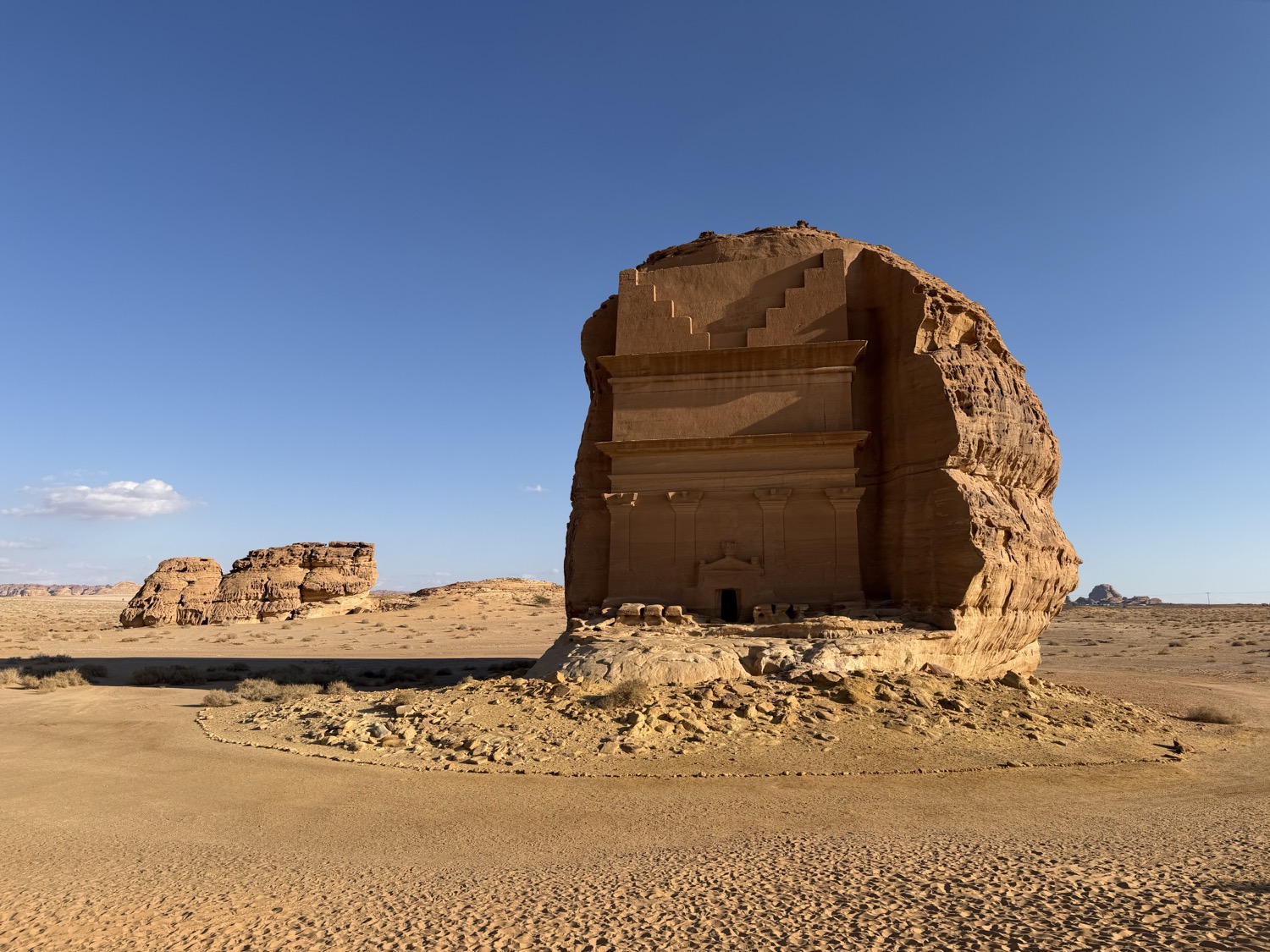
We start this one-week road trip in Saudi Arabia by Al Ula where we go straight to Hegra, the region’s postcard site. This former Nabataean city, often compared to Petra, is impressive both for the finesse of its rock-cut tombs and for how quiet it is. In front of the most famous tomb, there were only seven of us. A surprisingly quiet situation for a UNESCO World Heritage Site.

We then head to the Harrat View Point (free), located on a volcanic plateau over 2,400 meters above sea level. From there, mountains stretch as far as the eye can see.
Later in the evening, we explore the Old Town of Al Ula, now fully reconstructed and designed for tourism. Nevertheless, the area remains pleasant and well integrated into the landscape. If you have more time, the Oasis Heritage Trail starting from the old town also looked interesting.


The next morning starts with the ascent of the White Mountain, whose GPX track(1) is available here (5 km, 370 m elevation gain). It offers great views over the valley and is free, unlike most hikes in the area which require a guide.
In the afternoon, we join a guided tour of Dadan and Jabal Ikmah, two major archaeological sites. The first, Dadan, was the capital of an ancient pre-Islamic kingdom, famous for its monumental rock-cut tombs, some decorated with sculpted lions, while the second, Jabal Ikmah, is known for its rock inscriptions, a true open-air archive of the region’s ancient civilizations.
The day ends with sunset at Elephant Rock (free), an iconic rock formation that fully deserves its reputation.


DAY 3 & 4 – Red Sea
After about four hours of driving, we finally reach the coast. Overall, the road is generally good, despite a long dirt track section between Al Ula and the Red Sea.
Upon arrival at the Red Sea Edition (whose price may scare more than one traveler), things are chaotic. Endless check-in, missing formalities, and two checkpoints before eventually understanding how to reach the hotel on its private island. However, it is not the best first impression.
Nevertheless, once settled, things improve significantly. This recently opened luxury hotel is almost empty. We fully enjoy the calm sea, the pool, the gym and an excellent breakfast. Finally, it feels like a welcome break before heading back inland.


DAY 5 & 6 – Wadi Disah
After another four hours on the road, the scenery gradually changes. Eventually, mountains close in and the landscape becomes more dramatic. As we approach Wadi Disah, the open desert gives way to a green canyon, which is particularly unexpected in such an arid setting. It is possible to visit the wadi independently, but several river crossings with limited visibility can be intimidating for inexperienced drivers. At the entrance, several jeeps wait to take visitors into the canyon.


After an hour in the back of our guide’s old jeep, we reach our camp at Gravity Compass, pleasant but clearly overpriced. Personally, wild camping would have been better than enough in such a setting.
The next day, we explore part of Wadi Ghmrt. We leave the car at this point: 27°38′41.56″N 36°26′19.82″E and walk east. It is possible to go further by 4×4, but walking allows you to fully enjoy the calm. Over several kilometers, we only meet one other vehicle.


We then head to Tabuk and, due to lack of time, fly back to Riyadh.
DAY 7 – Riyadh
Back in Riyadh, I have several evenings to explore the city. Overall, the main highlights can be visited in one or two days.
Diriyah / At-Turaif
Diriyah / At-Turaif (50 SAR) is a must-see. The birthplace of the Saudi dynasty and a UNESCO World Heritage Site, this mud-brick complex has been extensively restored and turned into a large cultural area with exhibitions, walking paths and night lighting. A great introduction to the country’s history.


KAFD and Riyadh’s modern district
KAFD, Riyadh’s ultra-modern financial district, impresses with its architectural coherence. Here, the metro station, designed by Zaha Hadid, marks the entrance to a district where everything feels brand new. Meanwhile, below the towers, the pedestrian “wadi” level further enhances the sense of scale.


Wadi Hanifa green corridor
Wadi Hanifa offers a welcome breath of fresh air and is very popular with locals. We explore it by bike (rental shops here) with a small local group, following this green corridor at the edge of the city. My GPX track(1) is available here (19 km, flat).
Qasr Al Hokm and historic Riyadh
The Qasr Al Hokm area is also worth a visit. Its metro station is probably the most original on the network, with a mirrored UFO-like structure above a central courtyard. Nearby stands the Al Masmak Fort, heavily restored but impressive, with a free exhibition on Riyadh’s history. Right next door, the Al Zal Souk lines up vendors selling mabkhara wood, thobes, shemaghs and locally made agals. My favorite spot is the central square where antique auctions take place, a fascinating spectacle.


National Museum and Saudi heritage
Finally, the National Museum is a great introduction to the country. The temporary exhibitions are particularly well done, and the large free permanent exhibition traces the archaeological history of the region, giving a good overview of key sites if you start your journey here.
This concludes my one-week road trip in Saudi Arabia, though I wish I’d had more time to explore the rest of the country, especially the mountains around Abha.
Practical tips
Al Ula – Planning site visits and accommodation
To organize visits to the various points of interest in Al Ula, you need to go through the official website https://www.experiencealula.com/en, where all experiences are offered. In my opinion, the must-sees are Hegra, Dadan, and Jabal Ikmah, which can be visited in a single day thanks to two tours (one in the morning and one in the afternoon, for 2 × 95 SAR). This is the most economical way to discover the main archaeological sites. Even though the site was particularly quiet during my visit, I recommend booking tickets in advance. Elephant Rock and Harrat View Point, on the other hand, are free.
We ran out of time to try some popular places, such as the Our Habitas hotel, whose dreamy pool and access allow you to admire Maraya, the mirrored building, from the outside. The day pass was priced at 550 SAR. The price is high, but still reasonable when compared to the cost of a night there.
Few hotels are located in the immediate vicinity of the main attractions. Generally, you should expect about a half-hour drive to reach them. We stayed at Cloud7 Residence Al Ula, which turned out to be outrageously expensive for a very disappointing experience. It is therefore advisable to plan well in advance when choosing accommodation.
Duration
The places I visited during this one-week road trip in Saudi Arabia fit into about a week, but the country is huge and has a lot to offer, you could easily spend a month here without getting bored.
Social Change
The country is undergoing rapid economic and cultural change. Dress codes have become more relaxed, especially in big cities, and society is evolving faster than many people expect. This is particularly visible through the organization of large events and festivals, as described in the following section.
Festivals
Traveling to Saudi Arabia during major events such as Soundstorm, organized by MDLBEAST in Riyadh in December, offers a completely different perspective on the country. Spread across eleven stages, the festival features international pop, electronic and rap artists. But beyond the lineup, it’s the atmosphere that stands out. The crowd is young and very open, especially women, often without headscarves and dressed in a Western style. This contrasts strongly with common stereotypes. It gives a striking glimpse of the country’s cultural opening, even if it does not represent everyday life everywhere.


These events are part of Saudi Vision 2030, a wide-ranging reform program aimed at diversifying the economy, reducing dependence on oil, and developing tourism, culture and entertainment. In this context, international festivals like Soundstorm act as showcases for the country’s new image. Tickets remain intentionally affordable (around 200 SAR, or 50 euros for three days).
Alcohol is not (yet) allowed, but that does not prevent people from enjoying the concerts and the overall atmosphere.
There are also dedicated areas for women who prefer to watch the concerts in a more secure space, and anti-harassment campaigns are visible throughout the site.
Best season
- Winter (November to February) The most comfortable time to travel, ideal for sightseeing, hiking and road trips, with cooler evenings in the north and higher visitor numbers at major sites.
- Spring (March to April) A good balance between cities and nature, with still-manageable temperatures and sometimes greener wadis, though the heat starts to build during the day.
- Summer (May to September) Very quiet season and sometimes cheaper, but extreme heat severely limits outdoor activities and road trips.
- Autumn (October) A transition period with gradually milder temperatures, still hot at the beginning of the month, especially inland.
Transport, distance, and driving
With some time and a bit of confidence when it comes to occasionally chaotic urban driving, Saudi Arabia is well suited to a road trip. Renting a car offers great freedom to reach natural sites, cities and more remote regions, especially since public transport is limited outside a few exceptions such as the Riyadh metro.
To cover long distances efficiently, I combined driving with a few domestic flights. This mix allows you to explore the country without spending entire days on the road. In total, the trip includes about 900 km of driving (around ten hours) between Al Ula, the Red Sea, Wadi Disah and Tabuk.
Outside cities, traffic is generally smooth and pleasant, despite frequent speed cameras. In urban areas, however, traffic becomes dense, especially during rush hours, and driving can feel more aggressive.
A 4×4 is not necessary. Except for Wadi Disah, where a guide can take you in a jeep, roads are in very good condition. Even the dirt track between Al Ula and the Red Sea is accessible with a regular car, as long as you drive carefully.
(1)The GPX tracks mentioned in this article are provided for reference only. They should not be followed as official or safe routes. Mountain conditions change constantly and may make a track unsuitable or dangerous.
Leave a Reply