
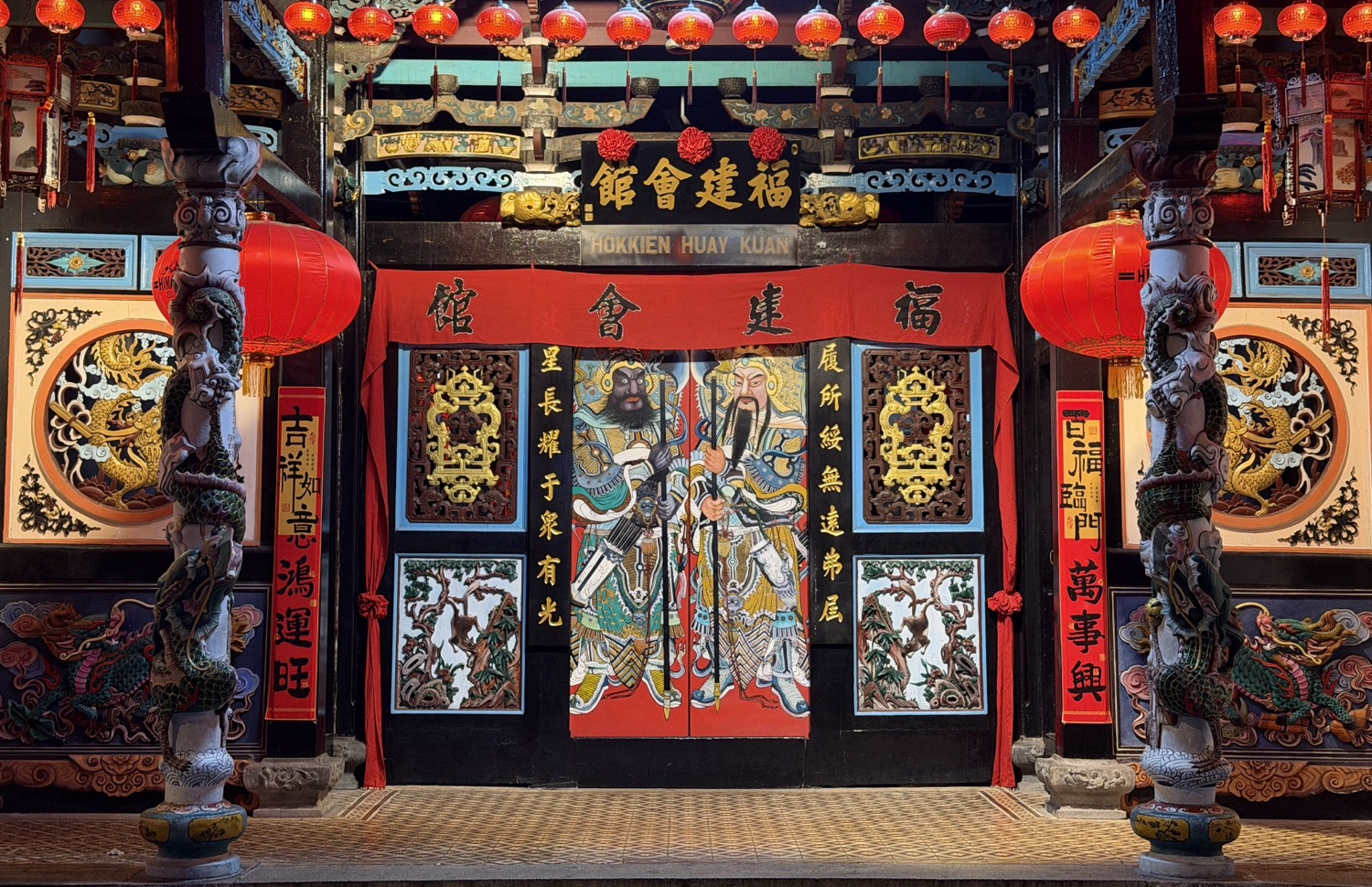
I’m sharing my itinerary for peninsular Malaysia, connecting Langkawi to Singapore in 2 to 3 weeks by public transport. It’s a journey through a remarkably diverse country. Traveling mainly along the west coast using trains, buses, and ferries, you’ll discover tropical islands, colonial cities, a futuristic and eclectic capital, rolling tea plantations, and one of the world’s oldest jungles. All while taking the time to soak in the country’s unique atmosphere.


Overview

Day-by-day itinerary
LANGKAWI – 2 days
I arrived in Malaysia after several weeks in the Thai islands, which I cover in my article Best Thai islands: between beaches and diving. Arriving by speedboat from Koh Lipe, Langkawi serves as an excellent entry point for starting this itinerary by public transport in Malaysia.
Langkawi really contrasts with the ultra-touristy Thai islands. The vibe is less paradisiacal, but more local and authentic, with a strong presence of Malaysian tourism.
I landed at Kuah and then took a Grab to Pantai Cenang. Even though it’s not the island’s most beautiful beach, it’s pleasant and, most importantly, the most practical. It has the highest concentration of hotels, restaurants, and water sports activities (jet skis, parasailing, etc.). As a bonus, the beach is on the right side of the island for watching sunsets!


Mangrove tour
On the first day, I joined a mangrove tour. Yes, there were crowds. Yes, the boat zips from one spot to another like a tropical amusement park. But the organization was efficient, and the landscapes are unique and worth the trip. I later learned my visit coincided with the arrival of a cruise ship, which partly explained the crowds. Several agencies in town offer similar tours that can be booked the day before without issues. For my part, I booked the tour through my hostel (see below). The one offered by the hostel was on the lower end of the prices I saw.


In the late afternoon, I had to make a practical round trip to Kuah to get my third dose of the rabies vaccine following an incident in Thailand (insert link). Thank you, monkeys! As a reminder, don’t feed them and travel with good insurance!
I took the opportunity to see CHOGM Park and Eagle Square. They are nice if you’re passing by, but clearly not essential.


Sky Bridge and Seven Wells Waterfall
The next day, I headed to the famous Langkawi Sky Bridge. Unfortunately, it’s not accessible on foot (at least not without a guide), so I followed the crowds and took the cable car. The structure is impressive (engineer speaking!) and the views over the archipelago are beautiful.
My advice: arrive before opening. We arrived a bit late and waited nearly two hours. There is a fast-track pass available for 50 RM.
Prices in February 2026:
- Cable car: 85 RM for foreigners
- Access to Sky Bridge: 6 RM extra


After the visit, I headed to Seven Wells Waterfall, visible from the cable car in the distance. A staircase leads to several natural pools where you can swim. I then tried to reach Peak 701, but a sign indicated a guide and permit were required. I admit I hesitated for a few seconds before choosing the sensible option. If you want to go, check Google reviews and inquire at the park entrance.


Unable to book a Grab (see the transportation section) from the cable car base, I walked to Pantai Kok beach and the Perdana Quay Lighthouse, enjoying a beautiful sunset. From there, I finally managed to get a Grab.


Duty-free zone
Langkawi is a duty-free zone. Apart from alcohol and cigarettes, chocolates are particularly cheap here. Let’s just say it’s the ideal place to buy souvenirs… that might melt before you even reach the hotel.
Getting around the island
This is the part of this Malaysia by public transport itinerary where traveling without a car is most challenging, as public transport seems almost non-existent on the island. Fortunately, taxi/Grab prices are quite reasonable, especially if you avoid peak hours.
Accommodation
I stayed at Bed Attitude Cenang, an extremely clean hostel (I saw them flipping mattresses in the dorms to clean underneath, which is rare!) with pleasant common areas, a game room, and a quiet room ideal for working.
ALOR SETAR – 1 day (optional)
From Langkawi, there is no longer a direct ferry to Penang since the COVID-19 pandemic. Many travelers opt for the plane, but for such a short distance, it didn’t seem very relevant.
So I continued this itinerary by public transport in Malaysia by choosing a route entirely by public transport, which seemed punctual and efficient, making this journey relatively easy:
- Ferry between Langkawi and Kuala Kedah (1h45, 47 RMB, booked in advance on cuticutilangkawi);
- Taxi/Grab to Alor Setar (20 minutes, 20 RMB);
- Train to Butterworth (1h, 7 RMB, no seat reservation, bought at the station, buses also available, more info in the transportation section below);
- Ferry to George Town (30 minutes, 2 RMB, regular and no reservation).
A pleasant stop before Penang
The big advantage of this option is that it allows you to visit a city often overlooked in classic itineraries, Alor Setar.
Its center is compact and pleasant, with beautiful shophouses, several street art murals, some colonial buildings, and an elegant mosque grouped around the main square. The whole area is quiet and feels off the beaten tracks, which contrasts with the following stops.


What are Shophouses?
These are traditional buildings where a shop occupies the ground floor and living quarters are upstairs. Very common in Malaysia, they blend Chinese, Malay, and colonial influences, with their colorful facades and covered walkways. Today, many house cafes, boutiques, or hotels while retaining their historic charm.
Note that the station unfortunately has no luggage storage. Since the city isn’t too big, I explored everything with my backpack on.
If you have an extra day, spending a night here allows you to explore the surroundings, which also seem worth a detour. Paddy Museum tells the story of rice cultivation in Malaysia, while Gunung Keriang offers a great viewpoint over the vast Kedah rice fields, which I only glimpsed from the train to Butterworth.
GEORGE TOWN / PENANG – 2 to 3 days
A UNESCO World Heritage site, George Town charms with its mix of cultures, colonial architecture, and famous street art. It’s possible to see the main sights in a day, but I recommend two to three to also explore the surroundings. With its wide range of accommodations, excellent restaurants, and central location, the city is an ideal base for an itinerary by public transport in Malaysia, especially for exploring Penang island.


The Kongsi, a unique heritage
On the first day, I explored the UNESCO-listed historic center. Among the most unique sites are the kongsi, of which the following two can be visited: Leong San Tong Khoo Kongsi and Seh Tek Tong Cheah Kongsi. These clan houses were founded by Chinese communities arriving from southern China in the 18th and 19th centuries. Much more than simple temples, they formed veritable small communities organized around a sanctuary, with their own schools, housing, and mutual aid systems. I was fascinated by the temple murals at the first site.


Colonial architecture
Fort Cornwallis was under renovation during my visit. However, the outdoor areas have been completely redesigned and are well worth the stroll. They also offer views of several remarkable colonial buildings, including the Town Hall, the Supreme Court, and the Church of the Ascension.
I also passed by The Blue Mansion, which looked beautiful but I couldn’t visit. Visits are limited, so you need to book in advance.


Street art, galleries, and historic neighborhoods
Several murals are scattered throughout the city center, such as Backlane Walkway, The Bike, and Boy on Motorbike. The best way to find them is to wander around or zoom in on Google Maps to see the ones that interest you.
I also really enjoyed Artlane, a series of old narrow houses transformed into a covered gallery where artworks are displayed across several buildings.
Another original spot, a bit further from the center, is Hin Bus Depot, a former bus depot converted into an art space, particularly active from Friday to Sunday. The program is available at https://hinbusdepot.com.


Sunset at the jetties
At dusk, I headed to the famous Chew Jetty, Tan Jetty, and Lee Jetty. In February, the sun doesn’t set directly in front of the jetties, but the stilt houses bathed in golden light create a beautiful atmosphere. To avoid the crowds, it’s better to come early morning or mid-afternoon.

Evening in Little India and Chinatown
In the evening, the Little India and Chinatown neighborhoods transform completely. Lanterns light up, temples like the Kuan Yin Temple are illuminated, and the streets become particularly photogenic. If you’re not too late, don’t miss Han Jiang Temple, whose interior paintings and decorations are among the most beautiful I’ve seen in Malaysia.
To end the evening, you have two options. The bars around Love Lane and Chulia Street are very lively. If you prefer a more original vibe, try a speakeasy-style bar. I chose Manchu Bar: the setting is original, the cocktails excellent, and live music is offered some nights. Prices, however, are significantly higher than in regular bars.


Penang Hill, a hike without a guide
On the second day, I went on a hike to Penang Hill. The view at the top didn’t particularly impress me, but the ascent is arguably one of my favorite hikes from this trip. The trails are uncrowded, access restrictions are almost non-existent (which seems rare), and the jungle remains surprisingly wild.
I followed a route shaped like… Pikachu. Some sections are particularly steep and slippery, with a few stretches on roads, but traffic is very limited. The hike ends at the Penang Botanical Gardens, after encountering two different species of monkeys. You can find the GPX track(1) here (16.06km – 993m ascent and 993m descent).


Penang National Park also seems to offer several nice trails, including one to Ketapang beach, which appears relatively unspoiled.
Accommodation
For sleeping, I chose Swing & Pillows @ Victoria Street. The private rooms are simple, with shared bathrooms, but the place is clean, very well-located, and hard to beat on price.
IPOH – 1 day (optional)
From Penang, I took the ferry back to Butterworth, then the train to Ipoh (12.80 RM). Ipoh isn’t essential in itself, but by public transport it serves as a good break on the route between Penang and the Cameron Highlands. I also considered stopping at Taiping and Kuala Kangsar, located on the same railway line, but the weather pushed me to limit my movements.
The historic center is compact and can be visited quickly. I especially enjoyed the atmosphere of the old shopping streets around Concubine Lane. If you have more time, the cave temples south of the city seem worth a detour, but I arrived too late to visit them.


Coffee like a local
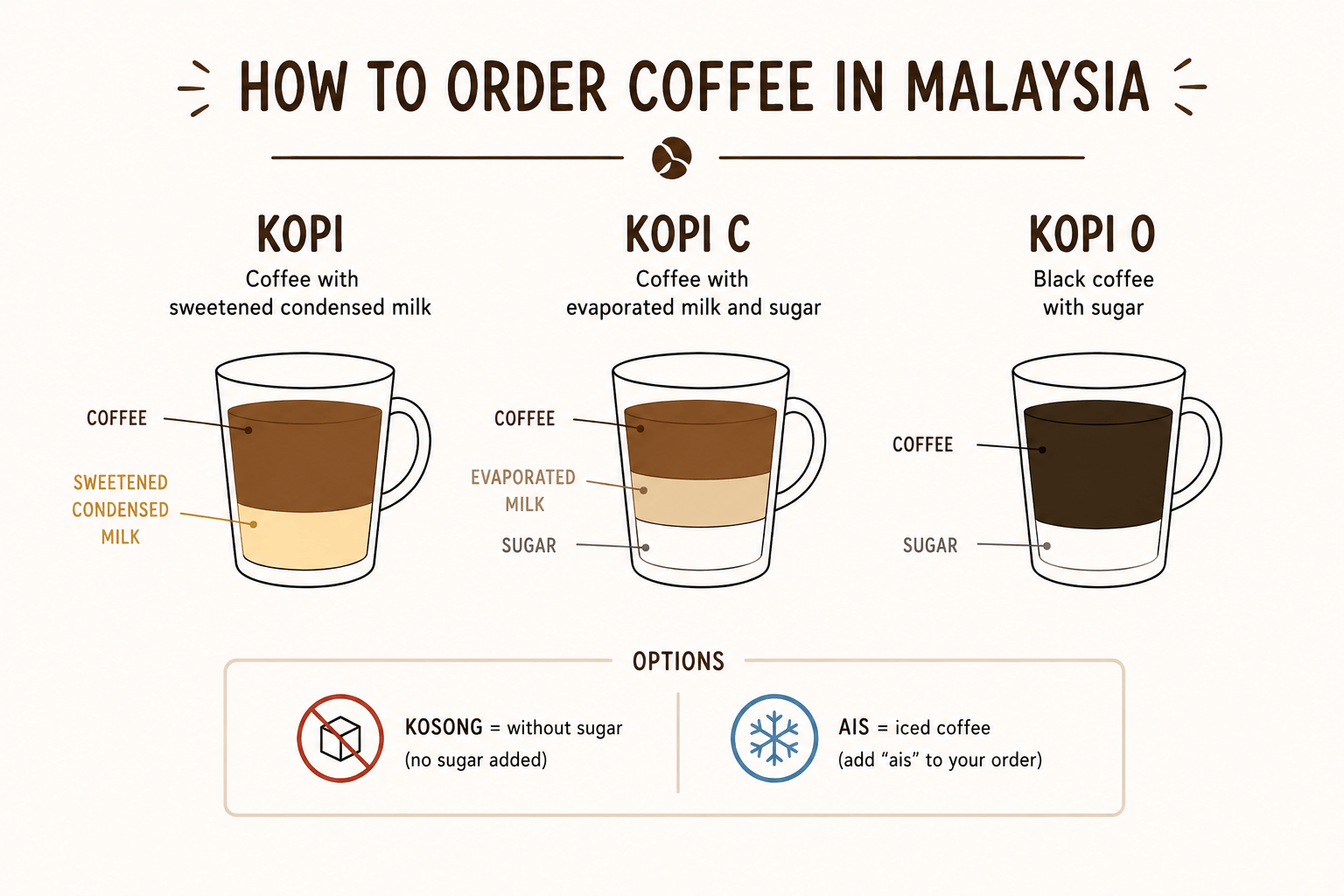
Ipoh is the birthplace of the famous white coffee. A kopitiam is a traditional Malaysian coffee shop serving coffee, tea, kaya toast, and simple dishes all day long. Kedai Makanan Nam Heong is one of the ideal places to try this specialty at unbeatable prices.
How to order your coffee?
Ordering coffee in Malaysia requires a bit of adjustment. A kopi is typically made with sweetened condensed milk, a kopi C uses evaporated milk, while a kopi O is black coffee. By default, these coffees are sweetened. For a sugar-free version, add kosong, and for iced coffee, add ais/ice (e.g., kopi O kosong ais).
Accommodation
I spent the night at Miner’s House, a somewhat out-of-the-way but very pleasant place to relax, with particularly comfortable common areas.
CAMERON HIGHLANDS – 1 day
I took the 10:15 AM bus from Ipoh to Tanah Rata. After a beautiful journey where the landscapes gradually change from cultivation to increasingly dense forest, I arrived in the early afternoon at this small village. Tanah Rata itself has little interest.
Most visitors choose an organized tour of half a day or a full day to discover tea plantations, strawberry farms, or cacti. This seems to be the default solution in this itinerary by public transport in Malaysia. However, I only heard mixed reviews. So I preferred to go on a hike to the tea plantations.
If you don’t like hiking, I honestly think the Cameron Highlands can be skipped. In my opinion, it’s the most interesting activity in the region, and a single afternoon was enough for me to get an excellent overview. Other trails exist, but several require a guide.
Jungle Trail 6 and 10
I combined Jungle Trail 6 and 10, which I highly recommend to hiking enthusiasts. The trail climbs to Gunung Jasar (1,670 m) via a sometimes very steep ascent, with a few sections equipped with ropes and even a ladder.
At the top, I realized a storm was approaching quickly. I even saw lightning strike lower than me in the valley… not exactly reassuring. I quickly descended and, against all logic, the high-voltage line the trail passes under afterwards was almost reassuring: at least I was no longer the highest point in the landscape.
The track then follows this power line through dense forest before arriving behind the tea plantations. This approach is particularly pleasant as it allows you to enjoy the scenery almost alone for a while before joining the crowds gathered around the famous “I Love Cameron Highlands” sign.
The entrance to the plantations is announced at the start of the hike, but… you only pay for it upon exiting.
My GPX track(1) is available here (5.70km – 323m ascent and 527m descent).


Return to Tanah Rata
From the plantations, the normal route back to Tanah Rata is along a main road. Taxis and Grabs seem available, but I ultimately didn’t need them as a motorcyclist spontaneously stopped to offer me a ride back.
I do not recommend this hike in rainy weather: the ground quickly becomes very slippery, both uphill and downhill.
TAMAN NEGARA – 2 to 3 days
I wanted to discover the Malaysian jungle and initially planned to visit Endau Rompin, which seemed wilder and less touristy. After several unsuccessful searches for a way to get there by public transport and organize an excursion within the flow of this Malaysia itinerary, I finally settled on Taman Negara, one of the world’s oldest tropical rainforests (no complaints there). However, don’t expect to see many large mammals; they seem to avoid the areas most frequented by visitors (good for them).
Access to Taman Negara
From Cameron Highlands, agencies and hotels offer two options to reach Kuala Tahan, in the heart of Taman Negara, using public transport: a direct minibus, or a minibus to Jerantut followed by a boat. I opted for the second option, longer and more expensive, but which I really enjoyed.
In Jerantut, we had time to eat, and I stumbled upon Gipsy Garden, which made my day. The owner welcomed me warmly, played me a guitar piece, and his wife cooked one of the best vegetarian fried rice dishes I’ve tasted.


After this break, we boarded the boat and immediately got into the thick of it: the park is immediately impressive with its gigantic trees and shallow rivers.
What you can do without a guide: Bukit Teresek
The park entrance is reached by crossing the river from Kuala Tahan. From the visitor center where you pay the entrance fee, you can access the main self-guided hike, which uses wooden boardwalks and stairs to reach the top of Bukit Teresek, offering a viewpoint over the canopy and the vastness of the reserve. The route passes by a beach where you can swim in the river. The Canopy Walkway was closed during my visit.
Taking the first boat across the river in the morning increases your chances of observing a bit more wildlife.
The GPX track(1) of my route is available here (6.23km – 307m ascent and 307m descent).


All other activities, like deeper jungle excursions or night walks, must be done with a guide. During my stay, the jungle camping tours were unfortunately closed due to rain and would only reopen a few days later. So I organized 3 day-trips on site.
Night walk
This was one of the best activities in my opinion. I opted for the longer outing, which allowed us to see spiders, scorpions, millipedes, snakes, a slow loris, and monkeys.


“Long hike”, waterfall, Orang Asli village, and rapids
Marketed as a 9km long hike (actually 7km), I was a bit disappointed to reach the end in 2.5 hours. But it’s one of the few affordable day-trip options.
We left early, which allowed us to enjoy the waterfall before the arrival of other groups (and there were many). In terms of wildlife, we saw a beautiful chameleon and some monkeys.
In the afternoon, we visited an Orang Asli village (indigenous Malaysian peoples). This gave us insight into their culture, habitats, and traditions, and also taught us how to make fire and blow darts.
I’m generally not a fan of this kind of somewhat “voyeuristic” activity, but I thought it was well-framed, with a dedicated area for tourists and pleasant interaction with the communities, who are paid for these visits.
The return is by boat through “rapids”: I expected some sort of rafting, but the boat just goes fast and the guide splashes you, it’s still very fun.


Boat trip to Lata Berkoh
For this tour, you only need to book the boat, and the price is the same for 1 to 4 people. Talking to people around me, I met two travelers whom I convinced to join me. The boat ride is beautiful and allowed us to spot a deer and monkeys. The boat drops us off on the bank and tells us to continue on foot. We arrived at a wide waterfall where we could swim. Very nice, but the price was going to double the month after my visit, and without sharing it, I personally find it exaggerated.


Practical organization
As you probably understood, most activities must be guided, which is a bit frustrating when you like to do things on your own. However, it helps limit our impact on the local ecosystem and contributes to the region’s economy, and honestly, the prices were generally reasonable. I organized everything on-site with my hostel, the Wild Lodge. The tours organized by them were generally of good quality, especially for the night walk where the number of spots was limited to 8 if I remember correctly, unlike others we encountered, sometimes with up to twenty people. This increased our chances of spotting animals.
For multi-day tours, I think some can be organized on-site, but most should be arranged in advance.
Accommodation
I stayed at Wild Lodge Taman Negara. Even though the dorms are quite basic, the owner helps organize the various tours, and it’s a great place to meet people, especially since it seems to be the only place selling alcohol.
KUALA LUMPUR – 2 to 4 days
I continue this Malaysia by public transport itinerary with Kuala Lumpur. This capital is unlike any other. The city blends futuristic skyscrapers, colonial architecture, mosques, gigantic shopping malls, and omnipresent nature that even finds its way into the city center. Dominated by Merdeka 118, which became the world’s second-tallest tower in 2026 behind the Burj Khalifa, it offers enough to easily fill several days.
Kuala Lumpur City Centre (KLCC)
The Petronas Towers, still the tallest twin towers in the world, are the city’s symbol. I simply admired them from the esplanade and KLCC Park; the mixed reviews on the visit and the high price didn’t convince me to go up. The area also houses several other remarkable skyscrapers for architecture enthusiasts. Don’t miss the Ilham Gallery, a small free art gallery located a few minutes’ walk away.

Rooftops
Kuala Lumpur is probably one of the cities offering the best selection of rooftops at reasonable prices. I chose Helipad Lounge Bar, a real helipad turned into a bar every evening. Entry cost 100 RM during my visit and included two drinks. The view of the skyline is superb.
From my accommodation’s swimming pool (see below), the view of the skyscrapers was equally impressive.

Chinatown and the colonial quarter
Chinatown concentrates many shophouses, temples, restaurants, and the Petaling Street market, located at the foot of the impressive Merdeka 118.
Don’t miss:
- Kwai Chai Hong, a very touristy small alley decorated with magnificent street art.
- Petaling Street Market, for its lively atmosphere.
- REXKL, a former cinema turned into a cultural complex with cafes, shops, creative spaces, and a surprising library upstairs.
- Central Market, perfect for browsing or buying souvenirs.
- The colonial buildings around Merdeka Square, including the Sultan Abdul Samad Building and St Mary’s Cathedral.
- The impressive National Mosque of Malaysia.


Batu Caves
Batu Caves are among Kuala Lumpur’s must-see sites. Even though the temple itself didn’t particularly impress me, the immense caves are well worth the trip. Just be careful of the monkeys, always on the lookout for food.


Access is very easy by train. Google Maps showed the times correctly (about one train per hour), and it’s the most economical solution in my opinion. If traveling in a group, a Grab can also be worthwhile.
The only “scam” of the trip?
Upon arriving at the station, several people tried to direct visitors to the left. This is actually a way to get you to visit paid caves that are not the real Batu Caves. Based on the reviews I saw, they are not very interesting. Just check the location on Google Maps before following anyone.
Museum district and National Mosque
Kuala Lumpur has several museums worth a visit. Here’s what I thought of those I visited:
- The National Museum seems a bit dated, but the free guided tour (about two hours, times available on the official website) is fascinating for understanding Malaysia’s history.
- The Islamic Arts Museum is probably my favorite museum in the city, especially for its impressive collection of mosque models from around the world.
- If you have time, the free National Planetarium is still interesting despite very outdated facilities.

Nature
One of the aspects that surprised me most about Kuala Lumpur is the place given to nature.
Tugu Park is my favorite. This true little jungle allows for a hike of about 5 km on a surprisingly small area. A very effective system of markers allows you to follow and adjust the distance you wish to cover.


The Perdana Botanical Gardens are pleasant for a walk, even though they impressed me less.
I didn’t visit KL Forest Eco Park, as the many negative comments about its value for money discouraged me.
Bukit Bintang: malls and night market
Few cities have as many shopping malls as Kuala Lumpur. Most are clustered around Bukit Bintang. I was there during Chinese New Year, and the decorations were particularly original.
My favorites are:
- GMBB, an atypical mall dedicated to artists, galleries, and creative workshops.
- LaLaport Bukit Bintang City Centre, whose rooftop offers a great view of the city.
- The Exchange TRX, a huge mall located at the foot of Merdeka 118.
- Pavilion Kuala Lumpur, very central with many international brands.
A few minutes away is the famous Jalan Alor night market, where food stalls line the street. It’s a great opportunity to try all sorts of fruits I didn’t know. Right next door, Changkat Bukit Bintang gathers several bars frequented by tourists, without particularly convincing me.


Thean Hou Temple
Thean Hou Temple is a beautiful Chinese temple, especially lovely at dusk when illuminated. However, it’s quite out of the way, and I don’t necessarily recommend it if your accommodation is far.


Accommodation
It’s fairly easy to find accommodations offering excellent value for money. I stayed at Riveria City, a complex of modern residences (some still under construction) with an infinity pool overlooking the skyline and a gym. Apartments are usually rented by individuals, even though this seems prohibited in some residences. However, read the comments carefully before booking, as the quality of accommodations can vary greatly.
The elevators sometimes seem undersized for the number of apartments. During my check-out time, I waited nearly 40 minutes before I could go down.
If you’re traveling for several months, Kuala Lumpur is also an excellent city for a break. Apartments in these residences with pools and gyms are surprisingly affordable.

MALACCA – 1 to 2 days
The last stop of this Malaysia by public transport itinerary before heading to Singapore, Malacca charms with its rich colonial past and UNESCO-listed historic center. A day is enough to see the main sites, although the numerous museums can easily occupy more time.
Historic center
The must-sees are concentrated around Dutch Square, St. Paul’s Hill with its church ruins, and Porta de Santiago, a vestige of the Portuguese fortress. These sites can be visited quickly.
The city then has many museums. As many cover parts of Malaysia’s history, the information can become repetitive. I particularly enjoyed:
- The Proclamation of Independence Memorial (free), tracing the country’s history up to its independence.
- The Cheng Ho’s Cultural Museum, dedicated to the famous Chinese explorer and navigator Zheng He, explaining the origins of the important ties between China and Malaysia.
- The Malaysia Architecture Museum, a small museum housed in a traditional house showcasing the country’s different architectural styles. A fairly specialized museum, but worth a visit if the subject interests you.
The Melaka Sultanate Palace Museum, housed in a 1980s reconstruction of the palace on the site of the former one, is mainly worth a detour for its exterior architecture. I felt that the exhibition itself wasn’t really worth it.
The Museum of History and Ethnography didn’t convince me further, probably because it was already the fifth museum dedicated to Malaysian history I was visiting.


Jonker Street
Around Jonker Street, where the city’s most popular night market is held, it’s pleasant to wander without a fixed itinerary. The shophouses, temples, mosques, and numerous street art pieces give this neighborhood a lot of charm. I was there during Chinese New Year, and it was clearly the best place to watch the festivities.


Villa Sentosa
I highly recommend not missing Villa Sentosa, accessible by walking along the river. This traditional former house, still inhabited by a local family and located outside the UNESCO-protected area, is one of the last testimonies of traditional life in a neighborhood now surrounded by modern buildings. The residents are happy to take the time to answer visitors’ questions. Entry is free, with donations appreciated upon exit.


Malacca Straits Mosque
At sunset, the Malacca Straits Mosque is particularly beautiful when illuminated. Although it’s possible to walk there, the route is quite long and uninteresting. I recommend taking a Grab instead.

SINGAPORE – 3 to 4 days
From Melaka, I leave Malaysia and continue my itinerary towards Singapore, still by public transport. This is covered in a separate article available here: Singapore in 4 Days: Multiculturalism 2.0.


Practical tips
Budget
On this Malaysia by public transport itinerary, I spent about 350 RM per day (approx. €50 / $55 USD), alternating between dorms, private rooms, and an apartment in Kuala Lumpur, eating mainly in simple restaurants, and taking part in a few organized activities. One of the great advantages of this itinerary is that most public transportation in Malaysia is very affordable.
Duration
Allow a minimum of 10 days. However, to complete this itinerary by public transport, some travel legs take time, and two weeks allow you to discover Malaysia more serenely. With three weeks, you can even add Singapore.
Borders and formalities
Koh Lipe → Langkawi
The crossing is by speedboat. On Koh Lipe, you need to arrive about two hours before departure (confirm when booking) to complete Thai immigration formalities before boarding, usually at the station near Pattaya Beach. During my journey, I had to hand over my passport, which was returned to me on board. Upon arrival at Langkawi, Malaysian immigration formalities are carried out, depending on the company, at Kuah Jetty or Telaga Harbour.
Malaysia → Singapore
To reach Singapore from Malacca, or more generally from Malaysia, the simplest way is to take a bus to Johor Bahru, then cross the border on foot using the bridge.
Free Arrival Card
For many nationalities, a free Malaysia Digital Arrival Card (MDAC) must be completed within three days of arrival in Malaysia. As conditions can change, always check the formalities on your country’s Ministry of Foreign Affairs website.
Caution: many fraudulent or intermediary sites appear at the top of search results and, after you fill in your details, ask you to pay. Always make sure you are on the official Malaysian immigration website, whose address ends with .gov.my, and never pay for this procedure.
Recommended season
For this itinerary, the best period is from December to March, when the west coast is generally at its driest.
Transportation
Public transportation in Malaysia is generally punctual, economical, and makes it easy to reach most of the stops proposed in this itinerary by public transport.
Grab
Grab, the equivalent of Uber, works extremely well in cities and remains very cheap compared to European standards. Prices vary according to demand; waiting a few minutes can sometimes halve the fare.
Trains
The official KTMB app lists all trains and is easier to use than the website. Komuter trains (notably between Alor Setar and Butterworth) operate like metro trains, and one ticket is valid all day. To check schedules, first select the train type (Intercity, Komuter, or Shuttle Tebrau), then click on My Railtime.
Ferries
For Langkawi, I recommend booking at the port or on cuticutilangkawi, which seemed to offer fair prices.
For the Koh Lipe ↔ Langkawi connection, Trip.com offered the best rates during my trip.
(1)The GPX tracks mentioned in this article are provided for reference only. They should not be followed as an official guide or a safe route. Mountain conditions are constantly changing and may make a route unsuitable or dangerous.
Leave a Reply