
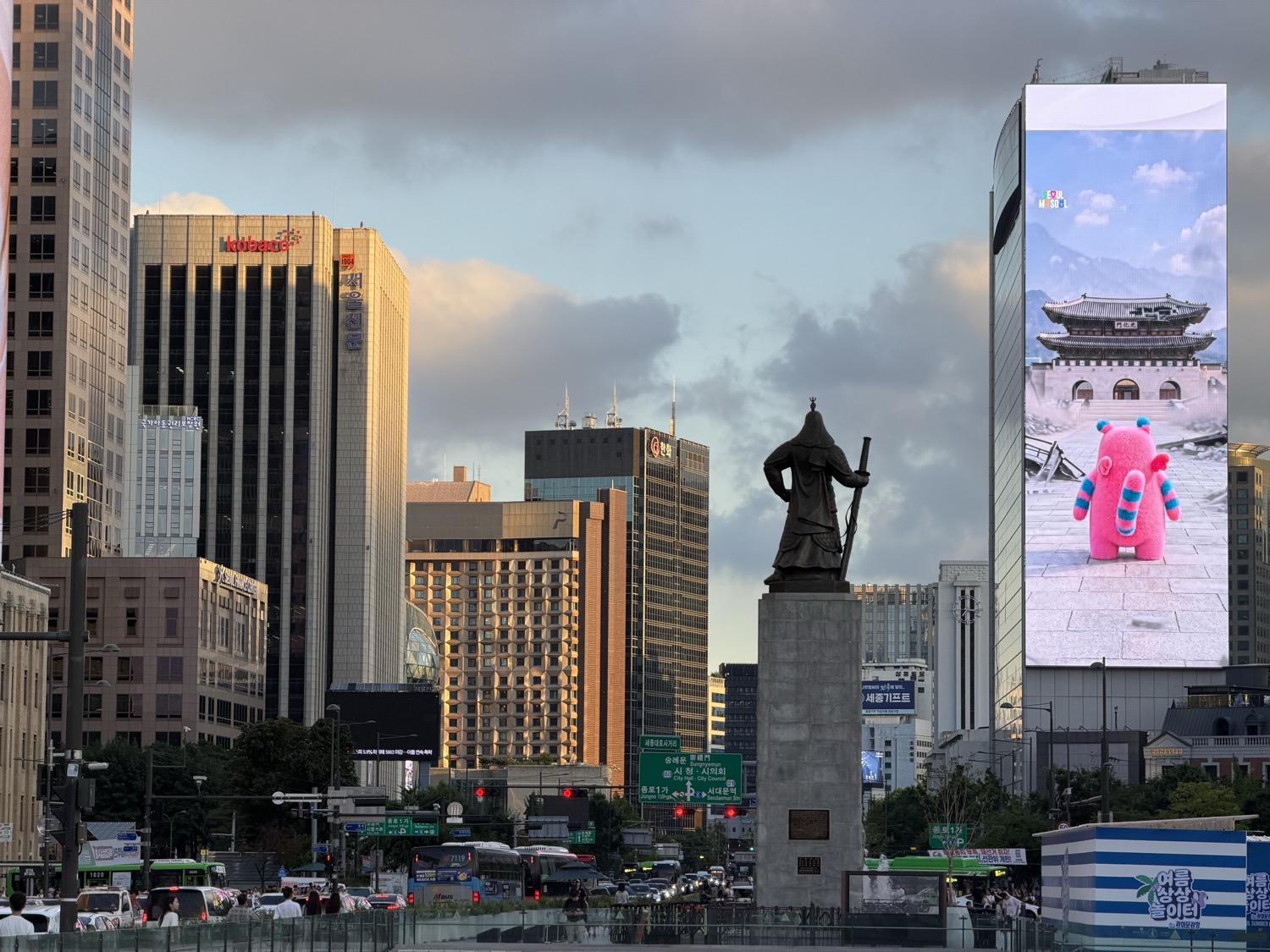
Seoul offers a remarkably exceptional snapshot of South Korea, and you can get a great overview in 5 days. The city combines a massive modern metropolis with royal palaces, temples, tombs, museums, traditional markets, spectacular contemporary architecture, and genuine natural spaces where you can hike.
I had already visited Seoul about ten years earlier on a business trip. At the time, I barely had time to see anything. Suffice it to say, the frustrating potential of a Seoul trip viewed from a conference room was quite high. This time, I spent 12 days there to fully enjoy the city.
In this article, I’ll share my impressions from each of my visits to Seoul and propose a 5-day itinerary combining walks, historical sites, museums, lively neighborhoods, and contemporary architecture. It also includes a day at the DMZ, which serves as the border with North Korea and is easily accessible from Seoul without necessarily booking an organized tour.


Overview
Map
Hiking, Nature and Sports
One of the aspects I appreciated most about Seoul is how easily you can transition from the city to the mountains.
I did two day-hikes that I particularly recommend. The first is very urban and historical and the second is significantly more wild and airy.
The Ancient City Wall Hike: Hanyangdoseong
21.06km – 1000m ascent and 1000m descent – difficulty 4/10(2) – GPX Link(1)
The first hike follows Seoul’s ancient city wall and allows you to discover a large part of the historic center. Since this route offers a great overview of the city, I propose it as the first day of a 5-day Seoul itinerary.
I personally started the loop from Hyehwamun Gate since I was staying in that neighborhood, but you can start anywhere along the loop.
The route begins with the most athletic part, tackling two of the loop’s three peaks: Bugaksan and Inwangsan. From the second mountain, the view is particularly beautiful.
The trail then descends toward the city center with Sungnyemun Gate. The hike passes by Namsan, the third mountain on the route and the most famous in central Seoul. It offers several beautiful viewpoints over the city and provides access to the Seoul Tower, which you can go up.
Next comes the impressive Dongdaemun Design Plaza (DDP), designed by Zaha Hadid and Samoo. The building also incorporates remnants of the ancient wall.
North of the DDP is Heunginjimun Gate, followed by Heunginjimun Parks and the Seoul City Wall Museum, which I didn’t visit.
The route continues toward Naksan Park, where the wall is particularly picturesque. This area is especially known for being used as a backdrop for several K-dramas.
The hike then runs alongside Ihwa-dong Mural Village, a pleasant spot to take a break at a café.
This hike is quite long, but you can easily select the sections that interest you.


Bukhansan: My Favorite Hike
15.05km – 1390m ascent and 1356m descent – difficulty 8/10(2) – GPX Link(1)
The second hike is much more athletic and I haven’t included it in my proposed 5-day Seoul itinerary. However, if you enjoy hiking, I recommend not missing it as it’s one of my favorites in South Korea!
It crosses Bukhansan National Park from southwest to northeast in a wilder environment, although most of the path is developed with barriers and stairs. Note that some sections are frankly steep and dizzying, especially in the first part.


Other Green Spaces
Seoul also has numerous parks where you can run, walk, and even lift weights! Indeed, the city has many outdoor fitness facilities. Some are quite comprehensive and have weights.
Here are the places I liked best.
Gyeongui Line Forest: this linear park built along an old railway line has a fairly complete outdoor gym with weights (here).
Namsan Park: right in the heart of Seoul, the park is best known for its viewpoints, but it’s also an excellent place to run or use outdoor fitness facilities (here).
Yeouido Park: this large park is pleasant for a stroll. In summer, Mulbit Square has a large wading pool particularly suited for families. You can also take the opportunity to see the National Assembly Building.


Cheonggyecheon Stream: this restored former waterway crosses central Seoul from west to east. It makes for a pleasant walking route and also seems particularly well-suited for running.
Seoul Olympic Park: a bit out of the way, it wouldn’t be on my priority list for a first visit. If you have more time, however, it’s worth a visit for its green spaces, museums, and sculpture park.
Contemporary Architecture in Seoul
Contemporary architecture is one of the aspects of Seoul I researched quite a bit.
Unlike Tokyo, where you can connect several remarkable buildings on foot as I detail in my article: Contemporary architecture and iconic toilets in Tokyo, the interesting buildings are much more spread out in Seoul.
Before my stay, I consulted several blogs and compiled a list of buildings I wanted to see. I then plotted them on the map.
I visited most of them. However, unless you’re already in the area, I don’t necessarily recommend crossing the entire city for each one. I’ve only listed my favorites below.
Buildings to See in Gangnam
Gangnam is probably the only area where you can build a proper walk dedicated to contemporary architecture.
Around Gangnam Station, you can see Boutique Monaco, Seocho Garak Tower East, and Urban Hive. These buildings are mainly viewed from the outside.
Between Bongeunsa and Apgujeong-Rodeo, Dosan-daero and Apgujeong-ro also concentrate many original facades, especially for luxury brands such as Dior and Celine.
I recommend not missing the Songeun Art Space, one of the most impressive buildings in the area with its concrete facade designed by Herzog & de Meuron. This building also houses a gallery that allows you to discover the interior. Unfortunately, I arrived after closing time.


My Other Favorite Buildings
Ewha Womans University: the campus features particularly spectacular architecture designed by Dominique Perrault, especially around its main building. A sign at the entrance indicates where tourists are supposed to stop. I visited the campus during the weekend and didn’t feel like I was disturbing anyone.

Amorepacific Headquarters: this building by David Chipperfield Architects is particularly interesting inside, especially thanks to its large concrete beams topped with a thin water blade that creates beautiful reflections on the structure. The building also houses an art museum that I didn’t visit.


Seoul City Hall: the renovation of the former Japanese colonial building yields a particularly audacious result. The project was carried out by the Korean firm iArc. I recommend coming on a weekday to access the Sky Plaza Gallery when it’s open. On the ground floor, a robot prepares coffee.


Dongdaemun Design Plaza: the complex designed by Zaha Hadid and Samoo is probably one of the most recognizable contemporary buildings in Seoul. It also incorporates remnants of the ancient wall.


Seoullo 7017: this former road viaduct was transformed into an elevated linear park about one kilometer long by MVRDV.
An Jung-geun Memorial Museum: the museum itself didn’t particularly impress me, but the building designed by D Lim Architects, near Namsan Park, is worth the detour in my opinion.
Whitestone Gallery Seoul: this small gallery has a very interesting building designed by Kengo Kuma.
For a much more exhaustive list of contemporary buildings in Seoul, the Archi Guide website is a good starting point for research.
Museums to Discover in Seoul
Seoul is full of museums. There’s truly something for every taste. Below, I share my impressions of the ones I explored. I’ve ranked them within each category in order of preference (my favorite at the top).
Art Museums
Leeum Museum of Art: a museum dedicated to traditional Korean art, modern art, and contemporary art, housed in a particularly interesting architectural ensemble designed by Mario Botta, Jean Nouvel, and Rem Koolhaas. A large part is free. However, the paid temporary exhibitions were worth it.


Seoul Museum of Art: a modern and contemporary art museum housed in a former Supreme Court building, with regularly renewed exhibitions and programs. Entry is free for the relevant spaces, excluding certain special exhibitions.
National Museum of Modern and Contemporary Art: the main national museum dedicated to Korean modern and contemporary art, with temporary exhibitions and a significant collection. Free on the last Wednesday of the month.
Piknic: a cultural space housed in a former industrial building, mainly dedicated to temporary exhibitions and contemporary art projects.
Centre Pompidou Hanwha: the new center dedicated to modern and contemporary art, located in Yeouido within the 63 Building complex. It opened in June 2026 as part of a partnership between the Hanwha Foundation and the Centre Pompidou. However, during my visit, several posters were calling for a boycott of the museum since the Hanwha Group supplies weapons to Israel. So I canceled my visit. However, if you’re in the area, the building is worth a look.


History and Archaeology Museums
National Museum of Korean Contemporary History: a free museum dedicated to Korea’s contemporary history, particularly useful for understanding the country’s modernization, the Korean War, and the division of the peninsula. The English audio guide available on smartphone is invaluable.
National Museum of Korea: Seoul’s large generalist museum, with collections covering several thousand years of Korean history and culture. Except for temporary exhibitions, the museum is free. If you go on the weekend, expect crowds. There’s a fast entry line for people without bags.
War Memorial of Korea: a vast free museum dedicated to the many conflicts that have marked the peninsula. I had high expectations, especially to learn more about the Korean War. Unfortunately, this section was closed during my visit.
Songpa Book Museum: a museum-library with a small exhibition dedicated to the history of books, writing, and literary culture. The building has several cozy corners for reading a book.
Bank of Korea Money Museum: a small museum dedicated to currency, its manufacturing, and Korea’s economic history, also featuring a significant collection of foreign currencies. Nice if you have time. Entry is free.


Other Museums
Seoul K Medi Center and Yangnyeongsi Medicine Market: a space to discover traditional Korean medicine, directly associated with the specialized market in Yangnyeongsi. If you plan to visit Daegu, the center of Korean medicine, I don’t recommend going.
The Sool Gallery: small space dedicated to traditional Korean food and alcohols. Only visit if you’re passing by.
When to visit Seoul’s museums?
Most museums close on Mondays, but some close on Tuesdays or Wednesdays.
The last Wednesday of the month is Culture Day when several museums are free.
Palaces, Temples and Historical Sites
Even though Seoul is now a vast metropolis, traces of its history are everywhere. Here’s the list of historical sites I visited.
Historical Center
Changgyeonggung Palace: a more intimate and quieter royal palace than other sites in the area. From here, you can enter Changdeokgung Palace and vice versa.
Changdeokgung Palace and Secret Garden: a rather elegant and peaceful royal palace but especially known for its secret garden, which was closed during my visit. It seems advisable to book in advance to ensure you can visit this garden.
Gyeongbokgung: I was a bit saturated with the many palaces I visited and decided not to visit it. However, since it’s the most famous of Seoul’s royal palaces, I’ve included it in the list.
Jongmyo Shrine: more of a royal shrine than a temple in the classical sense, Jongmyo houses the mortuary tablets of the Joseon dynasty kings. The smartphone audio guide is particularly interesting for understanding the site’s history.
Deoksugung: a more compact palace, interesting especially for its mix of traditional Korean architecture and more modern influences. I wouldn’t make it a priority. I went on the last Wednesday of the month when it was free.
Jogyesa Temple: a central Buddhist temple that’s nice to see if you’re in the area.
Hong Geonik’s House: small historic house in a neighborhood with a few small galleries and other traditional houses. However, I would only visit this house if you’re passing by.


Gangnam
Seonjeongneung: the complex groups the royal tombs of Seolleung and Jeongneung. The tumuli are quite different from those I’d seen elsewhere in Korea. I especially appreciated the calm of the site, quite surprising in the heart of Gangnam.
Bongeunsa: this Buddhist temple located in the heart of Gangnam is another haven of peace. I really liked the atmosphere created by the alleys decorated with white lanterns (probably permanent) and the many lotus flowers installed in July.


Wear a Hanbok and Enter Free
Visitors wearing a hanbok, the traditional Korean garment, enjoy free admission to several palaces and historical sites in Seoul. This is notably the case for the main royal palaces, under certain conditions. However, be sure to check the specific terms for each site before your visit.
Markets
Markets are an excellent way to discover another side of the capital. Here are the ones I selected.
Namdaemun Market: one of Korea’s oldest markets, with thousands of shops spread around Namdaemun Gate, the city’s former southern gate. It’s quite central and allows you to discover many local treats, such as hotteoks, small thick, slightly crispy pancakes, usually filled with brown sugar, cinnamon, and dried fruits.
Gwangjang Market: if you’re passing by Cheonggyecheon Stream, make a small detour to this market to discover its food stalls and traditional products.
Seoul Central Market: a traditional market much less tourist-oriented, with food shops and restaurants set up around the market’s alleys. It’s one of Seoul’s major traditional markets.

Lively Neighborhoods
Seoul’s face changes completely depending on which neighborhood you’re in. Some are centered around nightlife and youth, others around shopping, gastronomy, or a more international atmosphere.
Hongdae: Youth and Nightlife
Hongdae is one of Seoul’s liveliest neighborhoods and probably one of the best places to go out. For a first approach, just walk along Hongdae Street, known for its restaurants, bars, shops, and street performances. The streets come alive particularly in the evening on weekends.
The neighborhood is also known for its many fortune tellers, which are hard to miss. Those speaking English are clearly indicated, as on the sign below featuring Paris Hilton.

Gangnam: Shopping and Architecture
Gangnam is probably Seoul’s most internationally famous neighborhood, but it deserves to be discovered beyond the famous song.
The area combines high-end boutiques, cafés, restaurants, temples, royal tombs, and contemporary architecture.
It’s also one of the few places in Seoul where several interesting contemporary buildings can be grouped into a single walk, as detailed in the section above.
Itaewon & Haebangchon: Cosmopolitan and Creative Neighborhoods
Itaewon has a fairly international and hipster atmosphere.
I particularly enjoyed Itaewon Antique Furniture Street, where the specialized shops give the neighborhood a distinct identity different from the rest of Seoul.
It’s also a good area for eating. If you’re vegan, ALT.a is a good option.
Music lovers can then stop by Vinyl & Plastic, associated with the Hyundai Card Music Library, to listen to vinyl records for free.
Near Itaewon, Haebangchon is also worth a short escape. Located on the slopes of Namsan, this residential neighborhood mixes small steep streets, cafés, restaurants, and independent shops, with a quieter and more local atmosphere than Itaewon.


Myeongdong: Shopping and Buzz
Myeongdong is probably Seoul’s most obvious tourist neighborhood.
You’ll find a huge number of hotels, shops, restaurants, and food stalls, especially around the night market. Although the neighborhood personally seemed too touristy to me, it’s a convenient place for an evening after a day of sightseeing, especially if you’re staying there and enjoy shopping.
If you’re vegetarian, it’s also a good place to find vegetarian options. I recommend Myeongdong Joomak and 대가인생순두부 명동본점.
Banpo Bridge and Evenings on the Han
Banpo Bridge and its rainbow fountain offer another option for enjoying Seoul after sunset. In summer, jet skis circulate under the fountain, giving the place a unique atmosphere. However, with only 5 days in Seoul, I wouldn’t make it a priority.

Visiting the DMZ from Seoul
The DMZ, or Demilitarized Zone, is undoubtedly one of the most popular excursions from Seoul.
I must admit I had some reservations before going. I was afraid of ending up in a very touristy and rather artificial activity.
In the end, I’m glad I made the trip, and if you have 5 days in Seoul, I recommend going. I found the visit particularly interesting, especially because it allows you to concretely observe the situation on the Korean peninsula.
If you go, don’t forget your passport!
What is the DMZ?
The DMZ (Demilitarized Zone) is a strip about 4 km wide that extends on both sides of the MDL (Military Demarcation Line), the military demarcation line that separates the two Koreas.
South of the DMZ is the CCL (Civilian Control Line), a South Korean buffer zone where civilian access is controlled.
The JSA (Joint Security Area), at Panmunjom, is a special area located on the MDL, with conference buildings and facilities where forces from both sides can face each other.


What Do You See During the Visit?
The tour I took allowed access to the Third Infiltration Tunnel, the Dora Observatory, and the area called Unification Village.
The infiltration tunnels are former tunnels dug from North Korea to allow soldiers to quickly enter South Korean territory. Several have been discovered over the decades.
The Third Infiltration Tunnel is one of four officially discovered tunnels that have been developed for visitors.
The Dora Observatory then allows you to observe North Korean territory through binoculars. From the platform, you can see several points of interest and buildings located in North Korea. However, photography is prohibited there.
During my visit, the JSA was closed. A replica of the JSA could nevertheless be visited as part of some organized tours booked in advance.
Access conditions can change, so always check the current rules before your departure.
At Imjingang, the tour’s starting point, several memorials and a museum are also worth spending a little extra hour on.
How to Get to the DMZ from Seoul?
The easiest option is probably to book an organized tour from Seoul. You get an English-speaking guide and full transportation, but this option is significantly more expensive than the following one.
The alternative, which I chose in July 2026, cost me less than 15,000 won. It involves reaching Imjingang on your own, then taking a tour from the Imjingak Tourist Information Center. The easiest way is to check the route on Naver Maps: a few direct trains leave daily from Seoul Station, stop for a few minutes at Munsan, then continue to Imjingang. Otherwise, get off at Munsan and complete the journey by bus. Allow about 1 hour 30 minutes and 2,500 won per trip, payable with a T-Money card. From the tourist center, you must participate in an organized tour, with regular departures. The tour cost me 9,200 won. I advise avoiding weekends and arriving early enough to get a spot. Despite the holiday period, I arrived at 9:45 am and was able to take the 10 am tour.
The main advantage of a tour from Seoul remains the English-speaking guide. However, several groups visit the same sites simultaneously with an English-speaking guide, and it’s fairly easy to find supplementary explanations online.
Before your visit, I also recommend the National Museum of Korean Contemporary History, whose audio guide helps you better understand the Korean War, the division of the peninsula, and the creation of the DMZ.
Where to Stay for 5 Days in Seoul?
Seoul is so vast that staying near a well-connected subway station can save you a lot of time.
Myeongdong
Myeongdong is the go-to choice for many tourists.
With only 5 days in Seoul, it seems like the easiest option to me. Even though it’s clearly not my favorite neighborhood, it’s relatively central and allows you to quickly access a large part of the city by public transport. Plus, there’s a high concentration of hotels and restaurants.
Hongdae
If your priority is going out in the evening, Hongdae is probably a better choice.
The neighborhood is particularly lively on weekends and offers a high concentration of bars, restaurants, and nightlife venues.
Quieter Neighborhood
I also stayed at White Story, in a quieter neighborhood that remains relatively close to the center.
The establishment offers private rooms at a price I found really reasonable. It’s clearly not new, but I found the value for money very good.
However, the sound insulation is really poor. If you’re a light sleeper, bring earplugs.
Itinerary
Planning a 5-Day Seoul Itinerary
The detailed itinerary below aims to offer a balanced mix of everything the city has to offer. However, I recommend adjusting these 5 days in Seoul according to your interests.
Group visits by neighborhood as much as possible. Indeed, the city is so vast that poor organization quickly leads to spending more time on public transport than enjoying the city.
For major museums, also check their closing days before building your program. Many close on Mondays, though this varies by establishment. Finally, avoid weekends for the most popular museums if possible. Some can be particularly crowded.
My Proposal for Visiting Seoul in 5 Days
Day 1: Hike on Seoul’s Ancient City Walls
If you enjoy walking, I would start these 5 days in Seoul with a long hike along Seoul’s ancient city wall.
It gives you an excellent first impression of the city, passing by several major sites like Namsan Park, Dongdaemun Design Plaza, and Inwangsan mountain.
If you don’t want to devote a full day to hiking, you can easily select only the sections that interest you.


In the evening, if you still have energy, head to Hongdae. The neighborhood is particularly lively on weekends and is a good introduction to Seoul’s nightlife.
Day 2: History, Art and Palaces
Start around Gwanghwamun Square with the National Museum of Korean Contemporary History.
I particularly recommend this visit before a DMZ excursion. The museum helps you better understand Korea’s recent history, especially the division of the peninsula and the Korean War. Its audio guide is also useful for putting events in context. The museum presents the country’s contemporary history from the late 19th century to the present day.
Continue with a dose of art at the Seoul Museum of Art. The institution offers a collection and exhibitions of modern and contemporary art, with generally free admission for the relevant spaces. The museum is closed on Mondays.
Spend the afternoon discovering one or more of Seoul’s palaces such as Gyeongbokgung, which is the most famous, or Changgyeonggung combined with Changdeokgung and its secret garden (book in advance). If you have time (and motivation), discover Jongmyo Shrine, which is in the same part of the city.

I suggest keeping the evening relatively quiet. The next day starts early.
Day 3: DMZ Excursion and Evening in Myeongdong
Leave early for a DMZ excursion, the demilitarized zone separating North and South Korea.
I detailed above how to reach the DMZ from Seoul without necessarily going through an organized tour.
After this rather unique day, completely change the atmosphere with an evening in Myeongdong. This very touristy neighborhood is ideal for shopping, eating, and discovering Seoul’s nightlife.
The contrast with the DMZ is probably one of the most significant you’ll experience in a single day.
Day 4: Gangnam, Temples and Contemporary Architecture
Devote this day to Gangnam, one of Seoul’s most upscale neighborhoods, which fortunately isn’t just about Psy’s song.
Start with Seonjeongneung, which groups the royal tombs of Seolleung and Jeongneung. The site is surprisingly calm despite its location in the heart of Gangnam.
Then head to Bongeunsa, a Buddhist temple surrounded by skyscrapers. In July, its alleys are decorated with many lotus flowers.
From the temple, walk up Apgujeong-ro toward Apgujeong-Rodeo, with a detour to the SONGEUN Art and Cultural Foundation, whose building designed by Herzog & de Meuron is worth the trip. Continue along the original facades of luxury boutiques and K Star Road.
Then head to Gangnam Station on foot or by public transport to discover Boutique Monaco, Urban Hive, and Seocho Garak Tower East, three contemporary buildings with unique facades. The neighborhood is also ideal for ending the day with its many restaurants, cafés, and bars.


Day 5: National Museum and Itaewon
Dedicate the morning to the National Museum of Korea. This is probably the museum to prioritize if you want a general overview of Korean history and culture. Its collections cover several thousand years, from Prehistory to more recent historical periods.
End these 5 days in Seoul with an afternoon in Itaewon.
The neighborhood is particularly interesting for eating, strolling along Itaewon Antique Furniture Street, and visiting the Leeum Museum of Art.
Finish the afternoon at Vinyl & Plastic, associated with the Hyundai Card Music Library, where you can listen to vinyl records.


Practical Tips
Money
Cash is hardly necessary in Seoul: credit cards are accepted almost everywhere, but it’s still useful to have some cash for small shops and markets, and it’s essential for public transport.
For transport, the T-money card is very convenient. This rechargeable card (3,000 to 5,000 ₩) can be bought and topped up at convenience stores (CU, GS25, 7-Eleven, emart24) with cash only. It’s valid on the subway and buses, which are the most efficient ways to get around the city.
Budget
I spent about 75,000 ₩ per day, including accommodation, food, transport, and sightseeing. With this budget, I alternated between a hostel dormitory in Myeongdong and private rooms on the outskirts, which helped keep costs down.
I didn’t take any taxis and mostly used public transport. Meals were simple (cheap restaurants or street food), but I still enjoyed many paid activities and visits.
Duration
5 days in Seoul allow you to see the essentials (palaces, historic districts, markets, museums, modern areas), but it remains short.
I spent 12 days without seeing everything: the city is immense, and each neighborhood can easily take half a day or a full day. You have to accept making choices.
Accommodation
Accommodations are often cheaper through Agoda, Booking, Trip.com, or Airbnb than directly with the establishments.
Choosing the right neighborhood is important: Myeongdong is very convenient for a first stay, but more outlying areas offer lower prices. I personally alternated between a central dormitory and private rooms on the outskirts.
Vegetarian Food
Being vegetarian in Seoul requires some attention, as many dishes contain meat or fish broth, even when they appear vegetarian.
In tourist areas, however, it’s fairly easy to find options by searching “vegetarian restaurant” on Google Maps. The simplest dishes are bibimbap or yachae gimbap, but you always need to ask to remove meat, fish, or egg. Gimbap can also contain hidden ingredients (ham, surimi, etc.).
In summer, kongguksu (cold soybean noodles) is a good option.
Navigation and Transport
Seoul’s subway and bus network is extremely efficient, allowing you to completely avoid taxis.
The Naver Map app is the most reliable for foreigners: it’s in English, gives precise routes, and handles connections between subway and bus well.
Recommended Season
Spring and autumn are the best times to visit Seoul: pleasant temperatures and beautiful scenery (cherry blossoms or fall foliage).
Summer is hot, humid, and rainy. July is therefore not ideal, although it’s still doable.
Budget-wise, July and August can sometimes be cheaper than the peak tourist seasons (spring/autumn), but prices vary greatly depending on demand.
(1)The GPX tracks mentioned in this article are provided for reference only. They should not be followed as an official guide or safe route. Mountain conditions constantly change and can make a route unsuitable or dangerous.
(2)These ratings reflect my personal experience and the conditions encountered during my hikes, in June with good weather, and sometimes with some snow patches. Difficulty may vary depending on the season and weather. If you don’t yet know your level, I recommend starting with a few level 1, 2, or even 3 hikes to gauge yourself before tackling more demanding routes. To understand my evaluation method in detail, check out my article Hiking difficulty scale.
Leave a Reply